
- Detailed breakdown of how unsanitized input in publication names leads to stored XSS in notifications
- Explanation of the attack flow involving Publications feature and invitation notifications
- Real-world risks in enterprise portal environments
- Official fixes and patch details
Introduction
Liferay Portal is a widely adopted open-source enterprise portal platform used by organizations to build customized digital experiences, intranets, and web portals. Recently, a stored cross-site scripting (XSS) vulnerability CVE-2025-43807 was disclosed in Liferay Portal and Liferay DXP. This flaw allows authenticated remote attackers to inject arbitrary web scripts or HTML through a publication's "Name" field, which is then reflected unsanitized in the notifications widget.
What Is CVE-2025-43807?
- CVE-2025-43807: A moderate stored cross-site scripting (XSS) vulnerability (CVSS v4.0 score 4.8) in Liferay Portal 7.4.0 through 7.4.3.112 and various Liferay DXP versions (including 7.4, 2023.Q3.1–10, 2023.Q4.0–8).
- The vulnerability affects the notifications widget, specifically with publication invitation notifications.
- The root cause is improper neutralization of input (CWE-79) when displaying publication names in notifications.
- Exploitation requires low-privileged authentication but can target higher-privileged users viewing notifications.
How Vulnerability Works for CVE-2025
The vulnerability occurs in Liferay's Publications feature, which allows users to manage content changes in a staging-like environment. An authenticated attacker can create or edit a publication and inject a malicious payload (e.g., <script>alert(document.cookie)</script>) into the publication's "Name" text field.
No widespread exploitation has been reported, and no public proof-of-concept is widely available at this time.
Fixes, Mitigations, and How It Was Resolved
- The issue was resolved in:
- Liferay Portal 7.4.3.113 and later
- Liferay DXP 2024.Q2.0, 2024.Q1.1, 2023.Q4.9, and corresponding updates
- Specific fix commit: Github
- Additional details: Liferay.dev
- Temporary Mitigation: Restrict access to the Publications feature for untrusted users or implement Content Security Policy (CSP) headers to reduce XSS impact. Upgrading is strongly recommended.
- Users should apply the latest patches via Liferay's update mechanism or download from official sources.
Real-World Applications and Impact
- Session hijacking and account compromise in enterprise portals
- Theft of sensitive data displayed in the portal
- Lateral movement within organizations using Liferay for intranets
- Phishing attacks targeting administrators or privileged users
- Compliance risks in regulated industries using Liferay-based solutions
Common Challenges and Pitfalls
- Stored XSS Vulnerability Requiring Authentication: This stored cross-site scripting (XSS) flaw (CWE-79) in Liferay Portal (versions 7.4.0 through 7.4.3.112) and Liferay DXP affects publication invitation notifications. An authenticated user with write access to an event/publication can inject malicious scripts or HTML via the "Name" field, which is then stored and executed in the browsers of other users viewing the content, potentially leading to session hijacking, unauthorized actions, or information disclosure.
- Risk Assessment and Mitigation Challenges: Although authentication mitigates some risk (reducing widespread unauthenticated exploitation), compromised or malicious insider accounts can trigger attacks. Detection is difficult due to limited logging of XSS events, and rapid weaponization of CVEs demands quick patching. The issue is fixed in Liferay Portal 17.8 and 18.2; organizations should urgently apply updates from the Liferay Developer Network, implement robust input sanitization, user training, and consider WAF rules for enhanced protection.
Best Practices and Tips
- Always upgrade to the latest Liferay versions and monitor security advisories.
- Implement proper output encoding and use frameworks that auto-escape by default.
- Deploy Content Security Policy (CSP) headers to mitigate XSS execution.
- Apply principle of least privilege for features like Publications.
- Regularly audit user-generated content display points.
- Use web application firewalls (WAF) with XSS rules as an additional layer.
Future Trends and Conclusion
As enterprise portals like Liferay continue to add collaborative features, vulnerabilities in user-generated content handling will remain common. Proper sanitization and defense-in-depth are essential. This CVE serves as a reminder that even moderate-severity XSS can have significant impact in authenticated environments security is only as strong as its weakest output.
FAQ
- Which Liferay products are affected by CVE-2025-43807?
The vulnerability affects Liferay Portal and Liferay DXP versions where publication invitation notification input is not properly sanitized before being rendered in the user interface.
- What type of vulnerability is CVE-2025-43807?
CVE-2025-43807 is a stored XSS (persistent cross-site scripting) vulnerability, which is more dangerous than reflected XSS because the malicious payload is saved on the server and executed whenever affected users view the compromised content.
- Which versions are affected?
The vulnerability affects Liferay Portal versions 7.4.0 through 7.4.3.112 and corresponding Liferay DXP instances.
- What are the potential impacts of CVE-2025-43807?
Successful exploitation can lead to session hijacking, unauthorized actions on behalf of victims, theft of sensitive information, or defacement, depending on the privileges of the viewing user.
Table of Contents
Eight KEV Additions and a Third APT: Enterprise Infrastructure Tested on Every Front
Eight KEV Additions and a Third APT: Enterprise Infrastructure Tested on Every Front
Explore the key security, speed, and performance differences between TLS 1.3 and TLS 1.2
Ready to Find and Fix Your Security Weak Points?
LoginSoft's cybersecurity experts help organizations conduct thorough gap analyses, build prioritized remediation roadmaps, and achieve measurable security maturity improvements.
Schedule a Security Assessment
Hari Charan
Director of Security Research & Threat Intelligence
A MESSAGE FROM OUR TECHNOLOGY LEADER
The NVD enrichment cutback is not a surprise to us - it’s the inflection point we’ve been preparing for. At Loginsoft, we’ve spent years building the research depth and tooling infrastructure to independently enrich vulnerabilities at scale, with the accuracy and context modern security programs require. LOVI is our answer. Our mission is simple: ensure that no CVE relevant to your environment goes unanalyzed, unscored, or unactioned - regardless of what remains in NIST’s queue.
Key Takeaways
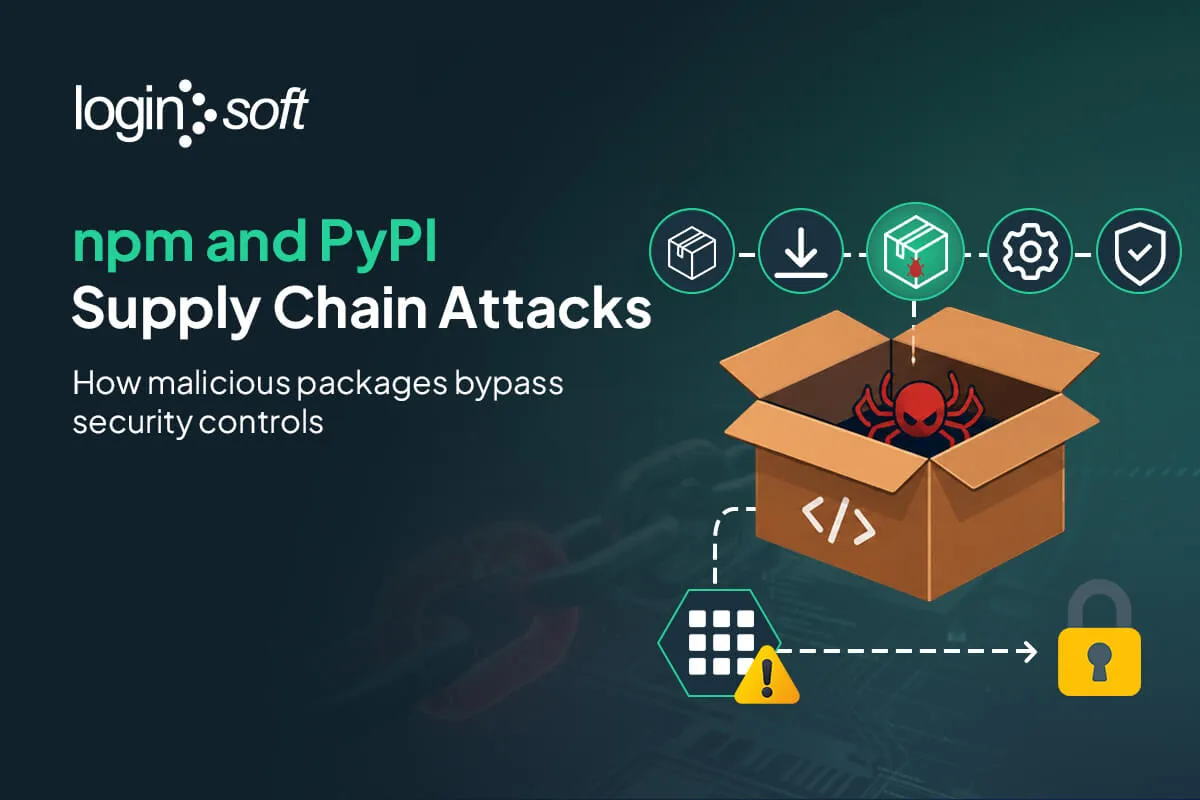
- Standard audit tools do not detect intentionally malicious packages. Tools like npm audit and pip-audit focus on known vulnerabilities, not malware behavior. A newly published malicious package with no CVE or advisory can pass these checks undetected.
- The attack surface is trust, not just code. Typosquatting, dependency confusion, and malicious updates exploit package-manager resolution and implicit trust. Developers and CI pipelines may install packages without verifying their provenance or behavior.
- Registry controls are only one layer of defense. Registry scanning, malware detection, and maintainer 2FA reduce risk, but attackers exploit gaps between these controls. Effective protection combines behavioral analysis, dependency pinning, SBOM governance, and build-environment isolation.
Stay Ahead
Get the Latest Cybersecurity Insights
Security research, threat intelligence, vulnerability updates, product news, and expert insights, delivered directly to your inbox. Stay informed. Stay secure.

BLOGS AND RESOURCES
Latest Articles

By using this website, you agree to the storing of cookies on your device to enhance site navigation, analyze site usage, and assist in our marketing efforts. View our Privacy Policy for more information.
Accept


© Copyright 2026, All Rights Reserved by Loginsoft
Privacy policy