
- Detailed breakdown of how insecure JDBC parameter handling leads to deserialization of untrusted data
- Explanation of bypass techniques: space manipulation in CVE-2025-6507 and double URL encoding in CVE-2025-6544
- Real-world exploitation risks in machine learning environments
- Official fixes and temporary mitigations
Introduction
H2O-3 is a popular open-source machine learning platform developed by h2o.ai, widely used for building and deploying AI models at scale. Recently, two critical deserialization vulnerabilities CVE-2025-6544 and CVE-2025-6507 were disclosed in H2O-3, both stemming from insecure handling of JDBC connection parameters. These flaws allow unauthenticated attackers to achieve remote code execution (RCE) and arbitrary file reads. Notably, CVE-2025-6544 represents a bypass of the mitigation introduced for CVE-2025-6507, highlighting ongoing challenges in securing JDBC integrations.
What Is CVE-2025-6544?
CVE-2025-6544: Another critical deserialization vulnerability (CVSS 9.8) in H2O-3 versions <= 3.46.0.8. This is a bypass of the fix for CVE-2025-6507 (and related earlier issues), achieved through double URL encoding to evade updated regex checks.
What is CVE-2025-6507?
CVE-2025-6507: A critical deserialization vulnerability (CVSS 9.8) in H2O-3 versions <= 3.46.0.7 (and some later builds). It allows unauthenticated attackers to bypass regular expression filters by manipulating spaces in JDBC parameters, leading to arbitrary file reads and RCE.
Both vulnerabilities affect the JDBC connection processing logic, particularly in endpoints handling database imports (e.g., /99/ImportSQLTable).
The root cause is deserialization of untrusted data (CWE-502) without sufficient validation.
How these Vulnerability Works (CVE-2025-6544 & CVE-2025-6507)
The vulnerabilities occur when H2O-3 processes user-supplied JDBC connection strings for importing data from external databases, such as MySQL. Attackers can inject malicious parameters into the JDBC URL or connection properties.
For CVE-2025-6507, attackers bypass regex filters by inserting spaces between malicious parameter segments, allowing dangerous deserialization gadgets to execute.
For CVE-2025-6544, the bypass uses double URL encoding (e.g., %2520 for encoded spaces or characters) to evade strengthened filters introduced in the previous patch.
Once bypassed, the application deserializes attacker-controlled data, potentially triggering gadgets (e.g., via common libraries) that enable:
- Arbitrary file reading (e.g., /etc/passwd or sensitive model data)
- Remote code execution on the server
Public proof-of-concept details exist, though active exploitation in the wild has not been widely reported yet.
Fixes, Mitigations, and How It Was Resolved
- The issues were resolved in H2O-3 versions > 3.46.0.8.
- Specific fixes include:
- Improved validation and filtering of JDBC parameters
- Commit for CVE-2025-6507 mitigation: Github
- Additional commit addressing CVE-2025-6544: Github
- Temporary Mitigation: Restrict network access to the H2O-3 service port (default 54321) to trusted sources only, as this does not impact core functionality but blocks remote exploitation.
- Users should upgrade immediately via: Github
Real-World Applications and Impact
- Compromise of production ML platforms hosting sensitive training data
- Data exfiltration from connected databases or server files
- Full server takeover, enabling persistence or lateral movement in enterprise environments
- Disruption of AI/ML pipelines in industries like finance, healthcare, and autonomous systems
- High risk for publicly exposed H2O-3 instances
Common Challenges and Pitfalls
- For CVE-2025-6507
Critical vulnerability (CVSS score 9.8) fin H2O-3 (an open-source machine learning platform) allows unauthenticated remote attackers to bypass security filters by manipulating spaces in JDBC connection parameters. It requires low attack complexity, no privileges, and can be triggered with a single HTTP request, enabling arbitrary code execution (RCE) and unauthorized access to sensitive system files.
- For CVE-2025-6544
Critical deserialization flaw (CVSS score 9.8) in H2O-3 is a bypass of the previous fix in CVE-2025-6507. Unauthenticated remote attackers can exploit improper handling of JDBC connection parameters by using double URL encoding to evade regular expression checks, enabling arbitrary code execution (RCE) and reading of arbitrary system files with low attack complexity and no privileges required.
Best Practices and Tips
- Always upgrade to the latest version of H2O-3 and monitor for security releases.
- Implement strict input validation using allowlists rather than blocklists or regex alone.
- Avoid deserializing untrusted data; prefer safer alternatives like JSON or protobuf.
- Apply network segmentation and firewall rules to limit access to service ports.
- Regularly scan dependencies with tools like OWASP Dependency-Check.
- Conduct penetration testing on data import features and external integrations.
Future Trends and Conclusion
As machine learning platforms like H2O-3 become more integrated with external data sources, vulnerabilities in connection handlers will remain a prime target. The repeated bypasses seen here underscore the need for defense-in-depth approaches beyond simple filtering. Security starts with integrity even in your database connections.
FAQ
- What is CVE-2025-6544?
A deserialization vulnerability in H2O-3’s JDBC parameter processing that allows arbitrary code execution and file reads.
- What is CVE-2025-6507?
A related vulnerability where attackers bypass regex filters to enable unsafe deserialization in JDBC connections.
- How severe are CVE-2025-6544 and CVE-2025-6507?
Both are rated CVSS 9.8 (Critical), allowing unauthenticated RCE.
- Does this affect other H2O products?
These CVEs specifically impact the open-source H2O-3 repository; check h2o.ai for enterprise product status.
- Which versions are affected?
All H2O-3 versions up to 3.46.0.8 (CVE-2025-6544) and early master builds prior to mitigation (CVE-2025-6507).
Table of Contents

Eight KEV Additions and a Third APT: Enterprise Infrastructure Tested on Every Front
Eight KEV Additions and a Third APT: Enterprise Infrastructure Tested on Every Front
Explore the key security, speed, and performance differences between TLS 1.3 and TLS 1.2
Ready to Find and Fix Your Security Weak Points?
LoginSoft's cybersecurity experts help organizations conduct thorough gap analyses, build prioritized remediation roadmaps, and achieve measurable security maturity improvements.
Schedule a Security Assessment
Hari Charan
Director of Security Research & Threat Intelligence
A MESSAGE FROM OUR TECHNOLOGY LEADER
The NVD enrichment cutback is not a surprise to us - it’s the inflection point we’ve been preparing for. At Loginsoft, we’ve spent years building the research depth and tooling infrastructure to independently enrich vulnerabilities at scale, with the accuracy and context modern security programs require. LOVI is our answer. Our mission is simple: ensure that no CVE relevant to your environment goes unanalyzed, unscored, or unactioned - regardless of what remains in NIST’s queue.
Key Takeaways
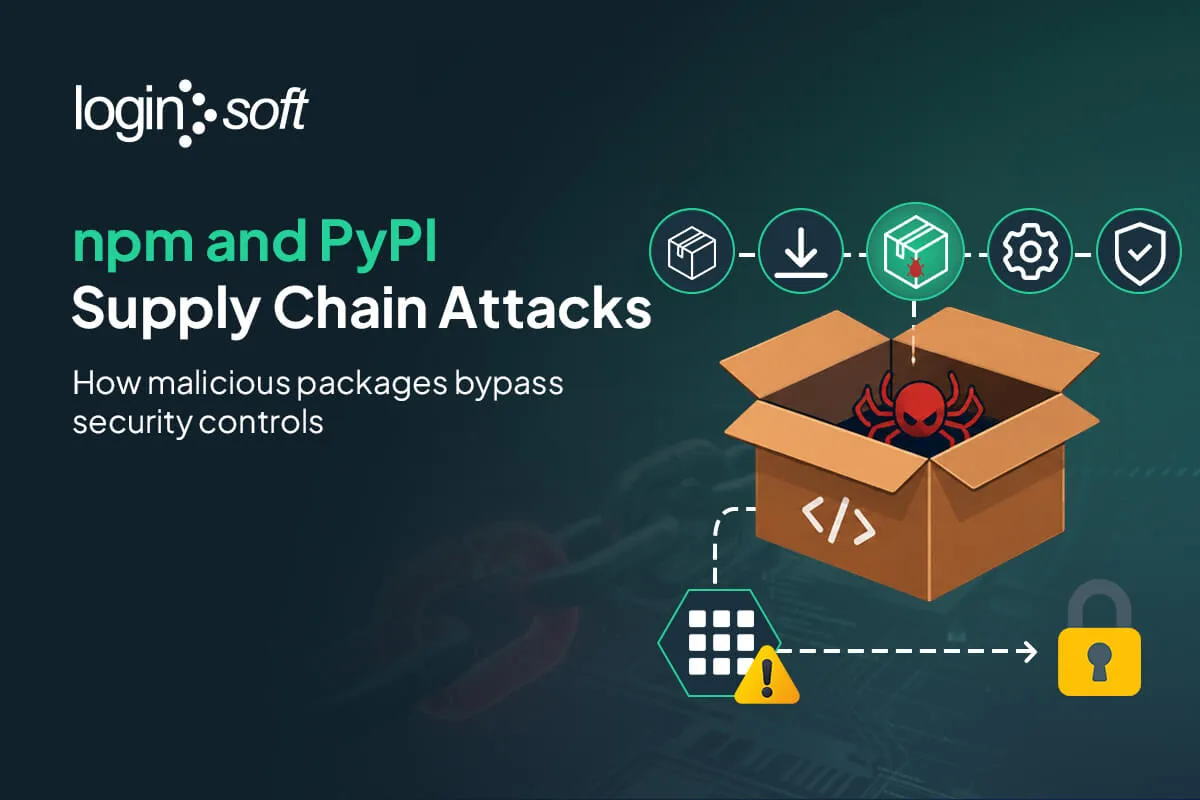
- Standard audit tools do not detect intentionally malicious packages. Tools like npm audit and pip-audit focus on known vulnerabilities, not malware behavior. A newly published malicious package with no CVE or advisory can pass these checks undetected.
- The attack surface is trust, not just code. Typosquatting, dependency confusion, and malicious updates exploit package-manager resolution and implicit trust. Developers and CI pipelines may install packages without verifying their provenance or behavior.
- Registry controls are only one layer of defense. Registry scanning, malware detection, and maintainer 2FA reduce risk, but attackers exploit gaps between these controls. Effective protection combines behavioral analysis, dependency pinning, SBOM governance, and build-environment isolation.
Stay Ahead
Get the Latest Cybersecurity Insights
Security research, threat intelligence, vulnerability updates, product news, and expert insights, delivered directly to your inbox. Stay informed. Stay secure.

BLOGS AND RESOURCES
Latest Articles
By using this website, you agree to the storing of cookies on your device to enhance site navigation, analyze site usage, and assist in our marketing efforts. View our Privacy Policy for more information.
Accept


© Copyright 2026, All Rights Reserved by Loginsoft
Privacy policy