Cloud Infrastructure Security services delivering security controls, governance, posture management, and continuous monitoring across AWS, Azure, and Google Cloud Platform (GCP).
Book a Meeting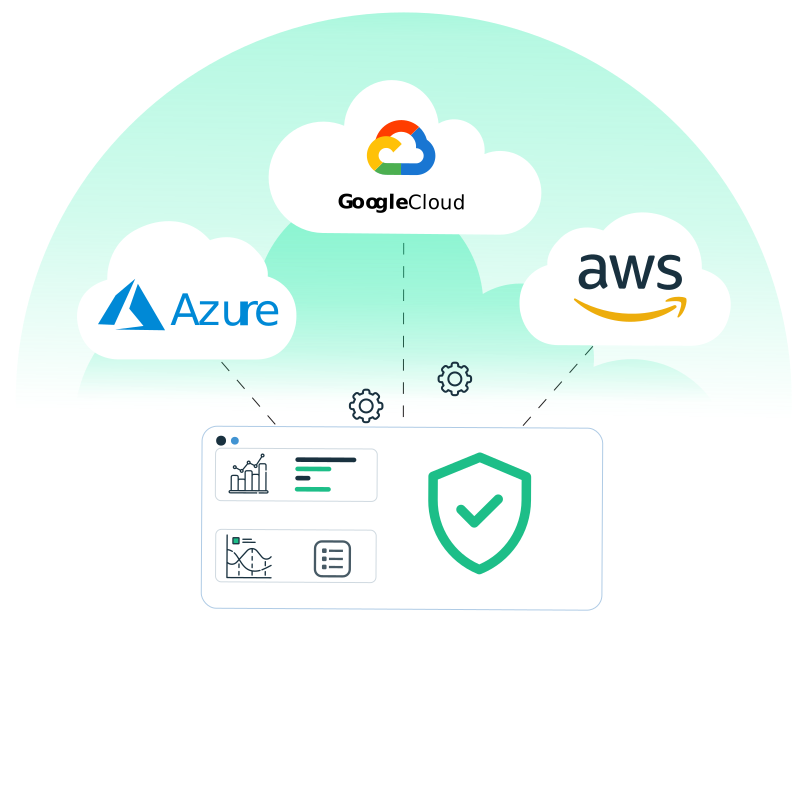


ABOUT THE SERVICE
We design and operationalize cloud security controls that prevent misconfigurations, detect drift, and enforce governance across AWS, Azure, and GCP. The goal is simple and direct: reduce attack surface, standardize posture, and keep cloud operations aligned to enterprise risk.
We translate policy into enforceable guardrails, validated baselines, continuous monitoring, and remediation playbooks. Our research‑led approach identifies control gaps missed by standard tooling and closes real attack paths without slowing delivery teams.

.svg)
.svg)
If your organization operates across AWS, Azure, and GCP and needs stronger governance, reduced misconfiguration risk, and measurable security control maturity, Cloud Infrastructure Security Services provide the structure, operational depth, and research-driven expertise required for enterprise-scale protection.
How we do it
We begin by aligning your cloud security objectives to business risk and regulatory expectations. We map existing controls, identify gaps, and classify them into deterrent, preventive, detective, and corrective controls. This provides a structured control strategy that is easy to govern and measurable over time.
We define secure cloud baselines and codify them as policies that can be enforced across accounts, subscriptions, and projects. This includes identity controls, network segmentation, encryption standards, logging requirements, and data protection policies. The focus is on guardrails that scale across multi‑cloud environments without creating friction for engineering teams.
We implement controls using native cloud security services and integrate them with enterprise workflows. This includes policy enforcement, configuration validation, and real‑time posture assessment. We ensure controls are consistent across providers while respecting platform‑specific capabilities and shared responsibility models.

Cloud environments change daily. We establish continuous monitoring that detects drift from approved baselines and flags high‑risk misconfigurations. Findings are prioritized based on exploitability and business impact, enabling security teams to focus on the issues that matter most. This mirrors the continuous posture assurance expectations of CSPM programs while remaining tailored to your environment.

Detective controls are paired with corrective actions to reduce time‑to‑remediation. We design remediation playbooks and integrate them with ticketing and automation to ensure issues are resolved, not just reported. Corrective controls also include resiliency practices such as backup integrity and recovery workflows.
Security controls must support compliance obligations. We map controls to enterprise frameworks and provide evidence artifacts that simplify audits. This work complements compliance management programs and reduces the operational burden of proving security maturity.
Key Benefits

We convert security policy into enforced controls and validated baselines. This closes the gap between compliance objectives and operational reality, reducing exposure caused by unmanaged changes and inconsistent configurations.

Misconfigurations are a leading cause of cloud incidents. By combining preventive guardrails with continuous posture monitoring, we reduce the likelihood of exposure and improve the speed of detection and remediation.

Our control engineering approach is designed for modern cloud operating models. As your environment grows, controls remain consistent, measurable, and adaptable without slowing delivery teams.
Enterprises operating across AWS, Azure, and GCP need a unified control approach. We deliver a consistent security posture across clouds while respecting the unique capabilities of each platform.

We provide clear evidence of control coverage, drift detection, and remediation actions. This strengthens audit readiness and gives executive stakeholders confidence in the organization’s cloud risk management program.
Cloud Infrastructure Security is the practice of securing cloud environments such as AWS, Azure, and GCP by implementing preventive, detective, and corrective controls. It includes identity governance, network segmentation, encryption enforcement, configuration management, drift detection, and continuous monitoring to reduce attack surface and align cloud operations with enterprise risk.
Cloud Infrastructure Security is the broader discipline of designing and enforcing security controls across cloud environments. Cloud Security Posture Management (CSPM) focuses specifically on identifying misconfigurations and compliance gaps. CSPM is one component of a comprehensive cloud infrastructure security strategy.
Cloud platforms are highly dynamic. Frequent deployments, identity changes, and configuration updates can introduce exposed storage, excessive permissions, weak encryption, or open network paths. Without enforced guardrails and drift detection, these gaps create exploitable attack paths for attackers.
We define unified security baselines and enforce them using native cloud controls across accounts, subscriptions, and projects. While each platform has unique capabilities, we maintain consistent identity policies, encryption standards, logging requirements, and governance models to ensure enterprise-wide posture alignment.
Cloud configuration drift occurs when resources deviate from approved security baselines due to manual changes, deployments, or automation updates. Drift weakens control integrity and may reintroduce vulnerabilities. Continuous monitoring detects and prioritizes high-risk drift before it becomes exploitable.
Security controls are mapped to enterprise and industry frameworks. Evidence artifacts, audit logs, remediation records, and control coverage reports are generated to simplify compliance validation and reduce audit friction while maintaining operational security maturity.
Findings are prioritized based on exploitability, exposure level, business impact, and alignment to enterprise risk tolerance. This risk-based approach reduces alert fatigue and ensures remediation efforts focus on issues that materially increase attack surface.
Organizations should invest when they:
Cloud Infrastructure Security becomes critical as cloud complexity increases, and operational velocity accelerates.

VIEW PREVIOUS
CIS Benchmark Compliance Content Services
SCAP‑compliant security content development for reliable CIS Benchmark automated assessment, audit reporting, and secure configuration enforcement.
VIEW Next
Custom SAST Rules Development for AppSec
Custom SAST Rules Development using CodeQL query packs and Semgrep rules to scale enterprise Application Security, reduce false positives, and improve secure code review accuracy.

BLOGS AND RESOURCES

Loginsoft helps you find hidden malicious code in your dependencies and take action.