Independent AI Model Validation Services for LLM accuracy, hallucination reduction, safety assurance, and enterprise risk management.
Book a Meeting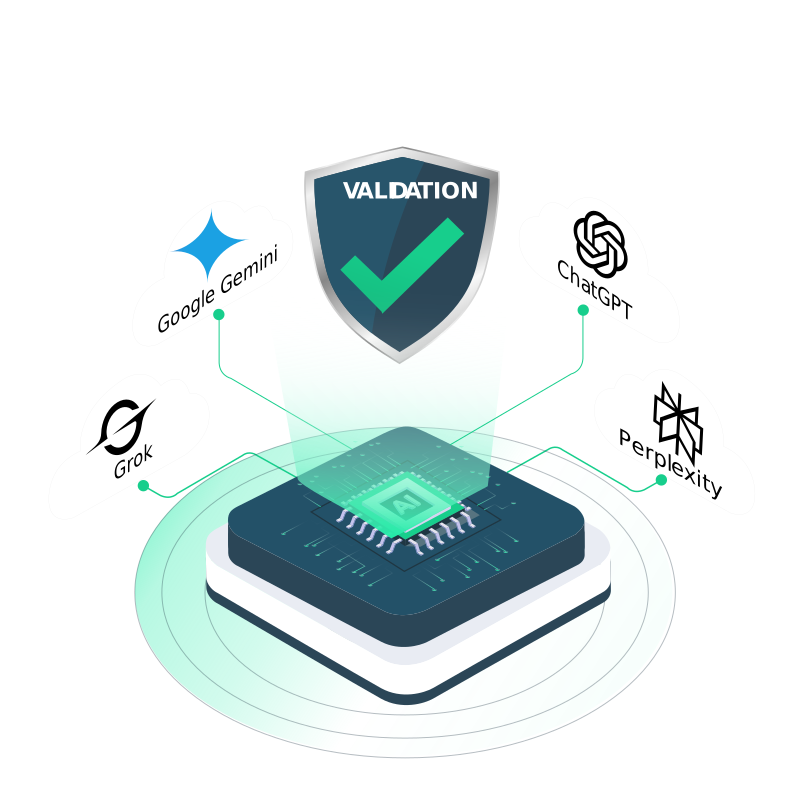


ABOUT THE SERVICE
LLM‑powered products are moving fast, but accuracy and reliability are hard to measure - especially in security use cases where false positives, hallucinations, and incomplete reasoning can create real operational risk. Enterprises and product companies need an independent validation layer that measures model performance against real‑world scenarios, not just synthetic benchmarks.
Our AI Model Validation service evaluates LLM results for correctness, relevance, and risk using realistic test suites and human‑in‑the‑loop review.
We validate AI used in security workflows such as code review, alert triage, threat analysis, and policy interpretation, and we also serve non‑security domains where accuracy and compliance are critical.
Engagements can be delivered as one‑time validation programs, ongoing evaluation subscriptions, or embedded expert review teams. Deliverables include evaluation protocols, labeled datasets, model scorecards, and remediation recommendations for prompt engineering, retrieval workflows, or training pipelines.
If you deploy LLM-powered systems in security, compliance, or high-risk enterprise environments, you need more than benchmark scores. You need measurable evidence of reliability, safety, and governance alignment.
AI Model Validation Services provide independent research-driven assurance that your AI systems are accurate, defensible, and ready for enterprise-scale deployment.
If you need a trustworthy AI output for enterprise or security use cases, AI Model Validation provides the independent validation and research depth to make it reliable at scale.
How we do it

We define what “correct” means for your use case and establish measurable success metrics. This includes accuracy thresholds, false positive/negative tolerance, safety boundaries, and escalation criteria aligned to business risk.

We build evaluation datasets that reflect real operating conditions, including edge cases and adversarial prompts. For security products, this can include code samples, exploit patterns, and contextual scenarios that challenge the model’s decision‑making.

We apply expert review to score model outputs for correctness, completeness, and security relevance. This produces labeled datasets and feedback that directly improves model training and prompt design.

We analyze failure patterns, identify root causes, and provide targeted recommendations on prompts, retrieval strategies, or model architecture changes. The focus is on practical adjustments that reduce risk and improve performance.

LLM behavior changes over time. We establish recurring validation cycles and monitoring to detect drift, regressions, and new failure modes as models and data evolve.
We document evaluation criteria, test coverage, and decision logic so AI systems can be defended in audits, regulatory reviews, and executive risk assessments.

We define acceptance thresholds for production release, create go/no‑go scorecards, and establish monitoring triggers for rollback or retraining when quality drops below agreed limits. This keeps AI deployments aligned to enterprise risk tolerance.
Key Benefits of AI Model Validation Services

Independent validation provides clear evidence that AI output meets accuracy and safety expectations, enabling broader adoption in enterprise workflows.

Clear feedback loops and labeled validation data accelerate model tuning and reduce trial‑and‑error experimentation.

We can validate using your sample data, sanitized datasets, or fully synthetic corpora to protect intellectual property and sensitive information.

By identifying failure modes early, we help teams reduce noisy or misleading output that slows security and operations teams.

Our validation process is grounded in cybersecurity research and real‑world threat context, making it well suited to security products and high‑risk AI use cases.
Validation outputs are structured to support go‑live decisions, SLAs, and model risk governance, enabling safe deployment at scale and clearer executive accountability.
AI Model Validation is the independent evaluation of LLM outputs to measure accuracy, safety, relevance, and reliability in real-world enterprise scenarios. It goes beyond synthetic benchmarks to assess operational risk and decision quality.
Internal testing often misses blind spots. Independent validation introduces adversarial testing, unbiased scoring, and structured evaluation frameworks that reduce deployment risk and strengthen governance confidence.
We use domain-specific evaluation datasets, human expert review, measurable accuracy thresholds, false positive/negative analysis, and risk-based scoring frameworks aligned to enterprise use cases.
Yes. By identifying failure patterns, adversarial weaknesses, and reasoning gaps, validation provides targeted improvements in prompts, retrieval workflows, guardrails, and model configurations that reduce hallucination rates.
AI systems should be validated before production release and periodically afterward. Continuous validation is recommended when models are updated, data sources change, or new use cases are introduced.
No. While especially critical in security workflows, AI validation is valuable in finance, healthcare, SaaS platforms, legal tech, compliance automation, and any domain where incorrect outputs carry risk.
Typical deliverables include evaluation protocols, labeled datasets, model scorecards, drift analysis reports, remediation recommendations, acceptance gates, and governance documentation.
Validation documentation provides traceability of testing methods, decision criteria, risk thresholds, and performance metrics. This supports regulatory audits, model risk governance programs, and executive accountability reviews.
BLOGS AND RESOURCES

Loginsoft helps you find hidden malicious code in your dependencies and take action.