Secure, minimal, and auditable container foundations with SBOM, VEX, and signed attestations for enterprise-grade software supply chain security.
Book a Meeting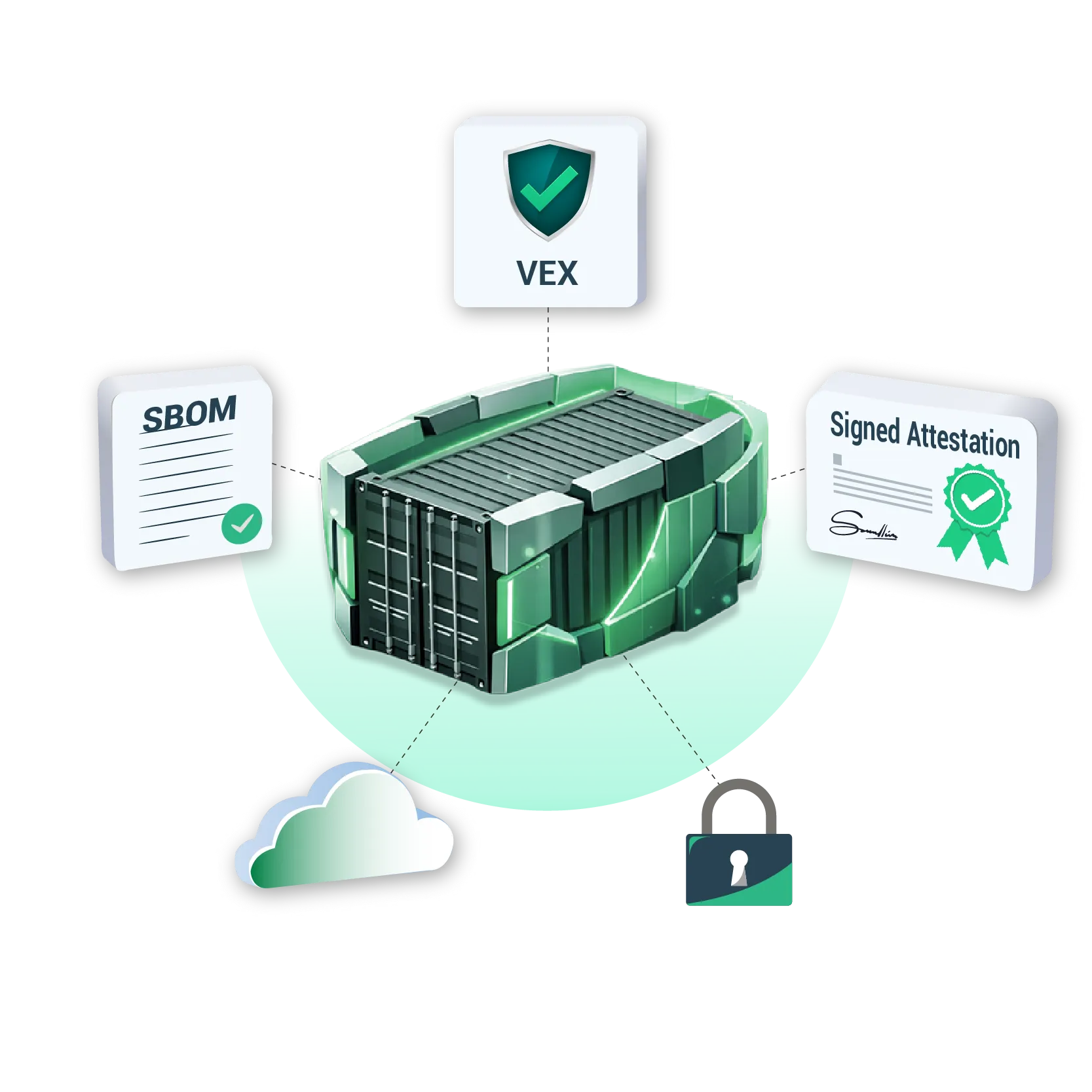


ABOUT THE SERVICE
Container platforms accelerate delivery, but most images are built from general purpose bases that include unused packages, tooling, and transitive dependencies. These extras expand the attack surface and increase vulnerability noise, even when the application does not use them. At scale, security teams face costly triage cycles and an unreliable risk signal that slows response and inflates operational overhead.
Our Hardened Container Images service delivers clean, production ready Docker images engineered for security and operational clarity. We enforce dependency minimization, deterministic builds, and security first defaults to reduce exposure while maintaining compatibility with modern cloud native stacks. Each hardened image includes software supply chain evidence such as SBOMs for transparency, VEX for exploitability context, and signed attestations to verify build provenance, enabling faster compliance reviews, fewer false positives, and consistent policy enforcement across environments.

If you are ready to reduce container risk and improve supply‑chain confidence, our Hardened Container Images service provides an enterprise‑grade foundation for secure software delivery.
How we do it
We begin with a comprehensive assessment of your existing images, base layers, and runtime dependencies. This includes OS packages, language runtimes, shared libraries, and build tools that often leak into production. We map what is required versus what is incidental, identify high‑risk components, and establish a reduction plan aligned to operational requirements.

We rebuild images around minimal bases and remove shells, package managers, and unnecessary utilities. Only the essential runtime dependencies remain, with versions pinned for reproducibility. We apply hardened defaults such as non‑root execution, restricted permissions, and conservative runtime configurations that align with enterprise security expectations.

Every image includes SBOMs for complete dependency visibility, VEX statements to document exploitability context, and signed build attestations that prove how and where the image was produced. This evidence enables gatekeeping in CI/CD, policy‑as‑code enforcement, and audit readiness without manual effort.

Hardened images are not a one‑time deliverable. We continuously monitor upstream advisories, rebuild images when fixes are available, and publish updated metadata. When a CVE does not apply to your runtime, we document that in VEX to keep security tooling accurate and reduce noise across your enterprise.

We integrate with your container registry, build pipeline, and security platforms to ensure consistent consumption across development and production. For large organizations, we help define image governance, base image catalogs, and lifecycle controls so your teams can move fast without weakening the security baseline.
Key Benefits

By stripping non‑essential components and focusing on minimal runtimes, hardened images dramatically reduce vulnerability counts and false positives. Security teams can focus on exploitable risk rather than inflated scan results.

Lean images reduce storage, pull time, and deployment latency in Kubernetes and CI/CD. This improves developer velocity and operational efficiency while keeping security intact.

Our work is grounded in cybersecurity research and real‑world vulnerability intelligence. This enables us to remove risky dependencies proactively and to deliver hardened images that align with evolving attack techniques and compliance requirements.
SBOMs, VEX, and signed attestations provide a verifiable chain of custody for every image. This simplifies compliance workflows and gives auditors the evidence they expect for modern software supply chain assurance.

We deliver hardened images that operate cleanly across AWS, Azure, and GCP, and integrate with common registries and security tools. Your teams get a consistent baseline from dev to production, regardless of platform.
Hardened container images are minimal, security-optimized Docker images that remove unnecessary packages, restrict runtime privileges, and include supply-chain evidence such as SBOMs and VEX statements. They reduce attack surface and vulnerability noise.
Most base images include unused libraries, package managers, and utilities that inflate vulnerability scan results. Even if those components are never executed, scanners still flag them, increasing false positives and triage burden.
An SBOM (Software Bill of Materials) lists all components within a container image. It provides transparency into dependencies and supports vulnerability management, compliance audits, and supply-chain assurance.
VEX (Vulnerability Exploitability eXchange) documents whether a known vulnerability is actually exploitable in your runtime context. It helps security tools differentiate between theoretical and actionable risk.
By running as non-root, removing unnecessary utilities, and limiting capabilities, hardened images reduce privilege escalation risk and align with Kubernetes security best practices.
Yes. SBOMs, VEX statements, and signed attestations provide audit-ready evidence for modern compliance frameworks focused on software supply-chain security.
Images should be continuously monitored and rebuilt when upstream patches are released. Ongoing lifecycle management ensures vulnerability data remains accurate and exploitability context is updated.
Organizations should invest when container vulnerability noise slows development, compliance scrutiny increases, Kubernetes environments scale rapidly, or supply-chain assurance becomes a board-level priority.

VIEW PREVIOUS
Secure Every Layer of Your Cloud Native Environment
Hardened containers. Automated compliance. Real-time workload protection. Loginsoft delivers end-to-end Cloud Native Security; built for DevSecOps, aligned to CIS & NIST, and integrated into your CI/CD pipeline from day one.
VIEW Next
Security Data for AI Training
Realistic and synthetic cybersecurity datasets for LLM training and evaluation.

BLOGS AND RESOURCES

Loginsoft helps you find hidden malicious code in your dependencies and take action.