Realistic and synthetic cybersecurity datasets for AI training, LLM fine-tuning, and model evaluation.
Book a Meeting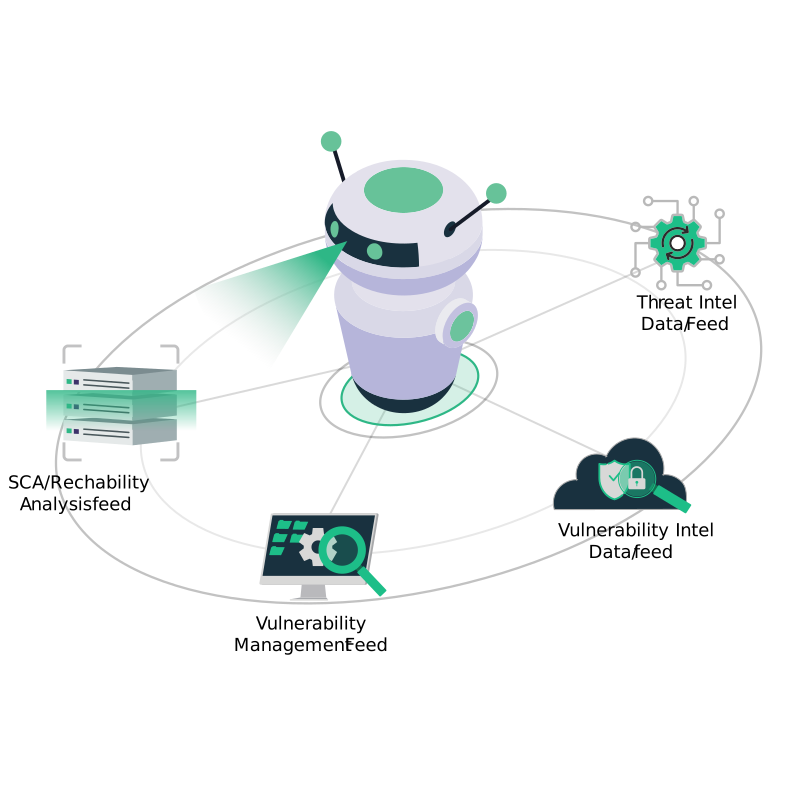


ABOUT THE SERVICE
AI models are only as good as the data they learn from. In cybersecurity, high‑quality data is scarce, fragmented, and often too sensitive to share. That leads to under‑trained models, high false‑positive rates, and unreliable outcomes in production.
Our Security Data for AI Training service provides curated, labeled, and synthetic cybersecurity datasets designed to improve model performance and reduce noise. We generate data with real‑world context across exploit detection, threat hunting, cloud security, and secure code review. The result is better coverage, more robust models, and lower operational risk.
As a cybersecurity research partner to security product companies and large enterprises, we understand how attackers operate and how defenders validate signals. This allows us to generate data that reflects real attack behavior while preserving privacy and intellectual property.
Engagements can include data discovery, labeling operations, synthetic data programs, and ongoing data refresh. Deliverables include datasets, schemas, labeling guides, and evaluation benchmarks aligned to your model objectives.
We support both real‑world and synthetic datasets, with optional red‑team data generation to evaluate adversarial robustness and model resilience.

If you are building AI for threat detection, exploit analysis, cloud security, or secure code review, your model performance depends on data depth and accuracy.
Security Data for AI Training Services provide realistic, synthetic, and research-grade cybersecurity datasets designed to:
Train AI models on data that reflect real threats, real defenders, and real enterprise conditions.
If you need security‑grade datasets to train, fine‑tune, or evaluate AI models, Security Data for AI Training provides the data depth and research rigor to deliver reliable results.
How we do it

We map your AI use cases to data requirements, including detection goals, model inputs, and evaluation criteria. This ensures datasets are aligned to the behaviors your AI must recognize and the outcomes your business expects.
We curate labeled datasets from security telemetry, code artifacts, vulnerability patterns, and incident narratives. Data is normalized and structured to support training, fine‑tuning, and evaluation workflows.

We generate synthetic data to expand coverage, simulate rare attack paths, and protect sensitive information. This includes synthetic logs, code samples, indicators, and adversarial prompts that stress‑test model robustness.

We apply expert labeling and validation to ensure data quality, correctness, and consistency. This reduces model confusion and improves training signal across complex security scenarios.

We package datasets for secure delivery, including schemas, metadata, and usage documentation. Data can be delivered for offline training, evaluation pipelines, or continuous learning environments.

Threats evolve quickly. We provide ongoing dataset updates and enrichment so your models keep pace with new attack techniques, cloud services, and vulnerability patterns.

We build validation sets and scoring criteria so teams can measure accuracy, false‑positive rates, and model regressions over time.
Key Benefits

Quality data reduces model hallucinations and improves detection precision, especially in high‑noise security environments.

Synthetic generation and privacy‑aware processing protect proprietary data while still enabling robust model training.

Our cybersecurity research background ensures datasets capture the nuances of modern threat techniques and defensive context.
High‑quality training data reduces iteration cycles and accelerates time‑to‑value for AI features in security products and enterprise platforms.

Datasets are built from real‑world attack patterns and defender workflows, enabling AI to detect what matters most.
Well‑structured datasets accelerate training cycles and reduce time spent cleaning, labeling, and validating data.
We deliver data in secure formats with access controls, versioning, and governance alignment to support enterprise data management requirements.
Security Data for AI Training refers to curated, labeled, and synthetic cybersecurity datasets used to train, fine-tune, and evaluate AI models for threat detection, code analysis, cloud security, and adversarial defense use cases.
Poor data leads to hallucinations, false positives, and unreliable model decisions. High-quality security datasets improve detection precision, adversarial resilience, and operational reliability in production environments.
Datasets may include security logs, vulnerability patterns, exploit simulations, secure code samples, threat intelligence signals, incident narratives, and adversarial prompts designed to test robustness.
Synthetic data expands coverage of rare attack paths, protects sensitive information, and stress-tests models against edge cases, improving robustness and generalization.
Yes. We use synthetic data generation, anonymization techniques, and controlled processing environments to protect proprietary information and maintain compliance.
Expert reviewers validate labels for correctness, consistency, and contextual accuracy, creating reliable ground truth that improves model training effectiveness.
Datasets should be updated continuously or at regular intervals to reflect evolving threats, new vulnerabilities, and emerging cloud environments to prevent model degradation.
Security product companies, SOC teams, SaaS platforms, cloud providers, and large enterprises deploying AI for detection, compliance, or threat analysis benefit from high-fidelity cybersecurity datasets.
BLOGS AND RESOURCES

Loginsoft helps you find hidden malicious code in your dependencies and take action.