Security Patching for End-of-Life (EOL) and End-of-Support (EOS) Software
Book a Meeting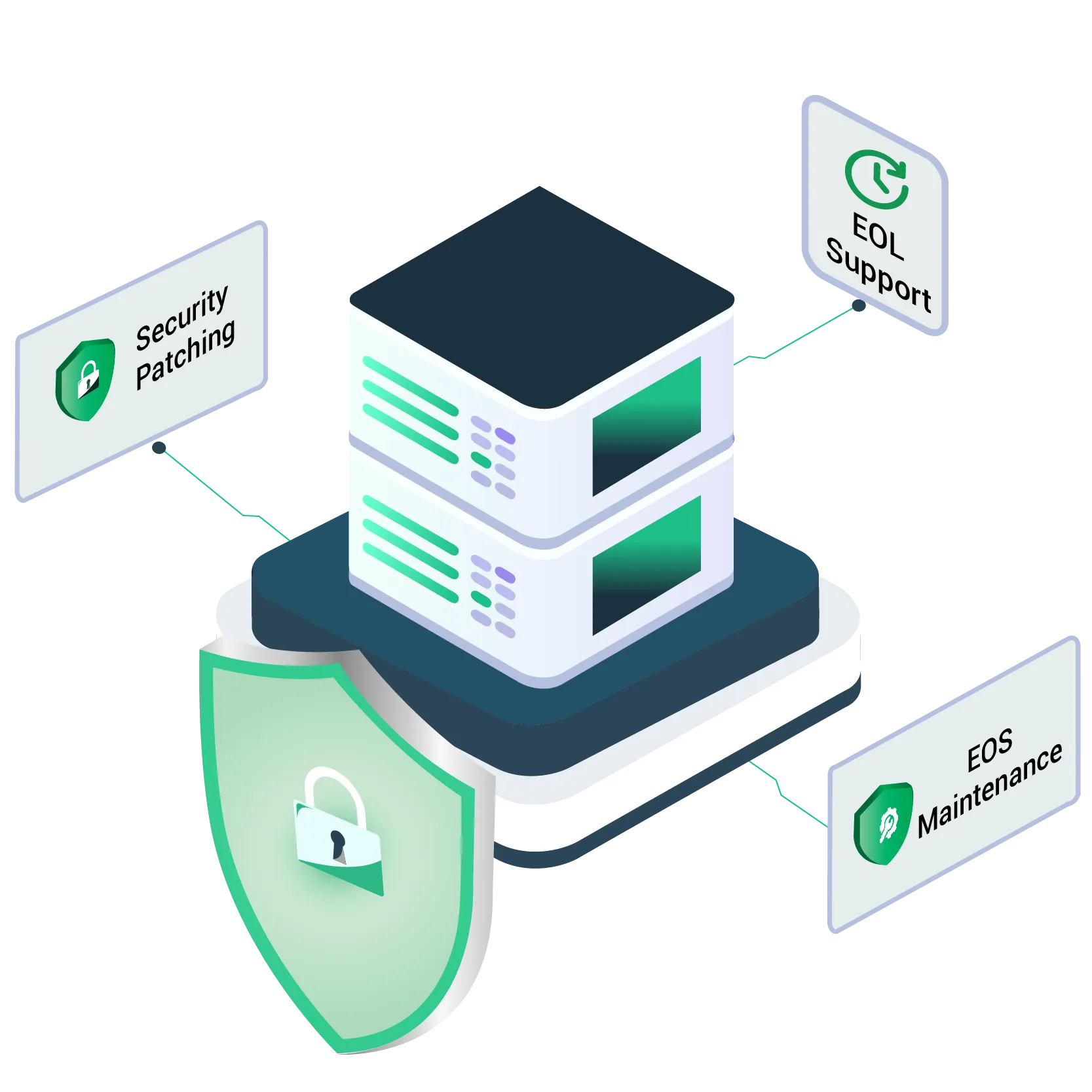


ABOUT THE SERVICE
Enterprises depend on legacy systems that cannot always be upgraded on a vendor timeline. When software reaches end of life (EOL) or end of support (EOS), security patches stop, advisories are no longer backported, and risk accumulates quickly. This creates a direct conflict between business continuity and security mandates.
Our Extended Lifecycle Support (ELS) service provides expert vulnerability remediation for EOL and EOS software so you can maintain stability without accepting unacceptable exposure. We backport security fixes, patch vulnerable components, and deliver hardened updates that fit your existing environment, with vulnerability intelligence grounded in real‑world exploit paths. This gives your teams time to modernize while meeting audit, compliance, and uptime requirements.

If you are running EOL or EOS software that cannot be upgraded today, Extended Lifecycle Support (ELS) provides the security coverage you need while you plan the future on your own terms.
How we do it
We start by identifying the precise versions running in production, their dependency trees, and their exposure to known vulnerabilities. We classify risk based on exploitability, attack surface, and business criticality, producing a prioritized patch plan tailored to your environment.
Our engineers build security patches that are compatible with legacy code lines and older build systems. We backport fixes from newer releases when available, and when necessary, develop custom mitigations that address the vulnerability without forcing a version upgrade. Each patch is designed to be minimally invasive and operationally safe.

We package updates for your preferred distribution method and ensure integrity with cryptographic signing. Whether you deploy through internal repositories, CI/CD, or configuration management, we provide a reliable path to rollout without disrupting existing workflows.
Legacy software often runs in tightly coupled environments. We validate patches against supported runtimes, external dependencies, and critical integrations to ensure functionality is preserved. Our goal is to eliminate security risk without introducing breaking changes or instability.
EOL software still receives new CVEs. We monitor upstream advisories and vulnerability disclosures, assess impact on your legacy versions, and issue updated patches on a predictable cadence. When a vulnerability is not exploitable in your runtime, we document the rationale to keep risk reporting accurate.

We provide documentation, change records, and vulnerability context to support internal governance. This allows security teams to demonstrate proactive risk management to auditors, regulators, and executive stakeholders.
Key Benefits

Ongoing security patching allows you to meet regulatory requirements and internal security baselines even when vendor support has ended. You can plan migrations on your timeline rather than under emergency pressure.

Legacy upgrades can be costly and disruptive. Our approach preserves the stability of existing systems while reducing exposure to known vulnerabilities, keeping critical services available and predictable.

We evaluate vulnerabilities based on real attack paths and environmental context. This reduces unnecessary work and helps security teams prioritize fixes that matter to your business.
For applications tied to revenue, manufacturing, financial systems, or public services, downtime is not an option. Extended patch support helps keep these systems secure while long-term modernization programs are executed.

Our practice is grounded in cybersecurity research and years of experience supporting security product teams. This expertise is applied directly to your legacy environment, delivering patches you can trust.
Extended Lifecycle Support (ELS) is a security service that provides vulnerability patching and remediation for software that has reached End of Life (EOL) or End of Support (EOS). It extends security coverage beyond the vendor lifecycle without requiring immediate software upgrades.
End of Life (EOL) or End of Support (EOS) means a software vendor has stopped releasing security patches, updates, and technical support for a product version. The software may continue running, but new vulnerabilities are no longer officially fixed by the vendor.
EOL software becomes risky because newly discovered vulnerabilities (CVEs) are not patched by the vendor. Attackers often target unsupported systems since known flaws remain unremediated, increasing the likelihood of exploitation and compliance violations.
Extended Lifecycle Support works by analyzing legacy software versions, identifying applicable CVEs, backporting security fixes from newer releases, or engineering custom mitigations. Patches are tested for compatibility and securely distributed without requiring major version upgrades.
Vulnerability backporting is the process of adapting a security fix from a newer supported version of software and applying it to an older, unsupported version. This allows organizations to remediate security flaws without changing the existing application architecture.
Yes. ELS helps organizations meet regulatory and audit requirements by documenting vulnerability remediation, patch management processes, and exploitability assessments for unsupported software used in production environments.
Vulnerabilities are prioritized based on exploitability, attack surface exposure, business criticality, and real-world threat intelligence - not just CVE severity scores. This reduces remediation noise and focuses resources on meaningful risk reduction.
No. Extended Lifecycle Support is a risk management strategy that provides temporary security coverage while organizations plan and execute modernization or migration initiatives on a controlled timeline.

VIEW PREVIOUS
Secure Every Link in Your Software Supply Chain
Loginsoft protects your software ecosystem with expert research across open-source dependencies, EOL components, and undiscovered zero-days; before attackers strike.
VIEW Next
AI Engineering Services
MCP servers, RAG systems, and agentic AI delivered by senior engineers.

BLOGS AND RESOURCES

Loginsoft helps you find hidden malicious code in your dependencies and take action.