Custom SAST Rules Development using CodeQL query packs and Semgrep rules to scale enterprise Application Security, reduce false positives, and improve secure code review accuracy.
Book a Meeting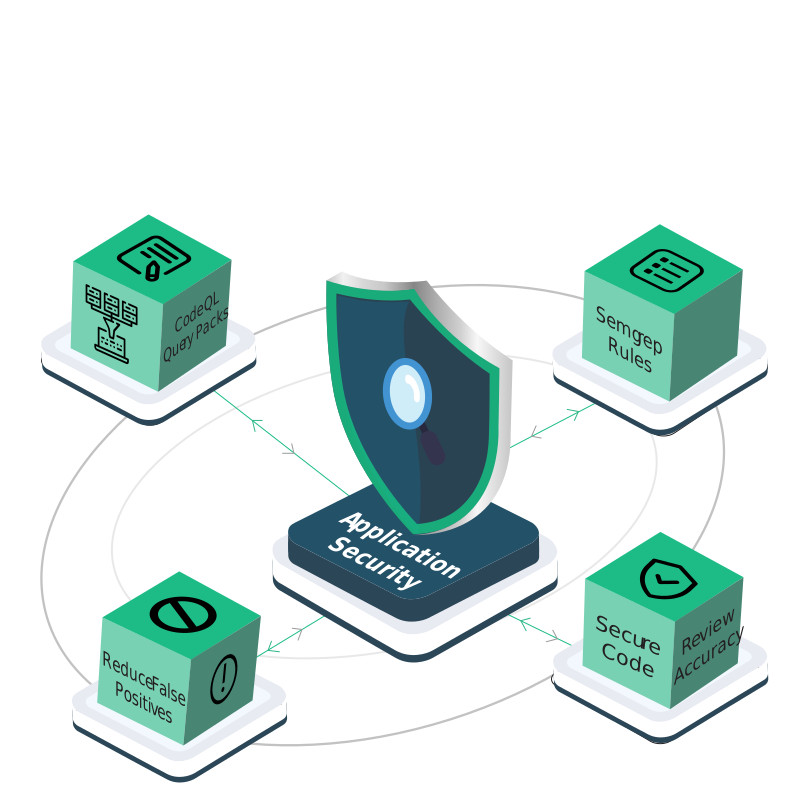


ABOUT THE SERVICE
Most SAST platforms ship with broad, generic rulesets. They find common issues, but they do not understand your architecture, threat model, or coding patterns. That gap creates false positives, misses environment‑specific risks, and limits the value of secure code review.
Our Custom SAST Rules Development service delivers high‑precision security content built by a cybersecurity research team trusted by security product companies and large enterprises. We design and maintain CodeQL queries and Semgrep rules that target real attack paths, reduce noise, and integrate directly into your AppSec workflows.
Engagements are delivered as project‑based rule development, ongoing content subscriptions, or embedded specialists. Deliverables include rule packs, test fixtures, and release notes. We support private rule repositories, confidential handling of proprietary code, and optional licensing for product vendors.

If you need SAST content that is precise, research‑driven, and production‑ready, Custom SAST Rules Development provides the engineering depth to scale secure code review across your enterprise or product.
What We Deliver
Engagement models include:
How we do it
We review your current SAST coverage, repository patterns, and risk profile to identify detection gaps and high‑value rules. The outcome is a prioritized roadmap mapped to your languages and frameworks.
We author CodeQL queries and Semgrep rules that reflect your real code paths and security requirements, including dataflow and taint logic. Coverage spans primary enterprise languages such as Java, JavaScript/TypeScript, and Python, with extensions to Go, C#, and other ecosystems as needed.

We validate against true‑positive and true‑negative cases, tune precision at scale, and package rules with metadata and severity alignment for CI/CD and code scanning pipelines.

We continuously update rules based on new vulnerability research, exploit techniques, and framework changes so your coverage stays current and relevant.

We provide coverage metrics, rule effectiveness summaries, and tuning recommendations so AppSec leaders can track progress, justify investment, and demonstrate measurable risk reduction.
Key Benefits

Custom rules built on your code patterns deliver a cleaner signal. This lets security teams focus on exploitable issues and helps developers resolve findings quickly.

We convert manual review knowledge into automated detections. The result is consistent coverage across repos and faster feedback during development and CI.

Security product companies can ship our rules as part of their platform, expanding their detection coverage and differentiation without building an internal rules team.
Rules are packaged to fit your existing pipelines, policies, and reporting requirements. We support staged rollout, monitor‑only modes, and enforcement‑ready rules for mature programs.

Our rules are grounded in cybersecurity research and real‑world exploit analysis. This produces detections that track actual attacker behavior, not just textbook patterns.
Coverage reporting and precision improvements make it easier to show reduced risk, faster remediation cycles, and higher developer adoption of secure coding practices.
We align rule metadata to internal risk categories, severity models, and control objectives so AppSec leaders can map findings to policy and compliance expectations. This makes it easier to demonstrate program maturity, support audit evidence, improve executive reporting, and maintain consistent enforcement across business units.
Custom SAST Rules Development involves creating tailored static analysis rules for platforms like CodeQL and Semgrep to detect vulnerabilities specific to an organization’s architecture, coding patterns, and threat model. It improves detection precision beyond generic rulesets.
Custom rules reduce false positives, detect business-logic vulnerabilities, and align findings to enterprise risk models. This increases developer trust and improves secure code review efficiency.
CodeQL enables deep dataflow and taint analysis across complex codebases, making it suitable for modeling sophisticated attack paths. Semgrep focuses on fast, pattern-based and lightweight dataflow detection ideal for CI pipelines and rapid iteration. Many enterprises use both for layered coverage.
Generic rules are designed for broad applicability and lack context about proprietary frameworks, architectural patterns, or internal libraries. Without contextual awareness, they flag theoretical issues that may not be exploitable in your environment.
Yes. Custom rules can model internal workflows, authorization paths, and sensitive data flows, allowing detection of logic flaws and misuse patterns that standard rules miss.
Rules are packaged with metadata and severity mappings compatible with enterprise CI/CD systems and code scanning workflows. They can be deployed in monitor-only mode before enforcement to ensure controlled rollout.
Effectiveness is measured through detection precision, false positive reduction, vulnerability coverage metrics, remediation velocity, and alignment to enterprise risk categories.
Investment is recommended when:
Custom SAST Rules Development becomes critical as Application Security programs mature and scale.

VIEW PREVIOUS
Cloud Infrastructure Security Services Across AWS, Azure and GCP
Cloud Infrastructure Security services delivering security controls, governance, posture management, and continuous monitoring across AWS, Azure, and Google Cloud Platform (GCP).
VIEW Next
AI Engineering Services
MCP servers, RAG systems, and agentic AI delivered by senior engineers.

BLOGS AND RESOURCES

Loginsoft helps you find hidden malicious code in your dependencies and take action.