
- GitHub is the command channel, so domain blocklists will not catch it. FlashHole used GitHub Pages for lures and private repositories, reached through the GitHub API, for tasking. Hunt behavior, not domains.
- Post-quantum encryption shields the traffic, not the malware. ML-KEM-1024 keeps captured sessions unreadable later, but sideloaded DLLs, in-memory loaders and odd parent processes are still visible on the endpoint.
- LNK phishing with GitHub C2 is shared DPRK tradecraft, not a confirmed Lazarus signature. Build detections from it, but be careful with attribution in your own reporting.
Everyone is talking about the quantum angle. It makes a good headline, and it is a real first worth studying. But if you run a SOC or a threat intelligence program, the detail that should change your week is a plainer one: Lazarus is still hiding its command channel on GitHub, in plain sight.
On October 21, 2026, a leading threat research team disclosed Operation FlashHole, a Lazarus espionage campaign active since at least July 2025 against South Korean construction, software and wire-communication equipment companies. The operators staged lures on GitHub Pages, used private GitHub repositories as a command channel, and shipped an updated LPEClient that sets up payload delivery with ML-KEM-1024, a NIST-standardized post-quantum key exchange. That is Lazarus Group post-quantum malware in the literal sense. The cryptography is genuine. What it protects, though, is the traffic, not the implant.
This post is for threat intelligence teams, CISOs and security researchers. We separate what is confirmed from what is not (LNK phishing, for one, is a nearby DPRK pattern and not part of the FlashHole report), and we finish with what to hunt this week. Cytellite tracks Lazarus TTPs across active campaigns, and we point to where that saves time.
What Operation FlashHole is and who it hit
The researchers presented the findings at the Security Analyst Summit in Bali and describe FlashHole as a new wave of Operation SyncHole, the Lazarus campaign disclosed in April 2025. Confirmed victims number at least three, all in South Korea, across construction, software and wire-communication equipment manufacturing. They treat it as cyber espionage and believe the real victim count may be higher.
The lure is the familiar Operation DreamJob move. A GitHub account created in September 2025 hosted a GitHub Pages site with the CV of a supposed senior network-appliance developer, complete with what looks like an AI-generated photo. The researchers believe AI was used to tailor the fake sites to each target. Victims received spear-phishing emails linking to those fabricated CV and portfolio pages.
From there, the likely way in runs through Cross Web EX, a security and web-authentication plugin widely used in South Korea. The researchers say a possible vulnerability in it may have been the entry point, and that exact path is not confirmed. Lazarus has abused this family of software before: earlier research reports Cross Web EX abuse in 2021, 2022 and 2023, and Sync Hole leaned on the related Cross EX product.
How the Flash Hole infection chain works
The chain is layered, and most of it lives in memory. Here is the sequence as the published research describes it.
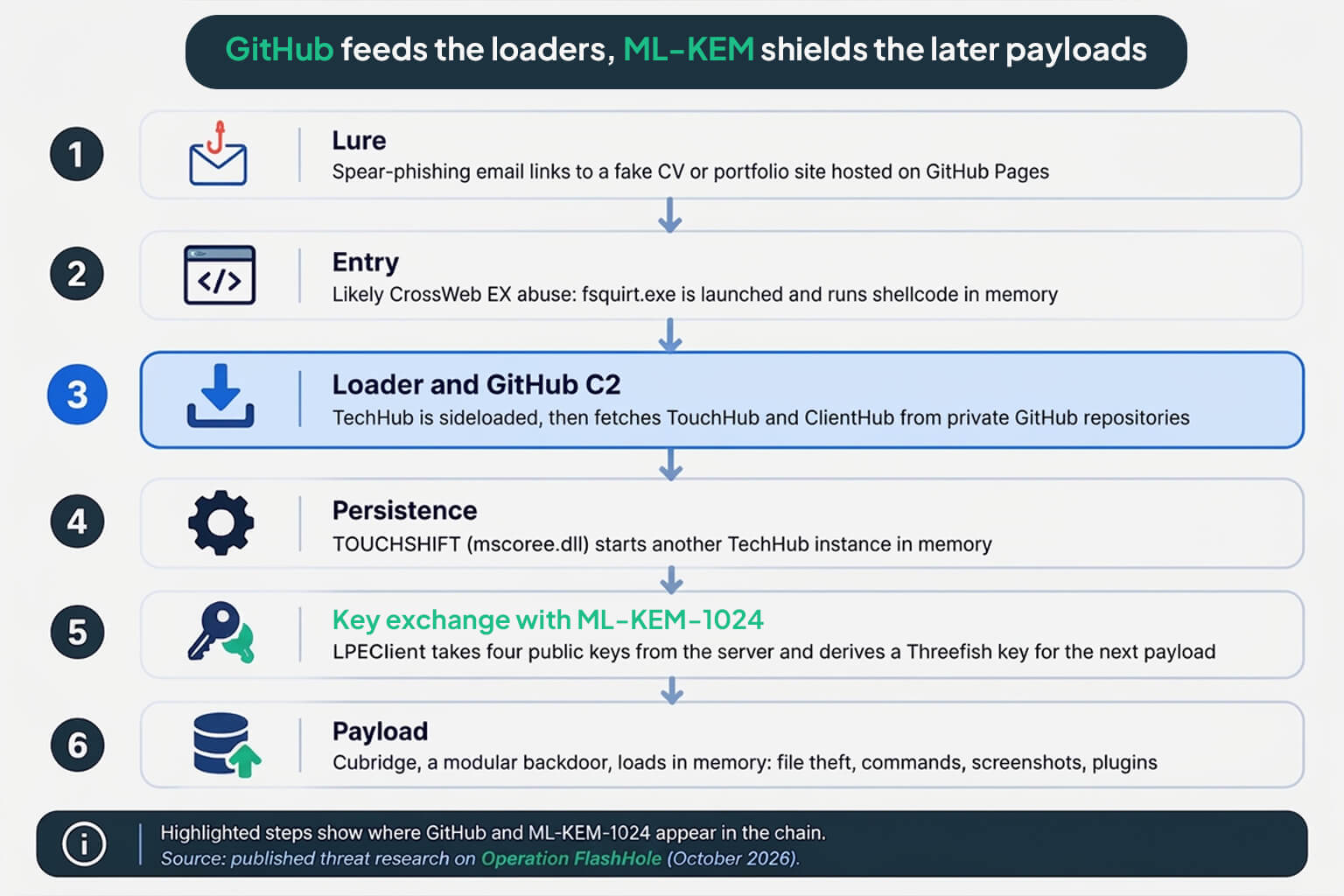
Read it from top to bottom: GitHub shows up at the loader stage, and ML-KEM-1024 only appears once LPEClient is already running in memory.
GitHub as command and control: why Lazarus keeps going back
GitHub is a gift for an attacker who wants to look like a developer. The domain is trusted, the traffic is TLS, and most corporate networks allow it by default. Private repositories add a second advantage: payloads and stolen data never show up in public view, so researchers cannot simply browse to them. Threat research published in 2024 made a similar point, noting that GitHub abuse spans payload delivery, dead drop resolving, full C2 and exfiltration, and that there is no universal way to detect it.
This is not new for Lazarus. MITRE ATT&CK already lists the group as having hosted malicious downloads on GitHub. What FlashHole adds is how deeply GitHub is wired into the loader chain.
How FlashHole uses GitHub
TechHub, a downloader researchers describe as an advanced version of CLOUDBURST and NickelLoader, reaches out to GitHub to fetch the next tools, TouchHub and ClientHub. Some TechHub instances use private repositories, accessed through the GitHub API, as a command channel. Reporting on the campaign points to at least three primary repositories and one backup. ClientHub also has a variant that talks to the Dropbox API, which gives the operators a second trusted cloud service to hide behind.
Why blocking GitHub is not the answer
You cannot block github.com for a company full of developers, and for everyone else the traffic looks ordinary. The signal is in who is calling. A browser-less process on a finance workstation calling the GitHub API is odd. A web server process doing the same is odder. That is a behavioral hunt, and it is where most teams have a gap.
LNK phishing attacks: the DPRK pattern next door
The title of this post mentions LNK phishing, so let us be precise. The FlashHole research does not describe LNK files. The LNK and GitHub C2 combination comes from a separate DPRK-linked campaign reported by a separate research team in spring 2026, aimed at South Korean organizations.
In that campaign, a file that looks like a PDF is really an LNK shortcut. Opening it runs embedded PowerShell, which decodes a decoy PDF with an XOR routine and shows it to the victim while the script keeps working. The script checks for virtual machines, debuggers and forensic tools, then creates a scheduled task that fires every 30 minutes, collects host details and uploads them to attacker-controlled GitHub repositories. It pulls new instructions from GitHub the same way. Researchers traced the LNK files back to 2024, with earlier variants carrying metadata tied to XenoRAT.
What we can and cannot say about attribution
The LNK metadata naming convention resembles tactics used by Kimsuky, APT37 and Lazarus, but none of the coverage we reviewed confirms Lazarus as the operator. Lazarus does have a history with shortcut files: MITRE notes LNK files placed in startup folders for persistence during Operation Dream Job. So the honest framing is shared North Korean tradecraft. For your threat reports, that means writing DPRK-linked, not Lazarus-confirmed.
The detection logic is the same either way: an LNK launching PowerShell, and PowerShell talking to GitHub.
Post-quantum malware: what ML-KEM-1024 does and does not do
ML-KEM is the key-encapsulation mechanism NIST standardized as FIPS 203 in August 2024. It is built to resist quantum attacks on key exchange, and it is the algorithm behind the "harvest now, decrypt later" defense: record traffic today, and it stays unreadable even if quantum hardware arrives later.
How LPEClient uses ML-KEM-1024
The updated LPEClient receives a byte array from the command server made of four 1,568-byte blocks, each holding an ML-KEM-1024 public key. It generates four shared secrets and matching ciphertexts, encrypts the ciphertexts with GOST and returns them through ClientHub. The four shared secrets combine into a 128-byte key for the Threefish cipher, which decrypts the server's response: parameters plus an executable payload. That payload runs in memory. Researchers trace the group's use of post-quantum cryptography back to at least September 2024, more than a year before it went public.
FlashHole is not a one-off. In August 2026, a separate research team reported a Dream Job wave against defense and aerospace firms in Europe and India that used the same style of key exchange before delivering a Windows zero-day, CVE-2026-68820, a use-after-free race condition in the AFD.sys driver. Microsoft flagged it as actively exploited in the August Patch Tuesday release.
What it does not do
No quantum computer is involved on either side. The post-quantum layer protects data in transit, so a captured session cannot be replayed later to recover the payload. It does nothing to hide a sideloaded DLL, a shellcode launch from an unexpected parent process, or a reflectively loaded backdoor. The researchers note, with some irony, that the group seems to have adopted post-quantum cryptography faster than many legitimate security products.
For threat intel teams, the practical result is that pcap-based retrospective analysis of this traffic is a dead end. The evidence you can still get is on the host.
Lazarus Group TTPs mapped to MITRE ATT&CK
Neither the primary research nor the coverage we reviewed publishes technique IDs, so the mapping below is ours. Treat it as a starting point for your detection backlog.
How to detect GitHub C2 and respond: by role
For threat intelligence teams
- Hunt for non-browser processes (powershell.exe, wscript.exe, cmd.exe) reaching api.github.com, raw.githubusercontent.com or gist.github.com, and for authenticated PUT uploads to repository contents paths. Do the same for Dropbox upload and download API calls from processes that have no reason to make them.
- Pivot on the tool names: TechHub, TouchHub, TOUCHSHIFT, ClientHub, LPEClient and Cubridge. The public summary lists no IOCs, so pull indicators from the full technical report.
- Track the family tree. FlashHole connects to SyncHole and to the broader Cascade Hole cluster, and a separate July 2026 campaign, Operation Double Barrel, used overlapping tool names.
For CISOs
- Scope GitHub access instead of blocking it. Limit or proxy outbound GitHub API traffic from systems with no business need, and alert on unusual use from non-developer hosts.
- Patch CVE-2026-68820, and review business-critical security plugins such as CrossWeb EX where you run them. Disable components you do not need.
- Ask your team one question: can we see in-memory execution and DLL sideloading on every endpoint class? If not, that is the gap this campaign is built to exploit.
- Brief the board accurately. The post-quantum story is about attacker tradecraft maturing, not about a quantum threat arriving.
For security researchers
- Plan for memory-first analysis. Network capture will not recover payloads protected by this key exchange.
- An ML-KEM-1024 public key is 1,568 bytes, so a blob made of four such blocks is a useful anchor in a debugger or memory dump.
- ML-KEM, GOST and Threefish together in one implant is unusual. Treat that combination as a code-level pivot for finding related samples.
- Watch for DLL sideloading with mscoree.dll outside its normal location and for fsquirt.exe launched by a CrossWeb EX process.
Where Loginsoft fits
At Loginsoft, we bring 18 years of IT engineering and more than six years of cybersecurity focus to this work. Our researchers have discovered 1,000+ zero-days and analyzed 20,000+ CVEs. Cytellite is where that research habit meets daily operations: real-time threat intelligence you can search in natural language across IPs, domains, CVEs and threat actors. It tracks Lazarus TTPs across active campaigns, so when the next major threat research report lands, your team can check what is new against what you already know instead of starting from scratch.
Frequently asked questions
Q1. What is Operation FlashHole?
Operation FlashHole is a Lazarus Group espionage campaign disclosed by a global research team on October 21, 2026. It has been active since at least July 2025, has hit at least three South Korean organizations, and uses new tools (TechHub, TouchHub, ClientHub) alongside an updated LPEClient.
Q2. Is Lazarus Group really using post-quantum cryptography?
Yes. Researchers found that LPEClient uses ML-KEM-1024 to set up an encrypted channel with the attackers' server before downloading more malware, and they trace this use to at least September 2024. Separate research also reported ML-KEM-style key exchange in an August 2026 Dream Job wave.
Q3. Does post-quantum encryption make this malware harder to detect?
It makes the network traffic harder to analyze after the fact, since captured sessions cannot be decrypted later. It does not hide the implant on the endpoint, so host-based detection still works.
Q4. Why do attackers use GitHub for command and control?
Because GitHub traffic is trusted, encrypted and rarely blocked. Private repositories keep payloads and stolen data out of public view, and API calls blend in with developer activity.
Q5. Did Lazarus use LNK phishing in Operation FlashHole?
No. The FlashHole research describes spear-phishing links to fake CV sites and CrossWeb EX abuse, not LNK files. LNK phishing with GitHub C2 comes from a separate DPRK-linked campaign reported by a different research team, and its attribution to Lazarus is not confirmed.
Q6. How do I detect GitHub being used as C2?
Look at behavior: script and non-browser processes calling GitHub or Dropbox APIs, authenticated uploads to repository contents paths, LNK files spawning PowerShell, and scheduled tasks that fire on a short interval. Then restrict GitHub API access from hosts that have no business reason for it.
Q7. What is ML-KEM?
ML-KEM is the key-encapsulation mechanism standardized by NIST in FIPS 203 (August 2024), based on CRYSTALS-Kyber. It lets two parties agree on a shared secret in a way designed to resist quantum attacks.
Q8. Who does the Lazarus Group target?
Lazarus targets both espionage and financial objectives. FlashHole hit South Korean construction, software and communications equipment firms, while the August 2026 Dream Job wave went after defense and aerospace companies in Europe and India.
Table of Contents

11 New KEV Entries, 2 Zero-Days and an AI-Driven Intrusion: What Defenders Need to Know
11 New KEV Entries, 2 Zero-Days and an AI-Driven Intrusion: What Defenders Need to Know
Explore the key security, speed, and performance differences between TLS 1.3 and TLS 1.2
Ready to Find and Fix Your Security Weak Points?
LoginSoft's cybersecurity experts help organizations conduct thorough gap analyses, build prioritized remediation roadmaps, and achieve measurable security maturity improvements.
Schedule a Security Assessment
Hari Charan
Director of Security Research & Threat Intelligence
A MESSAGE FROM OUR TECHNOLOGY LEADER
The NVD enrichment cutback is not a surprise to us - it’s the inflection point we’ve been preparing for. At Loginsoft, we’ve spent years building the research depth and tooling infrastructure to independently enrich vulnerabilities at scale, with the accuracy and context modern security programs require. LOVI is our answer. Our mission is simple: ensure that no CVE relevant to your environment goes unanalyzed, unscored, or unactioned - regardless of what remains in NIST’s queue.
Key Takeaways
- Standard audit tools do not detect intentionally malicious packages. Tools like npm audit and pip-audit focus on known vulnerabilities, not malware behavior. A newly published malicious package with no CVE or advisory can pass these checks undetected.
- The attack surface is trust, not just code. Typosquatting, dependency confusion, and malicious updates exploit package-manager resolution and implicit trust. Developers and CI pipelines may install packages without verifying their provenance or behavior.
- Registry controls are only one layer of defense. Registry scanning, malware detection, and maintainer 2FA reduce risk, but attackers exploit gaps between these controls. Effective protection combines behavioral analysis, dependency pinning, SBOM governance, and build-environment isolation.
Stay Ahead
Get the Latest Cybersecurity Insights
Security research, threat intelligence, vulnerability updates, product news, and expert insights, delivered directly to your inbox. Stay informed. Stay secure.

BLOGS AND RESOURCES
Latest Articles
By using this website, you agree to the storing of cookies on your device to enhance site navigation, analyze site usage, and assist in our marketing efforts. View our Privacy Policy for more information.
Accept





© Copyright 2026, All Rights Reserved by Loginsoft
Privacy policy