
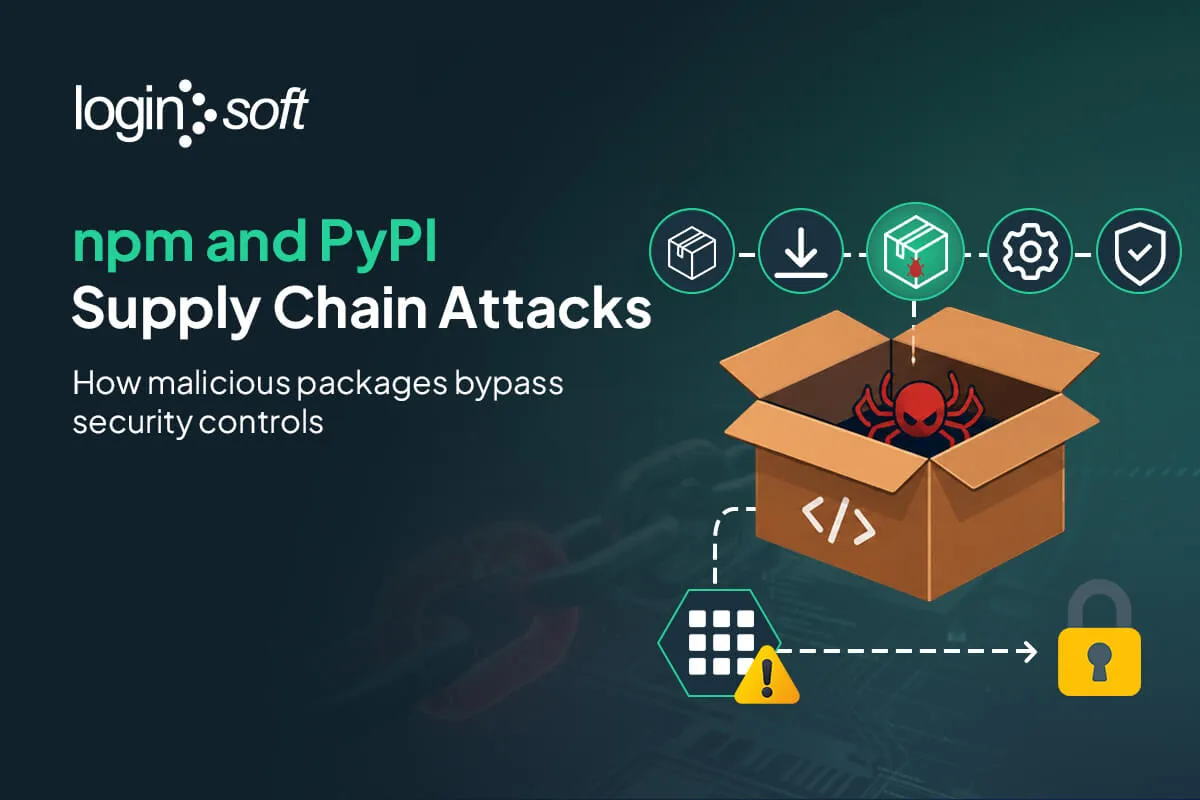
- Standard audit tools do not detect intentionally malicious packages. Tools like npm audit and pip-audit focus on known vulnerabilities, not malware behavior. A newly published malicious package with no CVE or advisory can pass these checks undetected.
- The attack surface is trust, not just code. Typosquatting, dependency confusion, and malicious updates exploit package-manager resolution and implicit trust. Developers and CI pipelines may install packages without verifying their provenance or behavior.
- Registry controls are only one layer of defense. Registry scanning, malware detection, and maintainer 2FA reduce risk, but attackers exploit gaps between these controls. Effective protection combines behavioral analysis, dependency pinning, SBOM governance, and build-environment isolation.
Introduction
AI agents are no longer experimental. Today, they read emails, query databases, interact with Slack, manage Jira tickets, and run cloud operations. Much of this connectivity is enabled by Model Context Protocol (MCP), which gives AI systems structured access to external tools and enterprise services.
That capability also creates a new security boundary. MCP tools are reviewed and approved at a point in time. But what happens when a trusted tool changes after approval? That is the problem an MCP rug-pull attack exploits, and it represents an emerging supply chain risk that enterprise security teams need to understand.
Key Takeaways
- An MCP rug-pull attack occurs when a previously approved tool or MCP server changes its behavior after deployment, creating unauthorized access or data exposure risks inside AI agent workflows.
- AI agents amplify the risk because they operate with persistent access, broad permissions, and repeated execution across privileged enterprise systems.
- Organizations should treat MCP servers as part of their AI supply chain and apply version pinning, change detection, least privilege, and re-approval workflows to manage trust over time.
What Is an MCP Rug Pull?
An MCP rug pull is a security pattern in which a tool or MCP server initially appears legitimate, is reviewed and trusted, and later changes its behavior in a way that introduces malicious or unauthorized activity.
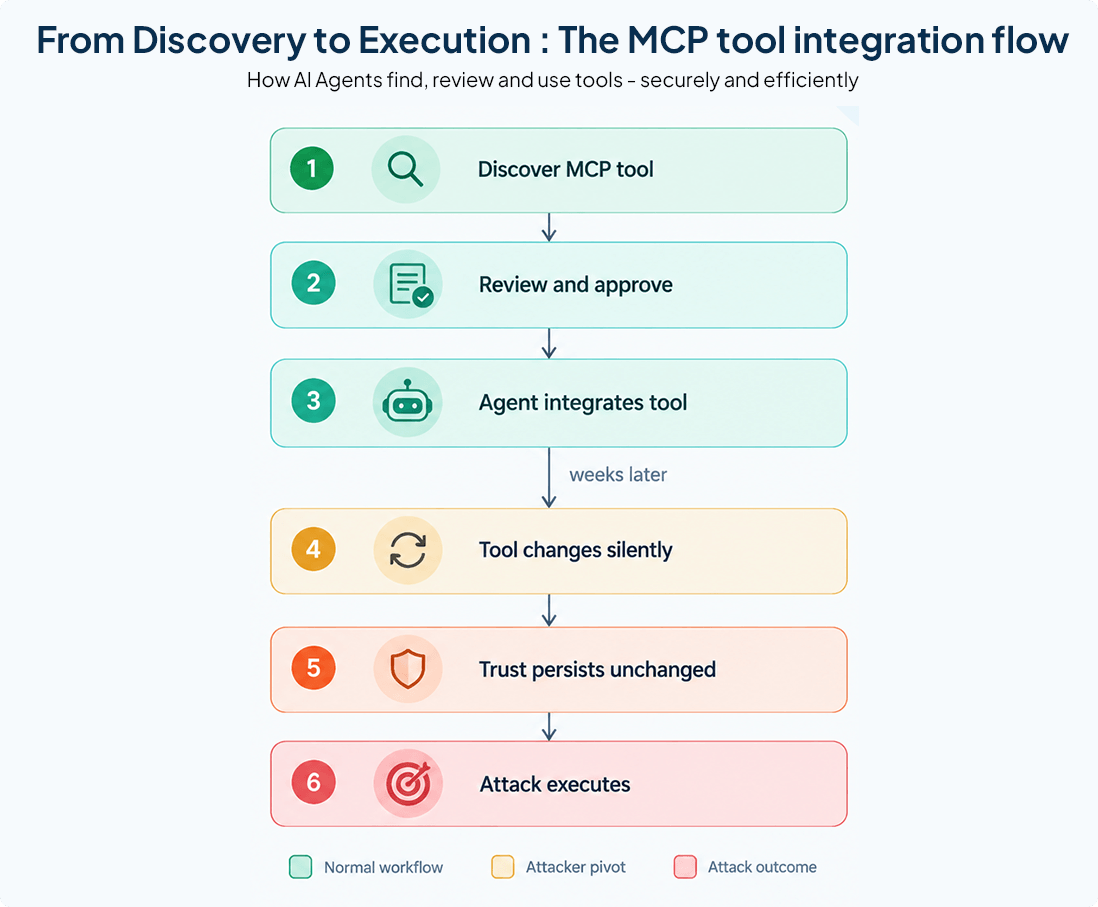
The basic sequence:
- An organization discovers an MCP tool.
- Security or engineering teams review and approve it.
- AI agents begin using it as part of normal workflows.
- The tool or its underlying implementation changes.
- The agent continues trusting it because the established relationship has not changed.
The attacker does not necessarily need to compromise the AI model itself. They may only need to compromise something the AI already trusts.
Why Is This a Supply Chain Problem?
Traditional software supply chains rely on controls such as version pinning, dependency locking, cryptographic signatures, checksums, immutable artifacts, and change-control processes.
AI agent ecosystems introduce another layer of dependencies: tools that agents can discover and invoke dynamically. Depending on the deployment architecture, MCP tool metadata, server implementations, dependencies, or external services may change without the same integrity and change-control mechanisms organizations expect from mature software supply chains.
That creates a new form of trust drift. The question is no longer:
"Did we approve this tool?"
It becomes:
"Is the tool we are using today still the tool we approved?"
A Simple MCP Rug Pull Attack Scenario
Imagine an organization deploys an MCP-based GitHub assistant. The tool initially provides legitimate capabilities: summarizing pull requests, search repositories, organizing issues, and helping developers investigate bugs. The organization reviews the integration and approves it.
Weeks later, the maintainer account is compromised or the underlying server is modified. The tool still has the same name. The AI agent still sees the same general capability. But the underlying behavior has changed.
If the compromised integration has sufficient privileges, it could potentially access information beyond its intended purpose, collect sensitive data, or send information to unauthorized destinations. The agent may continue invoking the tool because, from its perspective, nothing about the trusted relationship has changed. That is what makes the rug-pull scenario particularly concerning.
Why AI Agents Amplify the Risk
The risk becomes more significant when MCP tools are connected to highly privileged AI agents. Consider the combination of autonomy, persistent access, broad permissions, and repeated execution.
An agent may continuously interact with:
- Source-code repositories
- Cloud environments
- Internal documentation
- Customer data
- CI/CD systems
- Ticketing platforms
- Enterprise applications
A compromised tool operating inside that trust chain could turn legitimate automation into an attack path. Potential outcomes include data exfiltration, credential exposure, unauthorized actions, workflow manipulation, reconnaissance, and abuse of connected systems. The exact impact depends on the permissions granted to the agent and the MCP server, which is precisely why least privilege becomes critical.
Rug Pull vs. Other AI Security Threats
It is important to distinguish an MCP rug pull from related attacks:
- Malicious tool: The tool is malicious from the beginning.
- Tool poisoning: Malicious instructions or content influence how an AI agent interprets or uses a tool.
- Prompt injection: Untrusted input attempts to manipulate the model's behavior.
- Server compromise: A legitimate MCP server is taken over or modified.
- Rug pull: A previously trusted tool or integration changes after approval.
The defining characteristic is the change in trust over time.
How Organizations Can Reduce the Risk
Organizations adopting MCP should treat MCP servers and tools as part of their software and AI supply chain. Key controls include:
1. Version and configuration pinning
Know exactly which tool definition, server version, and configuration have been approved.
2. Integrity and provenance verification
Where supported, use signatures, hashes, trusted publishers, and provenance information to verify what is being deployed.
3. Change detection
Monitor tool definitions, schemas, permissions, dependencies, and server behavior for unexpected changes.
4. Least privilege
Give agents and MCP servers only the permissions they need. Avoid granting broad access simply because a tool might need it someday.
5. Runtime monitoring
Log and monitor which tools are invoked, who or what invoked them, parameters passed to them, data accessed, changes in tool behavior, and unexpected outbound communication.
6. Re-approval workflows
A significant change to an MCP tool should trigger a security review rather than being silently accepted.
7. Network and credential controls
Restrict outbound connectivity where possible and use scoped, short-lived credentials instead of unnecessarily broad or persistent credentials.
For teams operationalizing these controls, Loginsoft's AI Engineering services cover the integration and governance layer where they need to live.
Conclusion
MCP is helping make AI agents significantly more useful by giving them structured access to tools and enterprise systems. But that capability creates a new security boundary that organizations cannot afford to overlook. Software supply-chain security taught an important lesson: a dependency cannot be trusted simply because it was trusted yesterday. The same principle applies to AI tools. Securing AI systems will require not just protecting models but also continuously verifying the tools, integrations, identities, and trust relationships surrounding them. For security and engineering teams, the core question is not just whether a tool can be trusted. It is whether that trust can be continuously verified.
FAQs
Q1. What is an MCP rug-pull attack?
An MCP rug-pull attack is a security pattern in which an MCP tool or server is approved as legitimate and later modified to introduce malicious or unauthorized behavior. AI agents continue trusting the tool because the approved relationship appears unchanged, making it a particularly difficult threat to detect.
Q2. How does an MCP rug pull differ from a malicious tool attack?
A malicious tool is designed with harmful intent from the beginning. An MCP rug pull involves a tool that is genuinely legitimate at the time of approval and changes afterward. The risk comes from the trusted relationship that existed before the change, not from initial deception.
Q3. Why do AI agents increase the risk of MCP rug-pull attacks?
AI agents operate with persistent access, broad permissions, and repeated execution across enterprise systems. A compromised MCP tool embedded in an agent's workflow can exploit that position to exfiltrate data, manipulate processes, or access systems far beyond its original intended scope.
Q4. How can organizations detect changes to MCP tools after approval?
Organizations should implement change detection for tool definitions, schemas, permissions, dependencies, and server behavior. Runtime monitoring of tool invocations, parameters, and outbound communication helps identify unexpected behavior before it causes significant harm.
Q5. What is the most important control for reducing MCP rug-pull risk?
Least privilege is foundational. Limiting the permissions granted to AI agents and MCP servers reduces the potential impact if a tool is compromised or modified. Combining least privilege with version pinning, integrity verification, and re-approval workflows for significant changes provides a layered defense against this supply chain threat.
Table of Contents
Eight KEV Additions and a Third APT: Enterprise Infrastructure Tested on Every Front
Eight KEV Additions and a Third APT: Enterprise Infrastructure Tested on Every Front
Explore the key security, speed, and performance differences between TLS 1.3 and TLS 1.2
Ready to Find and Fix Your Security Weak Points?
LoginSoft's cybersecurity experts help organizations conduct thorough gap analyses, build prioritized remediation roadmaps, and achieve measurable security maturity improvements.
Schedule a Security Assessment
Hari Charan
Director of Security Research & Threat Intelligence
A MESSAGE FROM OUR TECHNOLOGY LEADER
The NVD enrichment cutback is not a surprise to us - it’s the inflection point we’ve been preparing for. At Loginsoft, we’ve spent years building the research depth and tooling infrastructure to independently enrich vulnerabilities at scale, with the accuracy and context modern security programs require. LOVI is our answer. Our mission is simple: ensure that no CVE relevant to your environment goes unanalyzed, unscored, or unactioned - regardless of what remains in NIST’s queue.
Key Takeaways
Stay Ahead
Get the Latest Cybersecurity Insights
Security research, threat intelligence, vulnerability updates, product news, and expert insights, delivered directly to your inbox. Stay informed. Stay secure.

BLOGS AND RESOURCES
Latest Articles
By using this website, you agree to the storing of cookies on your device to enhance site navigation, analyze site usage, and assist in our marketing efforts. View our Privacy Policy for more information.
Accept


© Copyright 2026, All Rights Reserved by Loginsoft
Privacy policy