
- CIS Controls v8.1 is a prescriptive framework built around 153 specific safeguards, while NIST CSF 2.0 is an outcomes-based framework built around governance, risk, and organizational maturity.
- The right framework depends on organization size, industry, regulatory obligations, and how mature the existing security program already is, not on which framework is "better."
- CIS v8.1 and NIST CSF 2.0 are explicitly cross-mapped, so most organizations that implement CIS well are already satisfying large portions of NIST CSF, and vice versa.
Introduction:
Every CISO, IT director, and growing security team eventually reaches the same fork in the road: should the organization build its program around CIS Controls or NIST CSF? Both are excellent, well-regarded frameworks, and that is exactly what makes the choice confusing.
The problem isn't a shortage of good guidance. It's that most comparisons treat these frameworks as head-to-head competitors when they're really designed to solve different layers of the same problem. Picking the wrong one or worse, blindly adopting both without a strategy, leads to compliance with theatre: documents that look great in audits but don't reduce risk.
With years of hands-on cybersecurity delivery experience, Loginsoft has worked alongside organizations implementing both frameworks from the ground up. CIS Controls focus on actionable technical safeguards. NIST CSF provides a broader structure for governance, risk management, and strategic communication. Neither replaces the other, nor does it explain why the fastest way is to stop wasting budget on the wrong starting point.
What Is CIS?
The Center for Internet Security (CIS) is a nonprofit organisation focused on practical, community-driven cybersecurity guidance. CIS is best known for two things: the CIS Controls, a prioritized list of technical safeguards, and CIS Benchmarks, Organizations looking to operationalize benchmark hardening at scale often turn to CIS Benchmark Compliance Content to move faster than building it in house.
CIS Controls v8.1: A Prescriptive Cybersecurity Framework
The Centre for Internet Security (CIS) Controls started life in 2008 as the SANS Top 20 Critical Security Controls. The idea was straightforward: take real-world breaches of data, figure out what attacks succeed, and build a prioritised list of specific things organisations should do to stop them. No ambiguity. No, it depends. Just action.
Today, CIS Controls v8.1 organizes that guidance into 18 top-level controls, each broken down into specific, measurable safeguards 153 total. Every safeguard is validated against MITRE ATT&CK data, meaning the controls directly counter techniques attackers are using in real breaches right now.
The Implementation Group Model
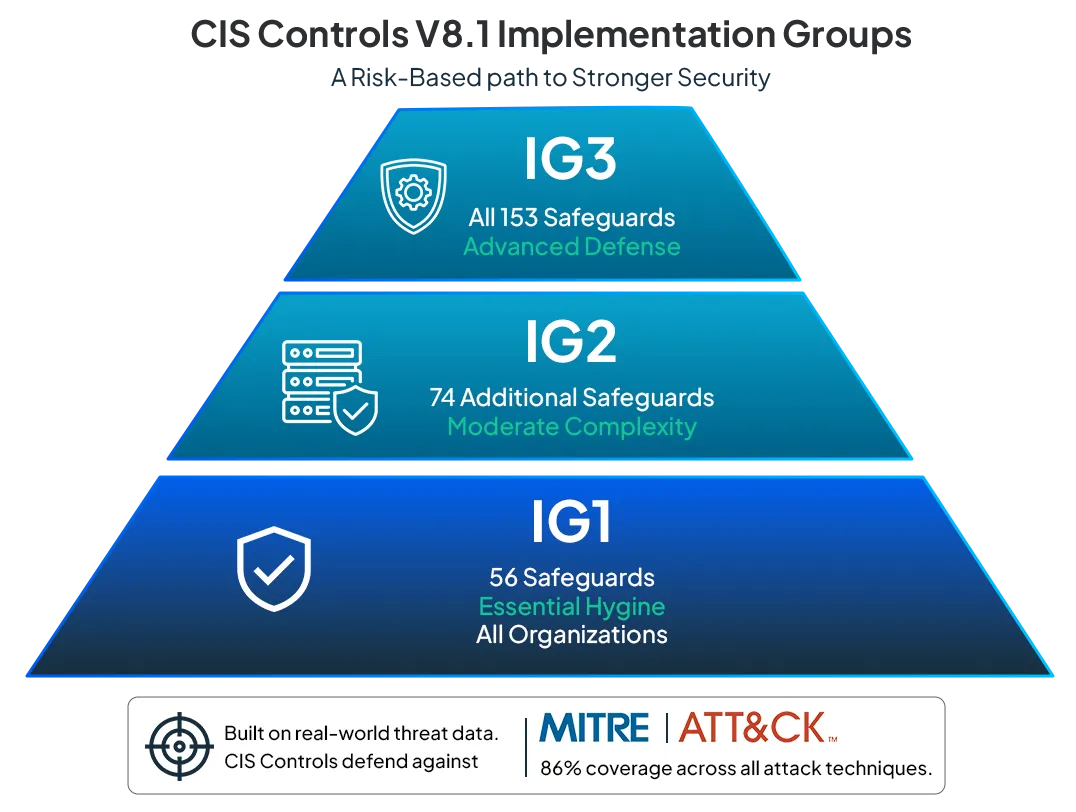
What separates CIS from nearly every other framework is its Implementation Group (IG) system. It acknowledges something most frameworks ignore: a 15-person startup and a 15,000-employee financial institution don't have the same resources, risk profile, or threat exposure.
The three IGs work cumulatively:
IG1 Essential Hygiene (56 safeguards)
- Every organization should implement these, regardless of size or industry
- Addresses the most common attack vectors
- Designed for SMBs with limited IT resources
- Achievable without a dedicated security team
- The strongest "bang-for-your-buck" baseline available
IG2 Moderate Complexity (74 additional safeguards)
- For organizations with regulatory obligations or more complex environments
- Covers deeper access management, log collection, and vulnerability management
- Maps to CMMC, PCI DSS v4, ISO 27001 simultaneously
IG3 Advanced Defense (all 153 safeguards)
- Includes all IG1 and IG2 safeguards plus more
- Designed for enterprises facing sophisticated threats
- Covers supply chain risk, cloud-specific controls, and privileged access hardening
The v8.1 Update: What Changed
Version 8.1 wasn't a cosmetic refresh. CIS added a Govern security function directly aligned to NIST CSF 2.0, making cross-framework mapping explicit. Safeguard descriptions were sharpened, glossary terms tightened (like a formal definition for "sensitive data"), and cloud guidance expanded. For organisations already using CIS v8, the migration path is backwards-compatible, you don't need to start over.
What Is NIST?
NIST (National Institute of Standards and Technology) is a non-regulatory federal agency under the U.S. Department of Commerce that promotes innovation, measurement science, and technology standards. Its key focus areas include measurement science, the Cybersecurity Framework, which provides voluntary guidelines and risk management tools organized around five core functions, technical publications such as the SP 800-series covering security and privacy controls, and emerging technology research spanning AI, cryptography, quantum science, and advanced manufacturing.
NIST CSF 2.0: Governance and Risk Management in Cybersecurity
NIST CSF 2.0 is the first major overhaul of the Cybersecurity Framework since its original launch. The headline changes: it's no longer just for critical infrastructure sectors. CSF 2.0 explicitly targets organisations of all sizes and sectors from small nonprofits to global enterprises.
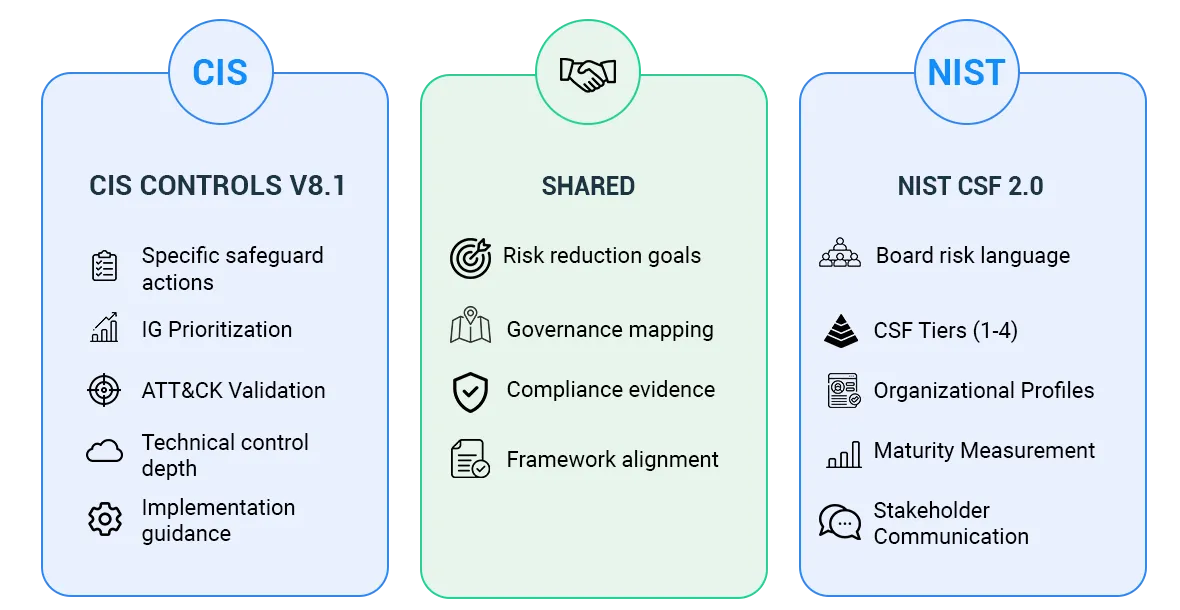
While CIS Controls focuses on the practical question, "What specific security actions should we take?", NIST CSF takes a broader view by asking, "What cybersecurity outcomes are we trying to achieve, and how do we communicate our risk posture to leadership?" Rather than prescribing exact tools, technologies, or processes, NIST CSF provides a common framework and language for understanding, managing, and discussing cybersecurity risk across the organization. It helps align technical security efforts with business objectives and enables clearer communication between security teams, executives, and stakeholders.
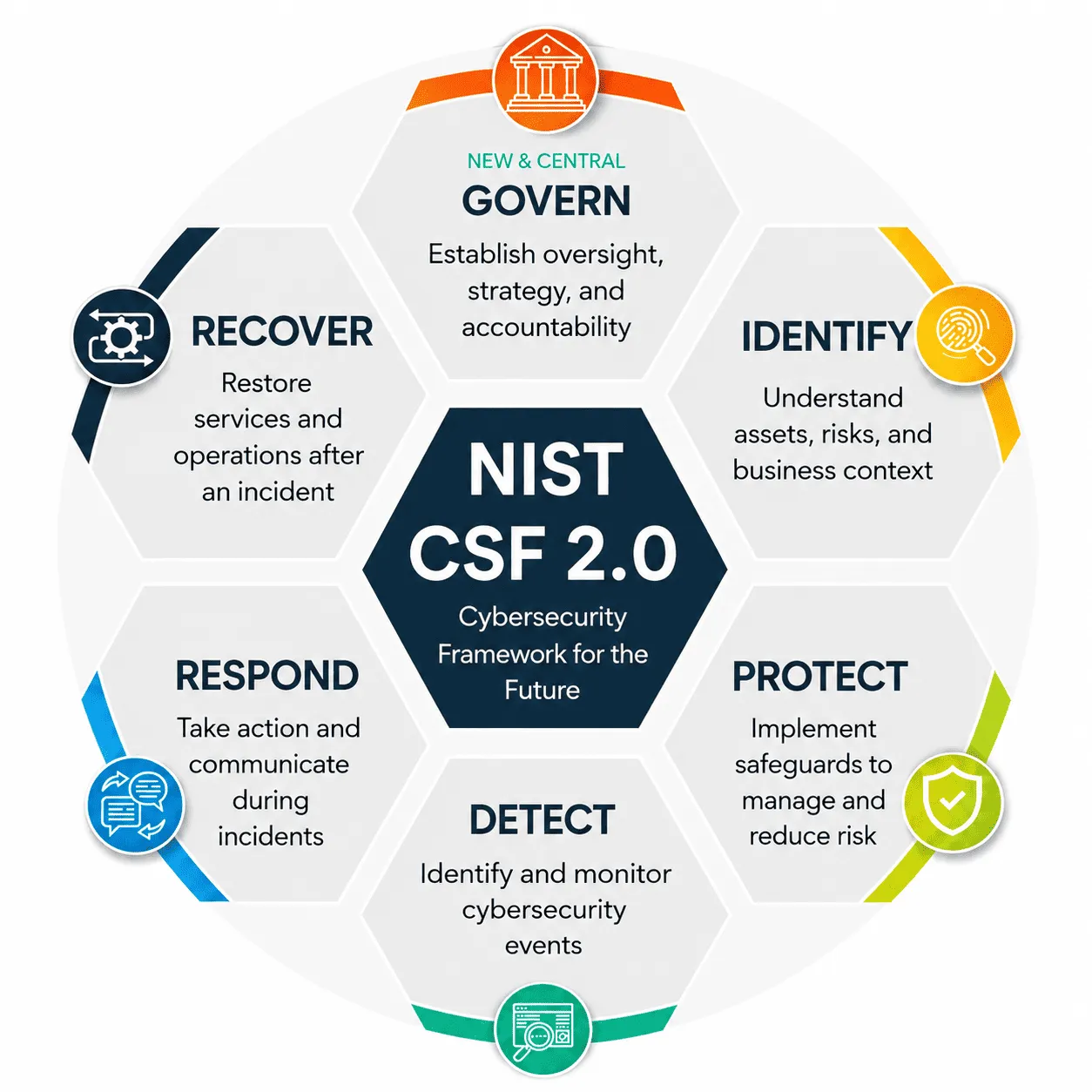
The Six Core Functions
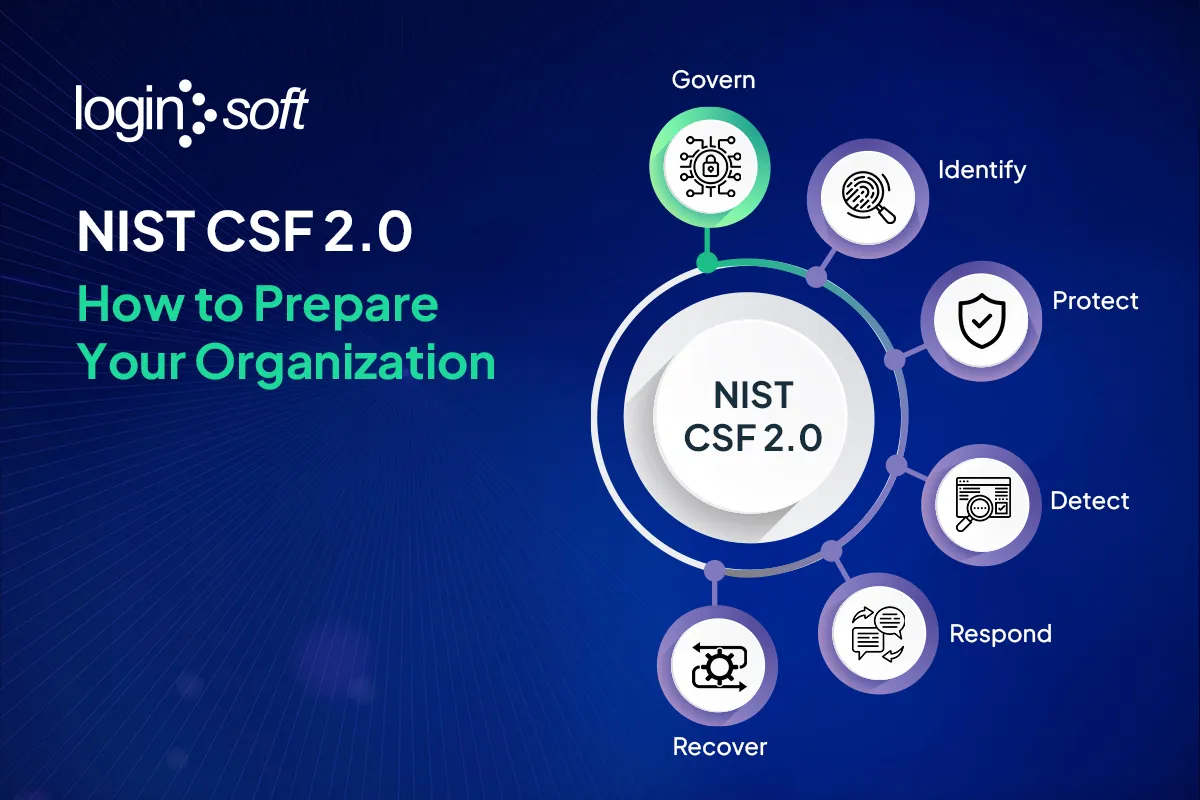
- GOVERN establishes cybersecurity risk management strategies, roles, and oversight. This is the new function added in CSF 2.0, placed at the Centre of the framework because it informs every other function. It's the board-level accountability layer.
- IDENTIFY Understand your organization's assets, risks, and business environment. You can't protect what you don't know you have.
- PROTECT Implement safeguards to mitigate cybersecurity risks. This is where technical controls live access controls, data protection, and configuration management.
- DETECT Identify cybersecurity events through continuous monitoring. Log management, anomaly detection, and threat intelligence consumption sit here.
- RESPOND Act when a cybersecurity incident is detected. Incident response planning, analysis, and communication.
- RECOVER Restore capabilities and services after an incident. Business continuity, backup validation, and lessons learned.
NIST CSF 2.0 Tiers: Measuring Cybersecurity Maturity
- The NIST Cybersecurity Framework (CSF) 2.0 uses Implementation Tiers to help organizations understand the maturity and sophistication of their cybersecurity risk governance and risk management practices. Tiers are not compliance levels or scores. Instead, they provide context for how well cybersecurity is integrated into organizational processes and decision making.
The four tiers are:
- Tier 1: Partial
Cybersecurity risk management is ad hoc and reactive. Practices aren't formalized, and there's limited awareness of cyber risk at the organizational level. Risk decisions are made case by case, often without organization wide visibility. - Tier 2: Risk Informed
Risk management practices exist and are approved by management, but they may not be consistently applied across the organization. Awareness of cybersecurity risk is growing, though processes remain somewhat siloed. - Tier 3: Repeatable
Practices are formally documented and consistently applied across the organization. Risk management is part of the organizational culture, with clear policies, defined roles, and regular updates based on changing threats and business requirements. - Tier 4: Adaptive
The organization adapts its cybersecurity practices in real time, based on lessons learned, predictive indicators, and past incidents. Cybersecurity risk management is fully integrated into organizational culture and decision making, with continuous improvement built in.
Most organizations sit at Tier 1 or Tier 2. The goal isn't necessarily to reach Tier 4 everywhere, it's to make deliberate, documented progress against a defined target.
New in CSF 2.0: The Govern function sits at the center of all other functions. It was added specifically to answer a growing demand from boards and regulators: cybersecurity decisions need documented ownership, risk tolerance statements, and accountability structures, not just technical controls.
Key Comparisons of CIS Vs NIST
Difference in Penetration Testing Between NIST and CIS
Both frameworks treat penetration testing as valuable, but they position it differently. NIST folds testing into its broader 800-53 guidance as one continuous risk-assessment tool among many. It is strongly recommended for regulated industries like healthcare and finance but is not universally mandatory, which leaves room for inconsistent adoption. CIS is more direct: Control 18 (Penetration Testing) is a required safeguard at Implementation Group 3, meaning enterprises validating advanced defenses must actively test their controls against real-world attack scenarios rather than assuming they hold. That single control also happens to be one of the clearest examples of how the two frameworks connect rather than compete, which is worth looking at directly.
Where CIS and NIST Overlap
One of the most important things to understand and something that doesn't get enough attention is that CIS Controls v8.1 was explicitly updated to align with NIST CSF 2.0. This wasn't coincidental. CIS publishes official mapping documents showing exactly which safeguards satisfy which NIST CSF function and category.
In practice, implementing CIS Controls satisfies significant portions of NIST CSF simultaneously:
- CIS Controls 1-2 (Asset Inventory & Software Inventory) map directly to NIST CSF's Identify function
- CIS Controls 3-7 (Data Protection, Secure Configuration, Account Management, Access Control, Vulnerability Management) map across NIST's Protect function
- CIS Controls 8-10 (Audit Log Management, Email & Web Browser Defense, Malware Defense) supports the Detect function
- CIS Controls 17-18 (Incident Response, Penetration Testing) support NIST's Respond and Recover functions
- CIS Controls v8.1 Govern function maps directly to NIST CSF's Govern function
If your organization fully implements CIS Controls using the official NIST CSF mapping documents, you can use the same evidence for NIST CSF compliance reviews. You don't need to build two separate compliance programs. One implementation, two framework checkboxes.
Who Should Use Which Framework?
Here's a practical decision guide based on real-world implementation experience. These recommendations reflect common adoption patterns and lessons learned from organizations building and maturing their cybersecurity programs.
Start with CIS Controls v8.1 If Your Organization
- Are an SMB or startup without a dedicated security team
- Need to know what to do first, today, not in six months
- Have a board that wants proof of hygiene rather than a governance narrative
- Are working toward CMMC, PCI DSS, or SOC 2
- Have a technical team that can execute specific safeguards directly
- Have limited budget and need a free, prioritized starting point
Start with NIST CSF 2.0 If Your Organization
- Are a federal contractor or agency with regulatory alignment needs
- Have a board that demands a structured risk communication framework
- Need to benchmark maturity across departments or business units
- Already have security tools in place and need a governance layer to organize them
- Manage third-party and supply chain risk
- Are preparing for ISO 27001 or CMMC and need a bridge framework
Use CIS Controls v8.1 and NIST CSF 2.0 Together If Your Organization
- Are an enterprise with gaps in both technical controls and governance reporting
- Want one implementation effort to satisfy multiple audits at once
- Have a CISO who needs to speak CIS to the security team and NIST to the board
- Operate in healthcare, finance, or critical infrastructure with layered regulatory requirements
- Want the fastest path to multi-framework compliance across HIPAA, PCI DSS, and ISO 27001
Organizations already running Azure or hybrid cloud workloads can also review how MCSB, CIS Controls, and NIST CSF 2.0 map each other before selecting a starting framework, since cloud-native environments often need all three mapped together.
Once the starting framework is chosen, the next question is sequencing: what happens in month one versus month six. That is where a concrete roadmap matters more than the framework of debate itself.
Build Your Security Roadmap: A Practical Roadmap
Choosing the right framework is only part of the process. The next step is understanding how to implement it effectively based on your organization's current security maturity, business priorities, and compliance requirements.
Launch a Security Program from the Ground Up
Step 1: Download CIS Controls v8.1 and run a self-assessment. CIS Controls are free. Start with IG1 56 safeguards covering the most impactful defenses. Use the free CIS-CAT Lite tool to benchmark your current posture against IG1 requirements and identify gaps immediately.
Step 2: Prioritize remediation by IG level and risk impact. Not all gaps are equally dangerous. Map your IG1 gaps to MITRE ATT&CK to understand which ones are actively exploited in attacks against your industry. A structured vulnerability management program helps operationalize this step by moving prioritization from spreadsheets to continuous, risk-based workflows aligned to CIS and NIST requirements.
Step 3: Build your NIST CSF Organisational Profile in parallel. Use NIST's free CSF Reference Tool to create a Current Profile and Target Profile. This doesn't require implementation, it's a documentation exercise that defines where you are and where you want to be. Use this for board reporting from day one.
Step 4: Use the CIS-to-NIST mapping to generate cross-framework evidence. Download the official CIS Controls v8.1 to NIST CSF 2.0 mapping document. As you complete CIS safeguards, tag each one with its corresponding NIST function. Your implementation log becomes your compliance evidence library. Organizations running Azure workloads can also reference the MCSB-to-CIS and MCSB-to-NIST control mappings to satisfy multiple audits from a single evidence base.
Step 5: Establish continuous monitoring and quarterly reviews. Security posture is not a project, it's a program. Schedule quarterly IG progress reviews, annual penetration tests aligned to CIS Control 18 and use your NIST Tier score to track maturity progress with leadership. Automate compliance checks where possible using SIEM integrations and endpoint security tooling.
Common mistakes to avoid do not try to implement every NIST CSF subcategory or all 153 CIS safeguards in year one. Organizations that try to cover everything at once end up with a documentation-heavy program that looks good on paper but does not reduce real risk. Start with IG1, complete it, then expand deliberately. Frameworks like Zero Trust Network Architecture 2.0 can then layer on top once the CIS and NIST baseline is in place, since ZTNA maps to both frameworks' Protect and Detect functions. Put all of that together, and the decision comes down to a fairly simple takeaway.
Conclusion:
CIS Controls v8.1 and NIST CSF 2.0 serve different but complementary purposes. CIS gives security teams a specific, prioritized list of actions that reduce risk immediately. NIST CSF gives leadership a framework for governance, risk communication, and long-term planning. Rather than picking one over the other, most organizations get the most value by starting with CIS to build foundational hygiene, then layering NIST CSF on top to give that hygiene a governance structure the board can track.
FAQs
Q1. What is the core difference between CIS Controls and NIST CSF?
CIS Controls and NIST CSF differ in approach: CIS Controls is prescriptive, offering a prioritized checklist of specific safeguards that tell organizations exactly what to do. NIST CSF is outcomes based, defining what strong cybersecurity looks like without dictating the exact steps to achieve it. In practice, CIS answers "what do we do next," while NIST answers "what outcome are we working toward, and how do we report on it."
Q2. Does CIS map to NIST CSF, and can I use the same evidence for both?
Yes, CIS Controls officially map to NIST CSF, so most evidence collected for one framework applies to the other. A safeguard implemented under a CIS Control typically satisfies one or more NIST CSF subcategories, since both frameworks address overlapping security outcomes despite different structures. The evidence usually needs light reformatting rather than a direct copy: CIS evidence tends to be technical and safeguard specific, while NIST evidence is framed around outcomes and governance. Mapping each piece of evidence to both frameworks at collection time is more efficient than reverse engineering later.
Q3. Is CIS Controls better than NIST CSF?
Both frameworks are strong choices, each suited to a different purpose. CIS Controls works best when a team needs concrete, prioritized actions to reduce risk quickly, especially organizations building a security program. NIST CSF works best when leadership needs a strategic view of risk across the organization, particularly for governance, reporting, and aligning security with business objectives. Many organizations use both together: CIS Controls to guide implementation, and NIST CSF to communicate posture and risk to executives and boards.
Q4. Can a small business or startup use NIST CSF 2.0?
Yes, NIST CSF 2.0 was specifically expanded to support organizations of all sizes, including small businesses and startups. Earlier versions were written mainly for critical infrastructure providers, but the 2.0 update broadened its scope and added resources like quick start guides and an online reference tool to make implementation more accessible for teams without a dedicated security function. A small business can adopt the framework at whatever depth fits its risk profile and resources, since NIST CSF is outcomes based rather than prescriptive.
Q5. Does either framework offer formal certification?
Neither CIS nor NIST CSF offers a certification in the traditional sense. Both work on a self-assessment basis, where organizations align to the controls and document that alignment. This documentation builds a strong evidence base for formal certifications such as ISO 27001 and SOC 2. CMMC certification connects here too, built on NIST SP 800-171, so alignment work done for NIST CSF lays out useful groundwork for organizations pursuing it.
Q6. How long does it typically take to implement CIS Controls IG1?
Most organizations implement CIS Controls Implementation Group 1 (IG1) within three to six months, depending on their starting security maturity and available resources. IG1 covers the 56 foundational safeguards considered essential cyber hygiene, things like asset inventory, access control, and basic malware defenses, so organizations with some existing security practices in place often move faster, while those starting from scratch may need closer to six months to build out the full set.
Q7. Which framework reduces implementation time for a resource-constrained team?
CIS Controls generally move faster for resource-constrained teams because its safeguards are prescriptive and prioritized, so teams know exactly what to configure first. NIST CSF requires more interpretation of the organization's specific risk profile before implementation can begin, which extends the initial planning phase but supports a more tailored program over time.
Q8. Do I need to choose one framework permanently, or can they change over time?
Frameworks are not permanent commitments. Many organizations start with CIS IG1 for fast, tactical wins, then adopt NIST CSF as the program matures, and board-level risk reporting becomes necessary. The two are designed to be layered rather than swapped.
Table of Contents
Week of Synchronized Exploitation: How Threat Actors Weaponized Shared Vulnerabilities
Week of Synchronized Exploitation: How Threat Actors Weaponized Shared Vulnerabilities
Explore the key security, speed, and performance differences between TLS 1.3 and TLS 1.2
Ready to Find and Fix Your Security Weak Points?
LoginSoft's cybersecurity experts help organizations conduct thorough gap analyses, build prioritized remediation roadmaps, and achieve measurable security maturity improvements.
Schedule a Security Assessment
Hari Charan
Director of Security Research & Threat Intelligence
A MESSAGE FROM OUR TECHNOLOGY LEADER
The NVD enrichment cutback is not a surprise to us - it’s the inflection point we’ve been preparing for. At Loginsoft, we’ve spent years building the research depth and tooling infrastructure to independently enrich vulnerabilities at scale, with the accuracy and context modern security programs require. LOVI is our answer. Our mission is simple: ensure that no CVE relevant to your environment goes unanalyzed, unscored, or unactioned - regardless of what remains in NIST’s queue.
Get Notified
BLOGS AND RESOURCES
Latest Articles
By using this website, you agree to the storing of cookies on your device to enhance site navigation, analyze site usage, and assist in our marketing efforts. View our Privacy Policy for more information.
Accept


© Copyright 2026, All Rights Reserved by Loginsoft
Privacy policy