
- ZTNA 2.0 continuously verifies users, devices, behavior, context, and risk while enforcing least-privileged access to reduce attack surfaces and lateral movement.
- Its eight core pillars strengthen identity, access control, monitoring, device trust, segmentation, visibility, automation, and risk-aware policies across hybrid and multi-cloud environments.
- ZTNA 2.0 aligns with NIST SP 800-207, NIST CSF 2.0, CIS Controls, ISO 27001, SOC 2, HIPAA, and PCI-DSS, supporting stronger security, compliance, governance, and breach containment.
Introduction
Zero Trust Network Architecture 2.0 is the security industry's definitive answer to the realities of modern enterprise infrastructure. It is not a product or a single-vendor solution, but an architectural philosophy built around enforceable technical controls for cloud-native, hybrid, and multi-cloud environments where users, applications, identities, and workloads are constantly moving.
Unlike traditional perimeter-based security models, ZTNA 2.0 assumes that no user, device, or workload should be trusted by default. Instead, every access request is continuously verified based on identity, context, device posture, workload behavior, and risk signals. This approach helps organizations reduce lateral movement, secure distributed workforces, and maintain visibility across increasingly dynamic cloud ecosystems.
Loginsoft’s research and engineering teams work across enterprise cloud deployments, vulnerability intelligence programs, and security framework implementations. The consistent pattern Loginsoft observes is that organisations adopting true ZTNA 2.0 principles not just legacy Zero Trust Network Architecture 1.0 tooling, significantly reduce breach impact radius, accelerate compliant cloud adoption, and close persistent compliance gaps identified during audits. This guide explains what Zero Trust Network Architecture 2.0 is, how it differs from earlier approaches, the eight operational pillars that define its architecture, and the measurable business outcomes enterprises achieve through proper implementation.
What Is Zero Trust Network Architecture 2.0?
Zero Trust Network Architecture 2.0 (ZTNA 2.0) is the next evolution of the Zero Trust security model that continuously verifies every user, device, session, and access request in real time. Unlike traditional network security approaches that grant broad trust after logging in, ZTNA 2.0 assumes no user or system should ever be inherently trusted. Access is granted dynamically based on identity, device posture, behavioral context, location, and risk signals, while users are connected only to specific applications, never to the underlying network itself.
The model builds on the original Zero Trust concept introduced by John Kindervag in 2010, based on the principle of “never trust, always verify.” ZTNA 1.0 applied this philosophy primarily to initial authentication. Once users successfully logged in, they were typically granted ongoing access to an application or network segment without continuous revalidation. While this was a major improvement over traditional VPN-based access models, it still left organizations vulnerable to compromised credentials, hijacked sessions, insider threats, and lateral movement after authentication had already been approved.
ZTNA 2.0 eliminates those gaps by enforcing continuous verification throughout the entire lifecycle. Every interaction is dynamically evaluated using real-time contexts such as user behaviour, device health, session risk, and environmental changes. If risk levels change during an active session, access can immediately be restricted, re-authenticated, or terminated. Designed for cloud-native applications, SaaS environments, remote workforces, and multi-cloud infrastructure, ZTNA 2.0 reflects the reality that in modern enterprises, trust cannot be granted once and assumed forever it must be continuously earned and continuously validated.
At its core, Zero Trust Network Architecture 2.0 enforces three principles simultaneously:
Principle 01: Verify Explicitly
Authenticate and authorise every user, device, and workload based on all available signal identity, device health, location, behaviour, and real-time risk score. No signal is ignored; no connection is assumed to be safe.
Principle 02: Use Least-Privilege Access
Grant the minimum level of access required for the specific task, and nothing more. Policies adapt dynamically to user roles, device type, location, and runtime risk context not static group membership.
Principle 03: Assume Breach
Design systems as if a breach is already in progress. Limit blast radius through micro-segmentation, encrypt all traffic, and continuously monitor for anomalous behavior. Every segment is independently defended.
How ZTNA 2.0 Differs from Traditional Security Models
To understand the significance of Zero Trust Network Architecture 2.0, it helps to place it alongside the security paradigms it is designed to replace. The comparison below captures the structural differences across six critical dimensions, and these are not minor stylistic variations. They reflect fundamentally different security design philosophies.
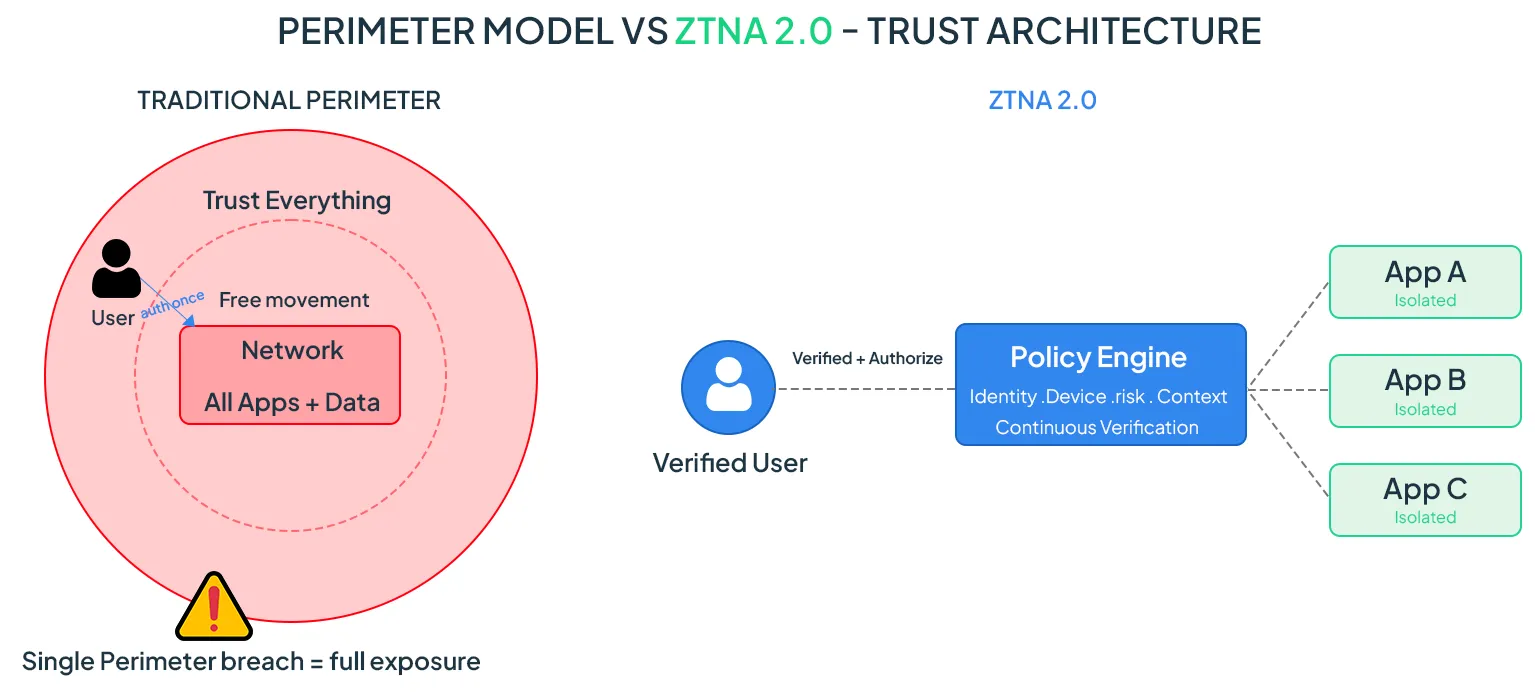
How Zero Trust Network Architecture 2.0 Architecture Actually Works:
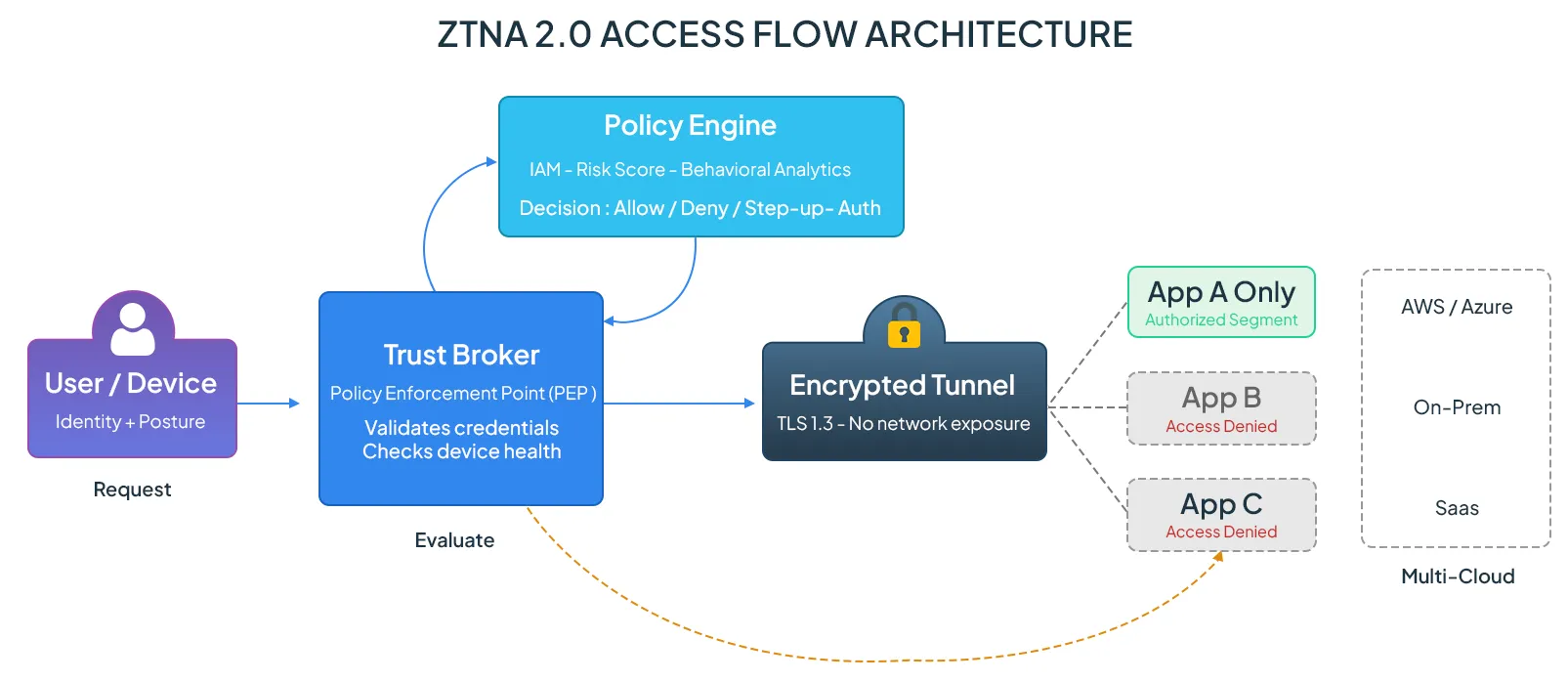
At a high level, ZTNA 2.0 inserts a policy enforcement layer between every user and every application regardless of where either resides. This is not a firewall rule set. It is a dynamic, context-aware decision engine that processes every access request before any traffic reaches an application.
The three key architectural components are:
- Policy Engine (the brain): Evaluates identity attributes, device posture, behavioral context, and real-time risk signals to make an access decision. This is where NIST SP 800-207's "trust algorithm" lives.
- Policy Administrator (the decision maker): Translates the Policy Engine's decision into session tokens, communicates approval or denial to the enforcement layer, and manages session lifecycle.
- Policy Enforcement Points (the gates): The network proxies or brokers that allow or block traffic based on the Policy Administrator's instruction. Multiple PEPs exist for one per application, cloud, or workload segment.
No traffic reaches an application without passing through this chain. The user is never placed on the network. They are connected directly to a single, authorized application through an encrypted tunnel with the underlying network infrastructure invisible and unreachable.
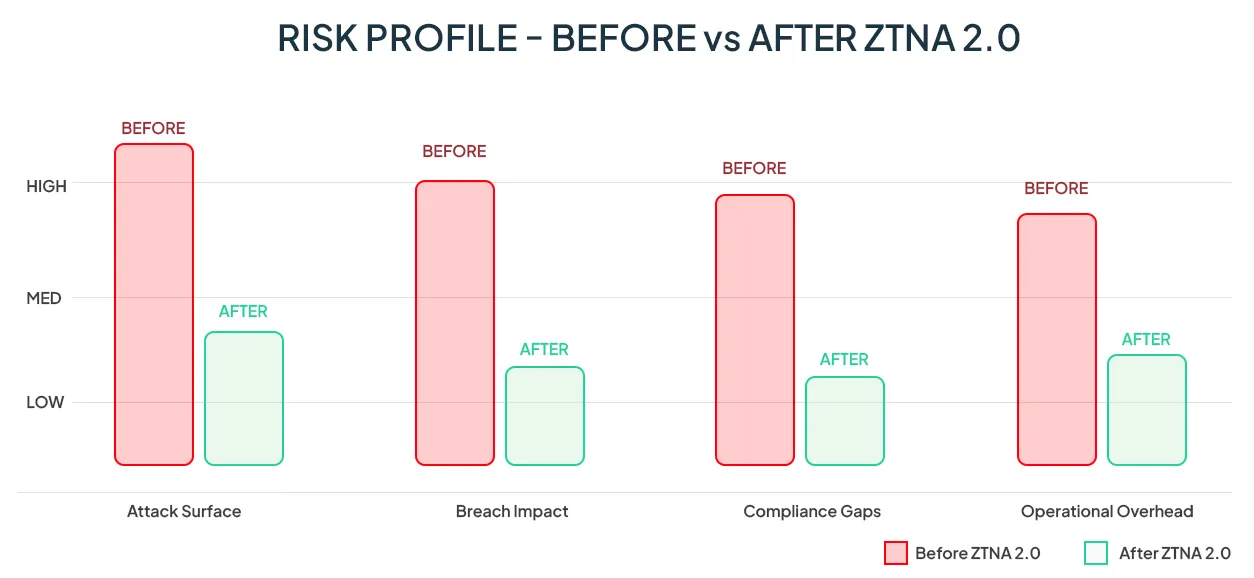
Zero Trust Network Architecture 2.0 Capabilities That Drive Business and Security Outcomes
Security architecture decisions are, ultimately, business decisions. Here is how ZTNA 2.0 maps the outcomes that CXOs and boards are accountable for, with the technical mechanism behind each outcome explained, not just asserted. ️
Reduced Breach Impact
Micro-segmentation and continuous session termination contain breaches before they escalate. A compromised credential reaches only the authorized application, not the network. Blast radius shrinks from "full data center" to "one application segment."
Faster Cloud Adoption
Security policies travel with workloads wherever they move to AWS, Azure, GCP, or back on premises. Cloud migration stops being blocked by security re-architecture work. ZTNA 2.0 is a cloud-native design.
Compliance Readiness
Zero Trust Network Architecture 2.0 controls map directly to NIST SP 800-207, ISO 27001, SOC 2, CIS Controls v8, PCI-DSS, and HIPAA, reducing compliance audit overhead by generating unified evidence across multiple frameworks simultaneously.
Lower Operational Risk
Dynamic, identity-aware policies eliminate the sprawl of static firewall rules and VPN ACLs that accumulate technical debt over time. Security policy becomes code version-controlled, auditable, and testable.
Secure Multi-Cloud Scale
A single consistent policy framework governs access across AWS, Azure, GCP, and private infrastructure with no per-cloud security silos. Policy enforcement follows the workload, not the data center boundary.
Stronger Customer Trust
Demonstrable Zero Trust controls signal security maturity to enterprise customers, partners, and regulators who increasingly require Zero Trust Network Architecture attestation as part of vendor due diligence and supply chain risk programs.
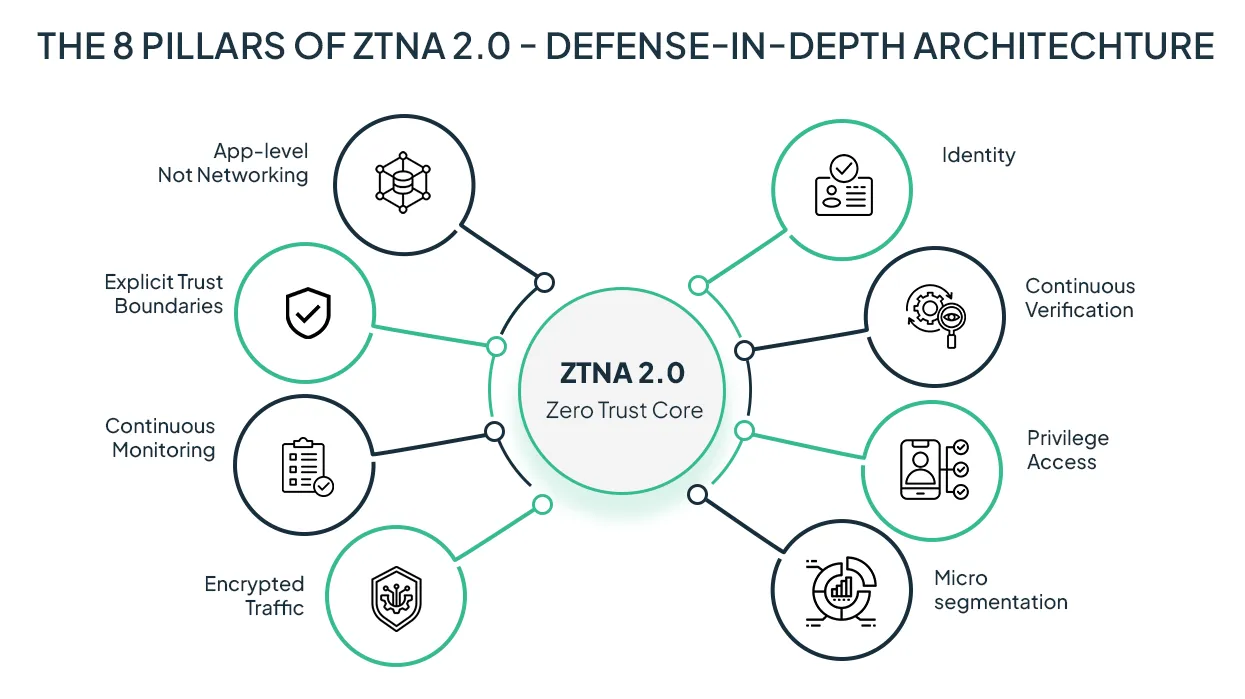
The 8 Core Pillars of ZTNA 2.0
Zero Trust Network Architecture 2.0 is not a single technology; it is a composite of eight reinforcing capabilities. Together, they form a defence-in-depth architecture that holds even when individual layers are tested. Organizations that implement ZTNA 2.0 partially, for example, adding continuous verification without micro-segmentation are still exposed to lateral movement attacks. All eight pillars need to be addressed for the architecture to function as intended.
Strong Identity as the Perimeter
The network boundary is gone. Identity verified through MFA, certificate-based authentication, and behavioral signals is the new perimeter. Every access decision begins with "who are you, really?" This identity layer integrates with enterprise IAM systems (Azure AD, Okta, Ping) and evaluates device certificates, user roles, and contextual signals before any session token is issued.
Continuous Verification
Authentication is not a one-time event at the front door. ZTNA 2.0 re-validates identity, device health, and risk posture throughout every active session. If a device security posture degrades mid-session for example, a user opens a suspicious attachment; the policy engine can instantly downgrade permissions or terminate the session without waiting for a new login event.
Least-Privilege Access
Users receive the minimum access required for their specific task, nothing more. Unlike static RBAC in VPN environments, Zero Trust Network Architecture 2.0 policies adapt dynamically to role, device type, location, and real-time risk score. A contractor accessing a financial report from an unmanaged laptop receives different permissions than a full-time employee using a corporate device on the corporate network.
Micro-segmentation
Workloads, applications, and data stores are isolated into discrete security segments. A breach in one segment, whether via compromised credentials, a vulnerability exploit, or a misconfigured workload, cannot traverse to another. The East-west movement is blocked by design, not by hope. Micro-segmentation is what makes ZTNA 2.0's "assume breach" principle operationally real rather than theoretical.
Encrypted Traffic Everywhere
All traffic is encrypted end-to-end between users and applications, between services, and within the data center. TLS 1.3 is the baseline. There are no clear-text paths for attackers to intercept not inside the data center, not in transit, not between microservices. Mutual TLS (mTLS) between workloads ensures both parties in any connection are cryptographically authenticated.
Explicit Trust Boundaries
Every access relationship is formally defined and documented in policy. There are no implied trust relationships or connections that are not explicitly authorized are denied by default. This "deny by default, allow by exception" model stands in direct contrast to perimeter security's "allow by default, deny by rule" approach. It is the technical embodiment of Zero Trust's core principle.
Continuous Monitoring & Enforcement
Behavioral analytics, anomaly detection, and real-time log analysis run persistently across all sessions and workloads. Violations trigger automated policy enforcement, not ticket-based remediation queues. UEBA (User and Entity Behavior Analytics) feeds risk signals back into the Policy Engine in real time, creating a closed feedback loop between monitoring and access control decisions.
Access to Apps, Not Networks
The user never touches the network. They are connected directly to an authorized application through an encrypted broker tunnel. The underlying network infrastructure is invisible and unreachable. This is what eliminates the entire class of attacks that depend on network visibility: scanning, lateral movement, MITM on internal traffic, and reconnaissance via network segmentation bypass.
How Zero Trust Network Architecture 2.0 Helps Organizations Meet Modern Compliance Requirements
One of the most underappreciated aspects of a properly implemented Zero Trust Network Architecture 2.0 architecture is how much compliance ground it covers simultaneously. Security teams often run separate workstreams for NIST, CIS, ISO 27001, and SOC 2 audits each generating its own evidence trail. ZTNA 2.0 implementation naturally produces evidence that satisfies all of them.
Who Should Deploy to Zero Trust Network Architecture 2.0 and when?
Here is a direct decision guide based on what Loginsoft observes consistently across enterprise cloud security engagements. The question is not whether your organization needs Zero Trust; it is where you are on the maturity curve, and which pillar gaps carry the most risk today.
Start with Zero Trust Network Architecture 2.0 If…
- You have a cloud-first or hybrid infrastructure where VPN performance and security gaps are both causing problems
- Your workforce is fully or partially remote and you need security that travels with the user, not the network
- You are operating in a multi-cloud environment (AWS + Azure + GCP) with no unified access control framework
- You have experienced a breach or near-miss where lateral movement extended the blast radius
- You have regulatory obligations that map to NIST SP 800-207, FedRAMP, or CMMC Level 2/3
- You are migrating legacy applications to cloud and need security policies that survive the move
- Your SaaS footprint has grown beyond what perimeter firewalls were designed to protect
Zero Trust Network Architecture 2.0 Pairs with These Initiatives
- Cloud migration programs ZTNA 2.0 policies travel with workloads; they don't need to be rebuilt per environment
- CIS Controls v8 implementation ZTNA 2.0 directly satisfies IG2/IG3 controls for network segmentation and privileged access
- NIST CSF 2.0 adoption provides the technical control layer that NIST CSF's Protect and Detect functions require
- SOC 2 Type II certification continuous monitoring and access controls are core trust service criteria
- M&A security integration zero trust micro-segmentation isolates acquired entities during integration periods
- DevSecOps pipeline hardening workload-to-workload mTLS and policy enforcement at the API layer
Common Mistakes Loginsoft Sees in the Field:
Organizations deploy a Zero Trust Network Architecture product, usually a cloud-based VPN replacement and declare Zero Trust done. A ZTNA proxy that only replaces remote access is Zero Trust Network Architecture 1.0 thinking with a 2.0 label. True ZTNA 2.0 requires all eight pillars: continuous session verification, micro-segmentation, and behavioral monitoring alongside application-level access control. Without micro-segmentation, a compromised session inside the application still allows lateral movement within that application's data layer.
How Loginsoft Enables Zero Trust Network Architecture 2.0 for Enterprises
Loginsoft brings together the research depth, engineering capability, and security domain expertise required to take ZTNA 2.0 from architectural concept to production reality. With 6+ years in cybersecurity, Loginsoft approach spans the full spectrum from initial architecture assessment and policy design through implementation, monitoring, and continuous improvement.
Loginsoft does not sell a ZTNA product. Loginsoft helps enterprises select, implement, and operationalise the right combination of technologies to realise a true ZTNA 2.0 architecture, vendor-neutral, outcome-focused, and built to last.
1. Cloud Infrastructure Security
Loginsoft's Cloud Infrastructure Security practice helps organizations design and validate ZTNA 2.0 architectures across AWS, Azure, GCP, and private cloud environments ensuring that policy enforcement points, micro-segmentation boundaries, and identity controls are correctly configured and consistently enforced. This includes architecture review, PEP placement strategy, and zero-trust network design for hybrid environments.
2. Cloud Security Posture Management (CSPM)
Continuous verification, the beating heart of ZTNA 2.0, requires real-time visibility into cloud configuration drift, identity policy violations, and workload exposure. Loginsoft CSPM capability provides persistent posture monitoring that feeds the ZTNA 2.0 policy engine with accurate, actionable risk signals. Drift detection feeds directly into automated policy responses, closing the loop between posture monitoring and access enforcement.
3. Vulnerability Intelligence and Management
ZTNA 2.0's device posture checks are only as strong as your vulnerability visibility. Loginsoft's Vulnerability Intelligence and Vulnerability Management services ensure that the device-health signals feeding your policy enforcement points reflect current, accurate risk data not stale scan results from last quarter's scheduled assessment. The real-time vulnerability context means the policy engine makes decisions based on what is exposed right now.
4. Threat Intelligence Integration
ZTNA 2.0 policies that respond to real-time threat signals are far more effective than those operating on static rules. Loginsoft Security and Threat Intelligence Integration services connect live threat feeds into your access control infrastructure, so policy decisions reflect what adversaries are doing right now, not what they were doing six months ago when the policy was last reviewed. This includes IP reputation feeds, TTP-based behavioral rules, and sector-specific threat of actor tracking.
5. Framework Gap Assessment and Roadmap
For organizations unsure where their current security posture stands against ZTNA 2.0 principles, Loginsoft provides gap assessments that map existing controls across all eight pillars. The output is a prioritized remediation roadmap: not every pillar gap carries equal risk. Loginsoft identifies the 20% of gaps that represent 80% of your actual exposure and sequences the implementation work to maximize risk reduction per investment dollar.
Build Your ZTNA 2.0 Implementation Roadmap
Knowing the framework is only half of the battle. Here is the concrete sequencing Loginsoft recommends for organizations at different stages of their Zero Trust journey. The goal is not perfection on day one; it is deliberate, prioritized progress that reduces real risk with every implementation cycle.
Launching from the Ground Up
Inventory Identities, Devices, and Applications
You cannot enforce zero trust on assets you do not know exist. Start with a complete identity inventory (human and non-human), device inventory, and application portfolio map. This is ZTNA 2.0's prerequisite and it maps directly to CIS Controls 1 and 2 (Asset Inventory) and NIST CSF 2.0's Identify function. Without this inventory, your policy engine is operating on incomplete information.
Deploy Identity Provider and MFA Across All Access Points
Strong identity is Pillar 1 for a reason, it is the foundation everything else builds on. Deploy or consolidate to a centralized Identity Provider (IdP) and enforce MFA across every access path: cloud console, SaaS applications, VPN replacement, and privileged access workstations. Phishing-resistant MFA (FIDO2/WebAuthn) is the target state; TOTP-based MFA is an acceptable interim step. No identity, no session token that is the enforcement model.
Deploy a ZTNA Proxy/Broker for Application Access
Replace VPN with an application-specific access broker that implements Pillar 8 (app-level access, not network access). Pilot with three to five high-sensitivity applications first. Measure session creation latency, user friction, and security event telemetry during the pilot. Common platforms include Zscaler Private Access, Palo Alto Prisma Access, Cloudflare Access, and Microsoft Entra Private Access ; each has different strengths depending on your existing cloud stack.
Implement Micro-segmentation for Critical Workloads
Start with your most sensitive workloads, financial data environments, customer PII, and intellectual property repositories. Apply micro-segmentation at the workload level using host-based firewalling, software-defined networking, or cloud-native security groups. Map segment boundaries to your data classification policy. This step directly addresses the lateral movement risk that remains after Pillar 8 deployment the access broker stops external lateral movement; micro-segmentation stops internal lateral movement.
Enable Continuous Monitoring and UEBA
Connect your SIEM, EDR, and CSPM outputs into a unified behavioral analytics layer. Define baseline behavioral profiles per user's role, device type, and application. Configure automated policy responses for anomaly triggers session downgrade, step-up authentication, or automatic termination based on risk score thresholds. This closes the Pillar 7 loop: monitoring findings feed the Policy Engine in real time, not in quarterly reports.
For Organizations with an Existing Security Program
If you already have cloud security tools in place with a CASB, a legacy ZTNA 1.0 product, a SIEM, and endpoint detection, the risk is architectural fragmentation: tools operating as silos rather than integrated pillars. Loginsoft's approach in this scenario is to run a ZTNA 2.0 maturity assessment against all eight pillars simultaneously, map existing controls to the pillar model, and identify which pillar gaps expose the organization to the highest-impact attack techniques in your sector's current threat landscape.
"Most enterprises we assess have elements of ZTNA 2.0 deployed in isolation, strong MFA here, a ZTNA proxy there, micro-segmentation in one cloud but not another. The gap is never the tools. It is the policy framework that connects them into a coherent architecture. That is the work Loginsoft does." - Loginsoft Cloud Security Practice
Conclusion
ZTNA 2.0 represents a fundamental shift in how enterprises think about security in a cloud-first world. Traditional perimeter-based defenses were designed for static networks and centralized workforces, but modern environments are dynamic, distributed, and constantly evolving. By enforcing continuous verification, least-privilege access, and micro-segmentation across all eight architectural pillars, ZTNA 2.0 replaces implicit trust with a security model built for hybrid infrastructure, SaaS applications, and remote work at enterprise scale.
More than a technology upgrade, ZTNA 2.0 is a business enabler. Organizations adopting this architecture gain stronger breach containment, faster cloud adoption, improved regulatory alignment, and reduced operational complexity. Instead of exposing entire networks, enterprises can securely connect users only to the applications they need while continuously validating identity, device posture, and runtime risk. This approach not only strengthens security resilience but also creates a more agile and scalable foundation for digital transformation initiatives.
Loginsoft helps enterprises turn Zero Trust principles into operational reality through cloud infrastructure security, CSPM, vulnerability intelligence, and threat intelligence integration. By combining research-driven security expertise with vendor-neutral implementation strategies, Loginsoft enables organizations to design ZTNA 2.0 architectures that are practical, scalable, and aligned with long-term business objectives. As the enterprise perimeter continues to disappear, ZTNA 2.0 is no longer optional as it is becoming the foundation of modern cybersecurity strategy.
FAQs
Q1. What is Zero Trust Network Architecture 2.0 (ZTNA 2.0)?
Zero Trust Network Architecture 2.0 is the next evolution of Zero Trust security, purpose-built for cloud-native, hybrid, and multi-cloud environments. It continuously verifies identity, context, and risk for every connection not just at initial login and operates on the principle that nothing inside or outside the network is trusted by default. Access is always granted to specific applications, never to the underlying network. The key advance over ZTNA 1.0 is that trust is not established once at login and then assumed for the session duration; it is re-evaluated continuously at every transaction.
Q2. How is ZTNA 2.0 different from a VPN?
VPNs authenticate once and then expose a broad network segment to the connected user, creating significant lateral movement risk if that credential is compromised. ZTNA 2.0 exposes only the specific application a verified user is authorised to reach, continuously revalidates the session throughout its lifetime, enforces least-privilege access dynamically, and contains breaches through micro-segmentation. VPNs were designed for a perimeter-based world with a defined inside and outside. ZTNA 2.0 was designed for a world without one, where the perimeter is the identity, not the network edge.
Q3. What are the 8 core pillars of ZTNA 2.0?
The eight pillars are: (1) Strong Identity as the Perimeter identity replaces the network boundary; (2) Continuous Verification re-authentication throughout every session, not just at login; (3) Least-Privilege Access dynamic, context-aware minimum-access policies; (4) Micro-segmentation workload isolation to contain lateral movement; (5) Encrypted Traffic Everywhere end-to-end TLS with no cleartext paths; (6) Explicit Trust Boundaries deny by default, allow by explicit policy; (7) Continuous Monitoring and Enforcement UEBA and behavioral analytics feeding automated responses; and (8) Application-Level Access users connect to applications, never to the underlying network.
Q4. Is ZTNA 2.0 a product or an architecture?
ZTNA 2.0 is an architecture and a set of principles not a single product or vendor solution. Vendors often market their products as "ZTNA 2.0," but a single product can satisfy at most two or three pillars. Realizing a true ZTNA 2.0 posture typically requires combining identity and access management (IAM), endpoint security, network policy enforcement, micro-segmentation tooling, and continuous monitoring capabilities from multiple providers, integrated under a unified policy framework. Loginsoft helps organizations select and integrate these components in a vendor-neutral way.
Q5. How does ZTNA 2.0 support regulatory compliance?
ZTNA 2.0 controls map directly to NIST SP 800-207 (Zero Trust Architecture), NIST CSF 2.0 (Protect and Detect functions), CIS Controls v8 (Controls 1, 5, 6, 8, 12), ISO 27001, SOC 2 Type II (CC6 and CC7 trust service criteria), HIPAA Security Rule, and PCI-DSS v4. Because ZTNA 2.0 enforces least-privilege access, continuous monitoring, encryption, and explicit trust boundaries, all of which are core requirements across these frameworks, a well-implemented ZTNA 2.0 architecture generates unified compliance evidence that dramatically reduces audit preparation overhead.
Q6. Where does ZTNA 2.0 fit alongside CIS Controls and NIST CSF?
ZTNA 2.0 is the technical implementation layer that CIS Controls and NIST CSF describe at different levels of abstraction. NIST CSF 2.0 defines what outcomes you need to achieve (Identify, Protect, Detect, Respond, Recover). CIS Controls v8 provides specific safeguards to implement (153 safeguards across 18 controls). ZTNA 2.0 is the architectural pattern that, when fully deployed, directly satisfies the most technically demanding safeguards in both frameworks particularly around network segmentation, privileged access, continuous monitoring, and incident response. See Loginsoft's CIS vs NIST framework comparison guide for the full alignment mapping.
Table of Contents

Final Week of September: CISA KEV Grew as Emergency Warnings Dropped Before Advisories
Final Week of September: CISA KEV Grew as Emergency Warnings Dropped Before Advisories
Explore the key security, speed, and performance differences between TLS 1.3 and TLS 1.2
Ready to Find and Fix Your Security Weak Points?
LoginSoft's cybersecurity experts help organizations conduct thorough gap analyses, build prioritized remediation roadmaps, and achieve measurable security maturity improvements.
Schedule a Security Assessment
Hari Charan
Director of Security Research & Threat Intelligence
A MESSAGE FROM OUR TECHNOLOGY LEADER
The NVD enrichment cutback is not a surprise to us - it’s the inflection point we’ve been preparing for. At Loginsoft, we’ve spent years building the research depth and tooling infrastructure to independently enrich vulnerabilities at scale, with the accuracy and context modern security programs require. LOVI is our answer. Our mission is simple: ensure that no CVE relevant to your environment goes unanalyzed, unscored, or unactioned - regardless of what remains in NIST’s queue.
Key Takeaways
- Standard audit tools do not detect intentionally malicious packages. Tools like npm audit and pip-audit focus on known vulnerabilities, not malware behavior. A newly published malicious package with no CVE or advisory can pass these checks undetected.
- The attack surface is trust, not just code. Typosquatting, dependency confusion, and malicious updates exploit package-manager resolution and implicit trust. Developers and CI pipelines may install packages without verifying their provenance or behavior.
- Registry controls are only one layer of defense. Registry scanning, malware detection, and maintainer 2FA reduce risk, but attackers exploit gaps between these controls. Effective protection combines behavioral analysis, dependency pinning, SBOM governance, and build-environment isolation.
Stay Ahead
Get the Latest Cybersecurity Insights
Security research, threat intelligence, vulnerability updates, product news, and expert insights, delivered directly to your inbox. Stay informed. Stay secure.

BLOGS AND RESOURCES
Latest Articles

By using this website, you agree to the storing of cookies on your device to enhance site navigation, analyze site usage, and assist in our marketing efforts. View our Privacy Policy for more information.
Accept


© Copyright 2026, All Rights Reserved by Loginsoft
Privacy policy