
- NIST CSF 2.0 expands beyond critical infrastructure and is designed for organizations of all sizes and industries.
- The new Govern function strengthens cybersecurity governance, accountability, and oversight across the organization.
- Enhanced focus on supply chain and third-party risk management helps organizations improve security and implement controls more effectively.
- Alignment with CIS Controls v8.1, ISO 27001, HIPAA, PCI DSS, and CMMC simplifies compliance efforts and supports a unified cybersecurity strategy.
Introduction
The cybersecurity framework your organization relies on may have been designed for a threat landscape that no longer exists. Most enterprises still operate around NIST CSF 1.1 as a framework created before cloud-native infrastructure, AI-driven attacks, and software supply chain threats became central security challenges. NIST Cybersecurity Framework (CSF) 2.0 represents a major evolution in how organizations approach cybersecurity governance and resilience.
The updated framework introduces the new Govern function and expands its focus beyond technical controls to enterprise-wide risk management. It addresses critical modern challenges including third-party risk, SaaS and API sprawl, hybrid identity, DevSecOps security, and executive accountability. This guide explores the key differences between NIST Cybersecurity Framework (CSF) 1.1 and 2.0 and explains how organizations can apply the framework in modern cloud and Zero Trust environments.
Loginsoft helps enterprises operationalize NIST CSF 2.0 by combining strategic advisory with hands-on technical execution across cybersecurity engineering, governance consulting, cloud security modernization, DevSecOps, and continuous security validation, turning the framework into a living security program that strengthens cyber resilience and evolves with modern threat landscapes.
What Is the NIST Cybersecurity Framework?
The NIST Cybersecurity Framework (CSF) is a widely used set of guidelines that helps organizations manage cybersecurity risks. Developed by NIST, it provides a clear approach for improving security and helps align business goals with cybersecurity practices.
Unlike prescriptive standards such as PCI DSS or HIPAA, the CSF gives organizations the flexibility to apply its guidance at whatever depth makes sense for their risk profile, size, and industry. That flexibility, combined with its alignment to dozens of other frameworks, is precisely why it has become the de facto cybersecurity language for thousands of organizations across every sector.
Not just for the U.S.: While the CSF originated from a U.S. Executive Order (EO 13636, 2013) focused on critical infrastructure, it has been adopted globally across government, healthcare, finance, manufacturing, and technology sectors. CSF 2.0 makes this global applicability explicit.
The Evolution of the Framework in NIST From 1.0 to 2.0
Understanding what changed in CSF 2.0 requires understanding the trajectory the framework has taken since its inception.
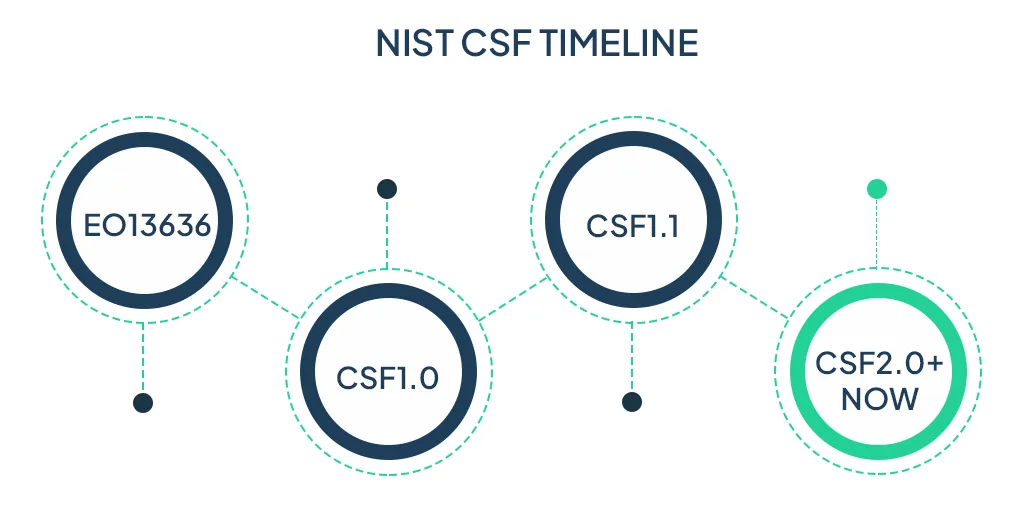
CSF 1.0 was designed primarily to help U.S. critical infrastructure sectors power grids, hospitals, and financial systems, structure their cybersecurity programs. It organized everything around five core functions: Identify, Protect, Detect, Respond, and Recover.
CSF 1.1 brought clarifications around identity management, authentication, and supply chain security, but kept the five-function structure intact. It also acknowledged that organizations beyond critical infrastructure were using the framework.
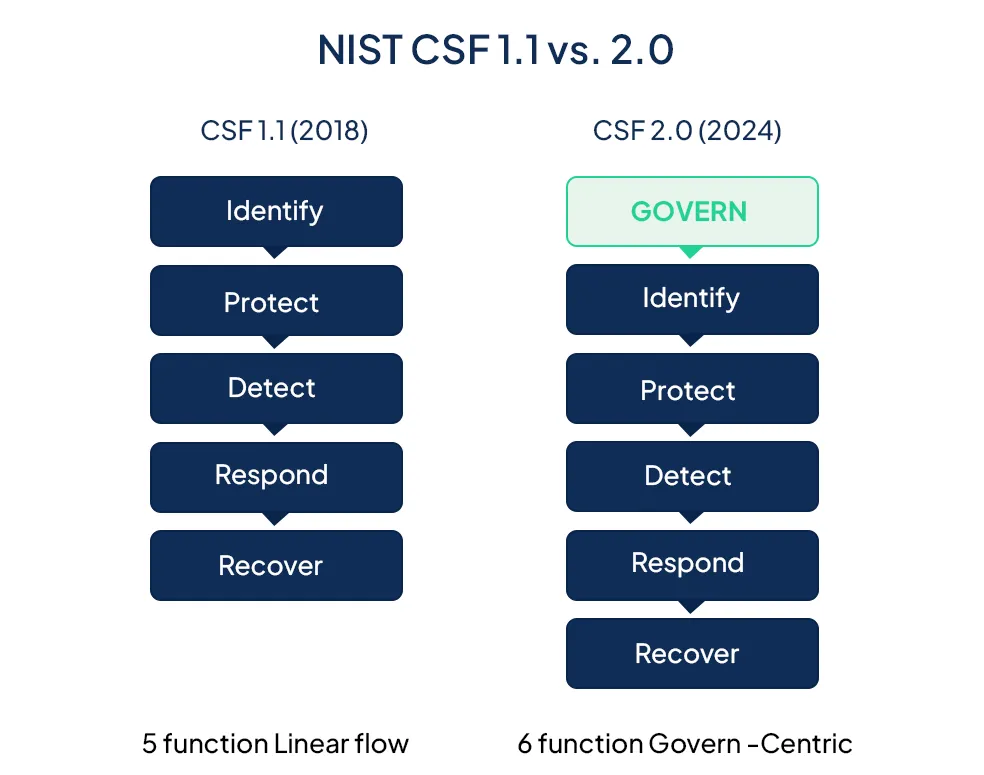
CSF 2.0 represents the most significant revision in the framework's history. It is not an incremental update; it is a rearchitected document that reflects a fundamental shift in how NIST believes organizations should approach cybersecurity risk, with governance now sitting at the very center of the model.
The Six Core Functions of NIST CSF 2.0
With the addition of Govern, CSF 2.0 now organizes all cybersecurity activities across six functions. Here is a concise breakdown of each and what changed:
Govern
Sets cybersecurity strategy, risk tolerance, policy, and accountability at the executive level. Covers organizational context, risk management strategy, roles & responsibilities, policy, oversight, and supply chain risk management. Sits at the center of all five functions.
Identify
Asset management, business environment, risk assessment, and risk strategy. Now includes an Improvement category for tracking progress across all CSF functions.
Protect
Access controls, data security, software development (DevSecOps), platform security, and technology infrastructure resilience. Secure software development moved here from Identify.
Detect
Continuous monitoring of assets, anomalies, and adverse events. Enhanced focus on detection effectiveness and timeliness of alert generation across cloud, hybrid, and on-prem environments.
Respond
Incident response planning, execution, communication, analysis, and mitigation. Revised to sharpen focus on practical, outcome-based response activities during an active incident.
Recover
Recovery planning, improvements based on post-incident lessons, and communication during recovery. Updated to emphasize business resilience and continuity rather than just technical restoration.
The 4 Key updates in NIST Cybersecurity Framework (CSF) 2.0
NIST's own documentation identifies four major areas of change. Here is each one unpacked in full.
1. The Govern Function - Cybersecurity Is Now a Board-Level Discipline
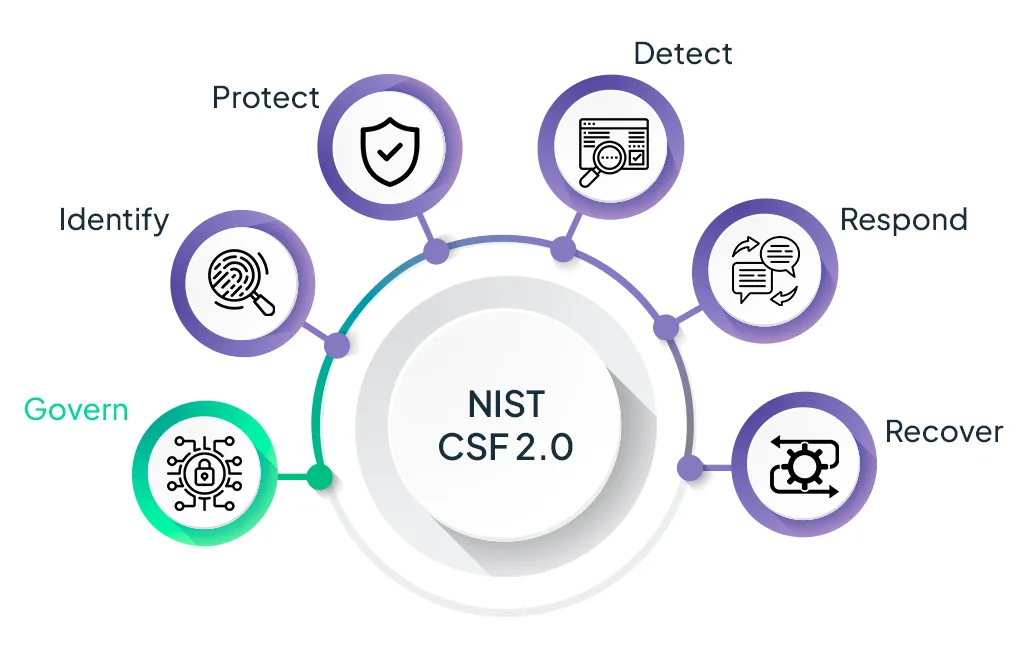
This is the headline change. CSF 2.0 introduces a sixth core function, govern that is architecturally different from the other five. While Identify, Protect, Detect, Respond, and Recover operate in a lifecycle sequence, Govern sits at the center, informing and enabling all of them simultaneously.
The Govern function covers six critical categories:
Organizational Context
Documenting the mission, stakeholder expectations, and legal/regulatory environment in which cybersecurity decisions are made.
Risk Management Strategy
Establishing executive priorities, risk tolerance, and constraints that shape how the security program operates.
Roles & Accountability
Defining who owns cybersecurity decisions, from the CISO through to technical implementers with explicit accountability at each level.
Policy
Establishing, communicating, and enforcing cybersecurity policies that reflect business objectives and risk strategy.
Oversight
Monitoring and reviewing the effectiveness of the cybersecurity program through metrics, audits, and continuous improvement cycles.
Supply Chain Risk Management
Identifying, assessing, and managing cybersecurity risks in the supply chain now elevated to a governance-level priority.
2. Expanded Scope CSF 2.0 Is Built for Every Organization
The original CyberSecurity Framework was titled "Framework for Improving Critical Infrastructure Cybersecurity." That name alone reflects its original design intent. While thousands of non-critical-infrastructure organizations adopted CSF 1.x anyway, the document language, examples, and framing were centered on sectors like power, water, and healthcare.
CSF 2.0 removes "critical infrastructure" from the framework name entirely. It is now simply the NIST Cybersecurity Framework (CSF) and its guidance is explicitly designed for:
- Small businesses with limited IT staff building their first security program
- Mid-market organizations navigating compliance requirements like HIPAA or PCI DSS
- Global enterprises aligning multiple regulatory obligations under a single framework
- Government agencies at federal, state, and local levels
- Educational institutions and nonprofits previously excluded from the critical infrastructure framing
- Practically, this means CSF 2.0 ships with audience-specific quick-start guides tailored for small businesses, enterprise risk managers, and supply chain security leads to content that did not exist in previous versions.
3. Strengthened Supply Chain Risk Management
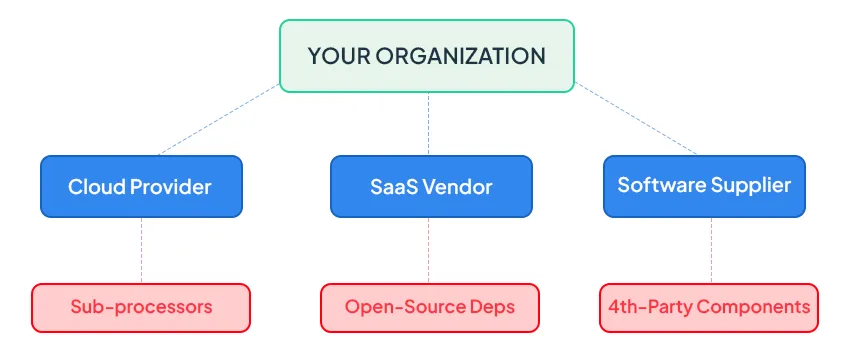
In CSF 1.1, supply chain risk management appeared as a subcategory within the Identify function. In CSF 2.0, it has been moved under Govern a structural decision that signals NIST's view that managing third-party risk is a governance-level obligation, not an operational detail.
The updated, guidance covers the full breadth of supply chain risk, including:
- Establishing and maintaining a supplier risk management program with defined criteria
- Requiring security requirements in contracts with vendors and service providers
- Monitoring suppliers' security posture continuously, not just at onboarding
- Tracking open-source dependencies and software component inventory
- Planning for supplier compromise scenarios and supply chain incident response
4. New Implementation Resources and Tooling
One of the most frequent criticisms of CSF 1.1 was the gap between the framework's strategic guidance and practical, day-to-day implementation. CSF 2.0 directly addresses this with a suite of supporting resources that did not exist previously:
Quick-Start Guides
Audience-specific entry points for small businesses, enterprise risk managers, and organizations focused on supply chain security.
CSF Profile Templates
Customizable templates to map your Current Profile (where you are) against your Target Profile (where you need to be), making gap analysis structured and repeatable.
Implementation Examples
Practical illustrations of what each CSF subcategory means in a real environment, reducing interpretation of ambiguity.
Searchable Reference Tool
An online NIST CSF 2.0 Reference Tool that allows cross-referencing against more than 50 other cybersecurity standards and frameworks.
Comparison between NIST CSF 1.1 and NIST CSF 2.0
For organizations implementing CSF 2.0 and CIS Controls simultaneously, our CIS Controls v8 guide explains how the 153 safeguards map directly to the CSF functions, reducing total implementation effort significantly.
How to Prepare Your Organization for NIST CSF 2.0: A 6-Step Roadmap
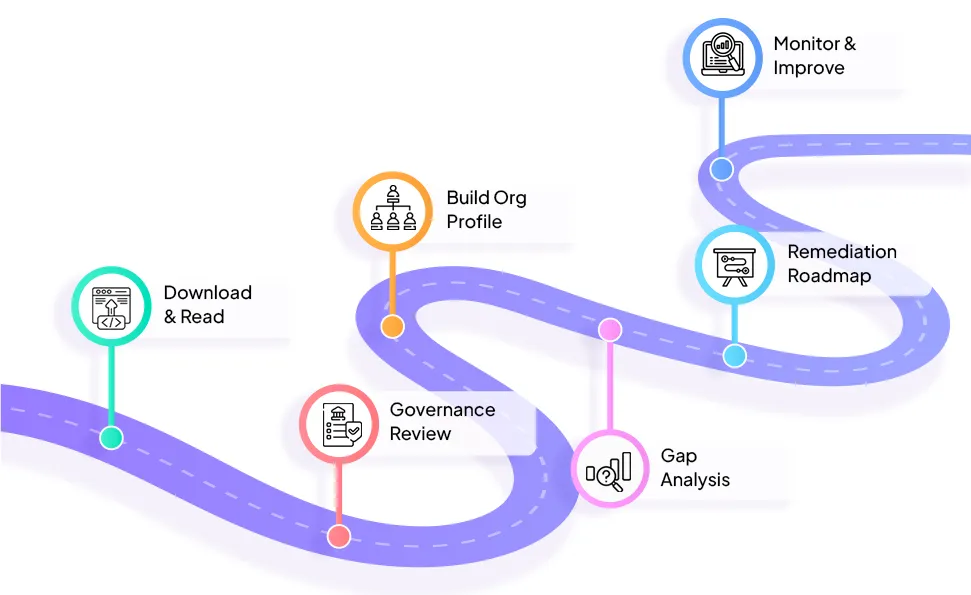
1. Download and Deeply Understand CSF 2.0
Before you run a gap, analysis or brief on your board, ensure your security leadership team has read the actual CSF 2.0 document, not just summaries. Pay particular attention to the new Govern function categories and the implementation of examples. Use the NIST CSF 2.0 Reference Tool to cross-reference against any existing frameworks your organization already uses.
2. Assess Your Governance Structures Against the Govern Function
The Govern function represents the most significant change, and for most organizations it will reveal the largest gaps. Map your current governance structures of risk management policies, CISO reporting lines, board-level cyber reporting, and RASCI matrices against the six Govern categories. Document what exists, what is informal, and what is missing entirely.
3. Create Your CSF 2.0 Organizational Profile
Use the NIST-provided CSF Profile Template to document your Current Profile (your present cybersecurity posture) and your Target Profile (where you need to be). The gap between them becomes your implementation roadmap. Be honest and specific, a vague profile produces a vague roadmap.
4. Conduct a Structured Gap Analysis Across All Six Functions
For each of the six functions, work through every category and subcategory, identifying which outcomes are currently achieved, which are partially addressed, and which are absent. This Security Controls Gap Analysis guide provides a practitioner-level methodology for this process that applies directly to CSF 2.0.
5. Build a Prioritized Remediation Roadmap
Not all gaps carry equal risk. Prioritize remediation based on your risk profile, regulatory obligations, and the CSF's own guidance on which outcomes deliver the highest defensive value. For organizations also implementing CIS Controls v8.1, align your roadmap to both frameworks simultaneously, the overlap is significant, and the dual-framework approach reduces total effort.
6. Establish Continuous Monitoring and Improvement Cycles
CSF 2.0 is not a one-time compliance exercise. The new Improvement category within the Identify function requires that you regularly review, measure, and update your cybersecurity program. Define KPIs for each CSF function, establish a review cadence (quarterly minimum), and create a feedback loop that connects threat intelligence findings to governance-level decisions.
How Loginsoft Accelerates Your NIST CSF 2.0 Readiness
Loginsoft has spent over six years engineering cybersecurity solutions for enterprises and security product companies. Our capabilities align with the six CSF 2.0 functions and the operational demands of a modern, governance-aligned security program.
Vulnerability Intelligence (IDENTIFY, GOVERN)
With 500+ CVEs discovered in open-source software, dedicated security research and SCAP/OVAL content development delivers the continuous vulnerability awareness and asset risk data that the Identify function demands, providing intelligence that directly feeds CSF Identify outcomes.
SIEM, SOAR & TIP Integration (DETECT, RESPOND)
With 250+ completed integrations across Splunk, Palo Alto, IBM Security, ThreatConnect, Elastic, and OpenCTI, purpose-built connectors, playbooks, and dashboards turn raw alerts into structured incident response workflows, operationalizing CSF's Detect and Respond functions at scale.
Cloud-Native Security (PROTECT, IDENTIFY)
CIS Benchmark-hardened container images, CSPM policy-as-code, and Cloud Workload Protection deliver CSF Protect outcomes across AWS, Azure, and GCP environments, with continuous compliance visibility across hybrid cloud estates built in from the start.
Software Supply Chain Security (GOVERN)
OSS Software Composition Analysis, Dependency Defense, and Zero-Day Discovery services directly address CSF 2.0's elevated supply chain risk requirements under the Govern function helping organizations understand and manage open-source and third-party component risk.
Continuous Security Monitoring (DETECT, RECOVER)
Real-time monitoring solutions combining threat intelligence feeds, automated alerting, and vulnerability analysis maintain the continuous visibility CSF 2.0 requires turning detection and recovery functions from aspirational to operational.
CIS Benchmark Content (PROTECT, GOVERN)
CIS Benchmark compliance content services operationalize configuration hardening aligned to CSF 2.0's Protect function, with SCAP/OVAL content for hundreds of platforms that directly support governance-level policy enforcement.
For organizations that have also explored the guide on Vulnerability Management Tools and Process, the connection to CSF 2.0's Identify and Govern functions is direct, as a mature vulnerability management program remains one of the highest-ROI investments any organization can make toward CSF readiness.
Conclusion:
NIST CSF 2.0 represents a significant evolution in cybersecurity, expanding the focus from technical controls to enterprise-wide governance, resilience, and risk management. Organizations that embrace the framework can strengthen security operations, improve third-party risk oversight, and better align with regulatory and compliance requirements. By combining strategic governance with continuous monitoring, cloud security, and operational execution, enterprises can build more resilient cybersecurity programs capable of adapting to today's rapidly evolving threat landscape.
FAQs
Q1. What is NIST CSF 2.0 and when was it released?
NIST CSF 2.0 is the second major version of the NIST Cybersecurity Framework, officially released on February 26, 2024, the first major update since version 1.1 in April 2018. It introduces a new sixth core function (Govern), expands scope to all organizations regardless of sector or size, strengthens supply chain risk guidance, and adds practical implementation resources including quick start guides and profile templates.
Q2. What is the new Govern function in NIST CSF 2.0?
The Govern function is CSF 2.0's sixth core function, and architecturally it sits at the center of the framework rather than one sequential step. It encompasses six categories: Organizational Context, Risk Management Strategy, Roles and Responsibilities and Accountability, Policy, Oversight, and Supply Chain Risk Management. Its primary purpose is to ensure that cybersecurity decisions are driven by executive strategy and enterprise risk management rather than operating in isolation within the IT or security team.
Q3. Is NIST CSF 2.0 mandatory or voluntary?
The NIST Cybersecurity Framework remains a voluntary standard for private sector organizations. However, it is increasingly referenced in regulatory requirements, government contract requirements, and cyber insurance assessments. For U.S. federal agencies, NIST guidance has mandatory elements through related publications. Practically speaking, even for organizations where it is technically voluntary, CSF 2.0 adoption is becoming a de facto expectation during security assessments, M&A due diligence, and enterprise risk reporting.
Q4. How does NIST CSF 2.0 relate to CIS Controls v8.1?
CIS Controls v8.1 includes official mappings to NIST CSF 2.0, including the new Govern function. The two frameworks complement each other: NIST CSF 2.0 provides the strategic framework and governance structure, while CIS Controls provide the specific, measurable safeguards that operationalize CSF outcomes. Organizations implementing both simultaneously can use a single implementation effort to satisfy both frameworks and generate compliance evidence for HIPAA, PCI DSS, SOC 2, ISO 27001, and CMMC at the same time.
Q5. What tools does NIST CSF 2.0 offer to assess current posture and define a path forward?
NIST CSF 2.0 offers two built-in mechanisms to help organizations assess where they stand and chart a clear path forward. CSF Tiers provide a maturity lens, ranging from Tier 1 where risk management is informal and reactive, to Tier 4 where it is adaptive, data-driven, and deeply embedded in organizational decision-making. CSF Profiles complement this by translating the framework into organization-specific outcomes, with a Current Profile mapping the existing cybersecurity posture and a Target Profile defining where the organization needs to be based on its risk tolerance and business priorities. The gap between the two profiles becomes an actionable roadmap that guides investment, effort, and improvement over time.
Q6. Does NIST CSF 2.0 address cloud security organisational-specific
The explicit drivers for the CSF 2.0 update were the need to address modern operating environments that did not exist when the original framework was designed. CSF 2.0 provides updated guidance on managing cybersecurity risks in cloud environments, hybrid infrastructure, and remote work settings. It also acknowledges emerging risks from artificial intelligence and the supply chain dependencies that come with AI tooling and SaaS platforms. NIST continues to develop AI-specific guidance (through the NIST AI RMF) that is designed to complement CSF 2.0.
Q7. How can Loginsoft help with NIST CSF 2.0 readiness?
End-to-end services operationalize all six NIST CSF 2.0 functions across the enterprise, with vulnerability intelligence and SCAP/OVAL-based configuration management addressing Identify and Protect, while 250+ SIEM, SOAR, and TIP integrations cover Detect and Respond. CIS Benchmark-hardened container images, CSPM, and software supply chain security services including SCA handle Protect and Govern, and continuous security monitoring delivers persistent cross-environment visibility across Detect and Recover. For organizations at any maturity level, Loginsoft conducts CSF 2.0 gap assessments and delivers prioritized remediation roadmaps that turn framework alignment into an actionable, measurable program.
Table of Contents

Week of Unexpired Threats: How Ten-Year-Old Flaws and Fresh Zero-Days Fueled New Attacks
Week of Unexpired Threats: How Ten-Year-Old Flaws and Fresh Zero-Days Fueled New Attacks
Explore the key security, speed, and performance differences between TLS 1.3 and TLS 1.2
Ready to Find and Fix Your Security Weak Points?
LoginSoft's cybersecurity experts help organizations conduct thorough gap analyses, build prioritized remediation roadmaps, and achieve measurable security maturity improvements.
Schedule a Security Assessment
Hari Charan
Director of Security Research & Threat Intelligence
A MESSAGE FROM OUR TECHNOLOGY LEADER
The NVD enrichment cutback is not a surprise to us - it’s the inflection point we’ve been preparing for. At Loginsoft, we’ve spent years building the research depth and tooling infrastructure to independently enrich vulnerabilities at scale, with the accuracy and context modern security programs require. LOVI is our answer. Our mission is simple: ensure that no CVE relevant to your environment goes unanalyzed, unscored, or unactioned - regardless of what remains in NIST’s queue.
Key Takeaways
- Standard audit tools do not detect intentionally malicious packages. Tools like npm audit and pip-audit focus on known vulnerabilities, not malware behavior. A newly published malicious package with no CVE or advisory can pass these checks undetected.
- The attack surface is trust, not just code. Typosquatting, dependency confusion, and malicious updates exploit package-manager resolution and implicit trust. Developers and CI pipelines may install packages without verifying their provenance or behavior.
- Registry controls are only one layer of defense. Registry scanning, malware detection, and maintainer 2FA reduce risk, but attackers exploit gaps between these controls. Effective protection combines behavioral analysis, dependency pinning, SBOM governance, and build-environment isolation.
Stay Ahead
Get the Latest Cybersecurity Insights
Security research, threat intelligence, vulnerability updates, product news, and expert insights, delivered directly to your inbox. Stay informed. Stay secure.

BLOGS AND RESOURCES
Latest Articles

By using this website, you agree to the storing of cookies on your device to enhance site navigation, analyze site usage, and assist in our marketing efforts. View our Privacy Policy for more information.
Accept




© Copyright 2026, All Rights Reserved by Loginsoft
Privacy policy