
- A forged cookie replaces the whole login. CVE-2026-0257 lets an unauthenticated attacker open a GlobalProtect VPN session without credentials, so MFA is skipped by design, not defeated.
- Patching is step one, not the finish line. Sessions opened before the fix can stay alive, and Qilin and INC went on to vCenter, domain controller disks and Veeam backups.
- The "medium" label was wrong. The advisory launched at CVSS 4.7 and was raised to 7.8 only after exploitation was proven. Rank edge flaws by exploitation evidence, not the first score.
Your MFA rollout was fine. Your VPN gateway simply never asked for it.
Two ransomware groups, Qilin and INC, have been walking into enterprise networks through Palo Alto GlobalProtect since June, and CVE-2026-0257 is the door. The flaw is a forged-cookie authentication bypass. The attacker presents a cookie the firewall trusts, the firewall opens a VPN session, and the second factor never enters the conversation. Palo Alto shipped the patch on May 13. Attribution to Qilin and INC only landed in Unit 42's October 19 update, five months later.
If you run GlobalProtect, the useful question is no longer "are we patched?" It is "did someone get in before we were?" This post walks through how the bug works, what Qilin and INC did once inside, and what enterprise security teams and CISOs should verify this week
What Is CVE-2026-0257? The Palo Alto GlobalProtect Vulnerability Explained
CVE-2026-0257 is an authentication bypass in the GlobalProtect portal and gateway of Palo Alto Networks PAN-OS and certain Prisma Access releases. The weakness class is reliance on cookies without validation and integrity checking (CWE-565). In plain terms, the gateway decrypts a cookie and believes what is inside.
Why a forged cookie skips MFA
GlobalProtect has a feature called authentication override. After a user logs in once, the portal or gateway issues a cookie that works like a bearer token, so the user does not have to re-authenticate on every connection. Rapid7's analysis shows the override cookie is RSA-encrypted, and the gateway decrypts it with its private key and trusts the contents without verifying a signature.
Here is the trap. If the certificate used for cookie encryption is the same certificate that secures the portal or gateway HTTPS service, its public key is visible to anyone who opens a TLS connection. An attacker takes that public key, forges a cookie for any user, and the gateway accepts it. Rapid7 built a working proof of concept that tests each certificate in the HTTPS chain and forges a cookie in seconds.
Exploitation needs three conditions together: GlobalProtect portal or gateway enabled, authentication override cookies enabled (not a default setting), and the cookie certificate reused with another feature. That is why the bug looked narrow on paper and still hit so many real networks. Reusing one certificate everywhere is a common shortcut.
The MFA point deserves precision. The attacker is not cracking or phishing a second factor. The cookie stands in for the entire authentication step, so the prompt never fires. A VPN gateway is where MFA is enforced for remote access, which means a bypass here removes the second factor for every account behind it.
Affected products and fixed builds
PAN-OS 10.2, 11.1, 11.2 and 12.1 are affected before the builds below, along with certain Prisma Access releases. Cloud NGFW and Panorama are not affected. Confirm against the Palo Alto Networks advisory before you schedule changes.
The severity score that aged badly
Palo Alto published the advisory on May 13 with a CVSS v4 score of 4.7, medium. After proof-of-concept code appeared and exploitation was confirmed, the vendor raised it to 7.8 on May 29. A CVSS 3.1 vector reported by the Cloud Security Alliance puts it at 9.1. One flaw, three numbers, and the lowest one is the one many patch queues were sorted by.
Timeline: From Patch to Ransomware in Five Months
The sequence matters because it shows how little time defenders had. Exploitation started four days after the patch, and the ransomware intrusions followed within weeks.
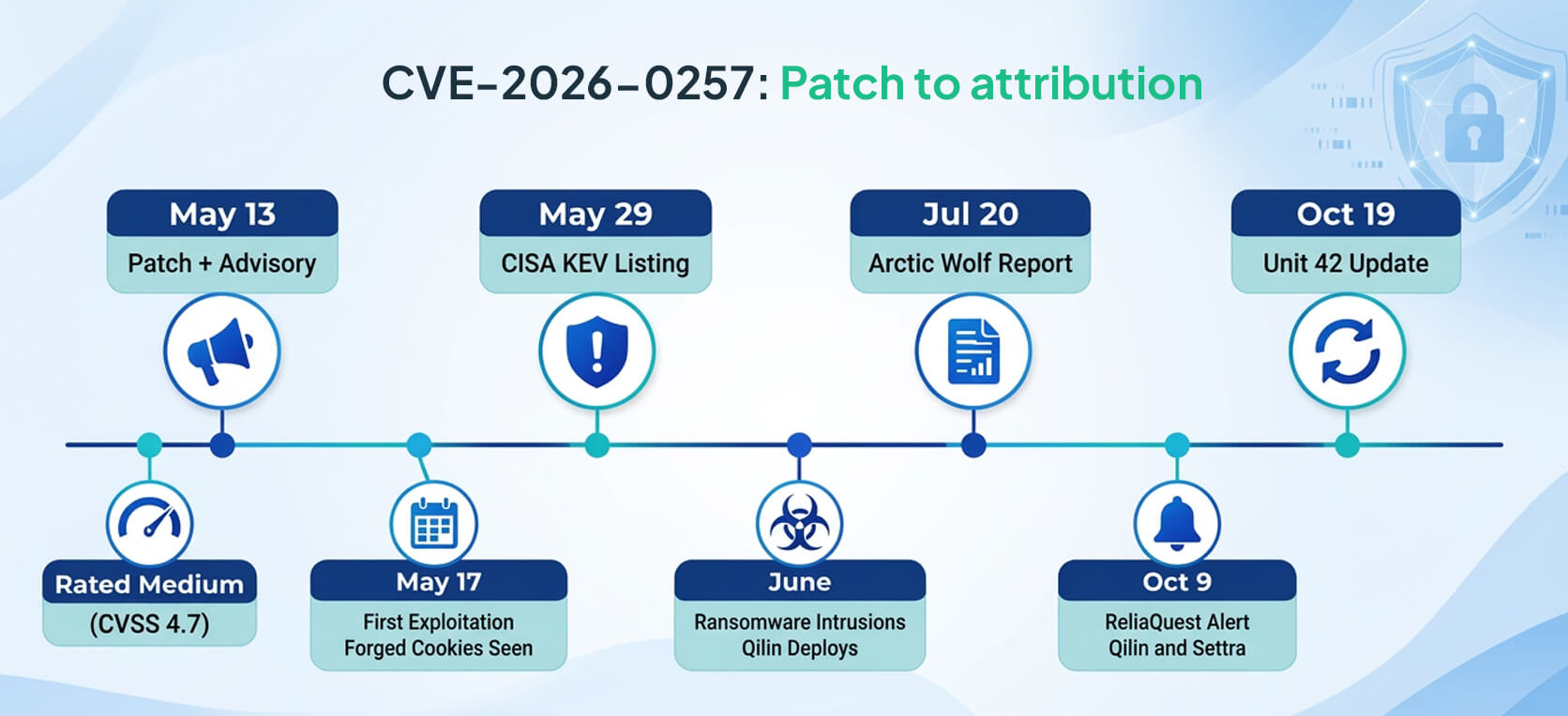
Rapid7 observed the first wave from Vultr-hosted infrastructure on May 17, targeting the local administrator account. A second wave from a different hosting provider followed on May 21, this time with VPN IP assignment, meaning the attacker had a route into the internal network. Palo Alto's own June 5 brief described an unidentified actor, with only a small share of probed devices establishing sessions. Arctic Wolf, for its part, investigated Qilin encryptions that began with this flaw during June.
Qilin and INC: Who Is Behind the Intrusions
Qilin ransomware
Qilin, which started as Agenda in 2022, is a ransomware-as-a-service operation with Go and Rust encryptors that run on Windows, Linux and VMware ESXi. ZeroFox counted at least 557 incidents between January and May 2026 and called it the most active group globally since Q2 2025. Comparitech noted that a rival, The Gentlemen, briefly passed Qilin in June 2026, but the affiliate engine keeps running.
The firewall pivot is not new for Qilin. A Qilin affiliate was also linked, with medium confidence, to Check Point's VPN authentication bypass CVE-2026-50751, exploited from May 7. Different vendor, same idea: find the trusted remote-access service and skip the login.
INC ransomware
INC Ransom, tracked by Unit 42 as Tarnished Scorpius and elsewhere as GOLD IONIC, emerged in mid-2023 and runs a similar affiliate model. Emsisoft puts it at more than 800 victims since 2023, with nearly 250 in the first half of 2026. Australian government guidance notes that INC affiliates rely on compromised credentials or public-facing vulnerabilities for initial access, and healthcare has been among its most frequent targets.
Unit 42 lists victims across 11 sectors for this campaign: education, financial services, healthcare, high technology, hospitality, manufacturing, professional and legal services, government, transportation and logistics, utilities and energy, and wholesale and retail. A third name, Settra, appears in ReliaQuest's reporting. Palo Alto's own material does not independently confirm it, so treat it as public reporting.
Inside the Attack Chain: From VPN Session to Domain-Wide Encryption
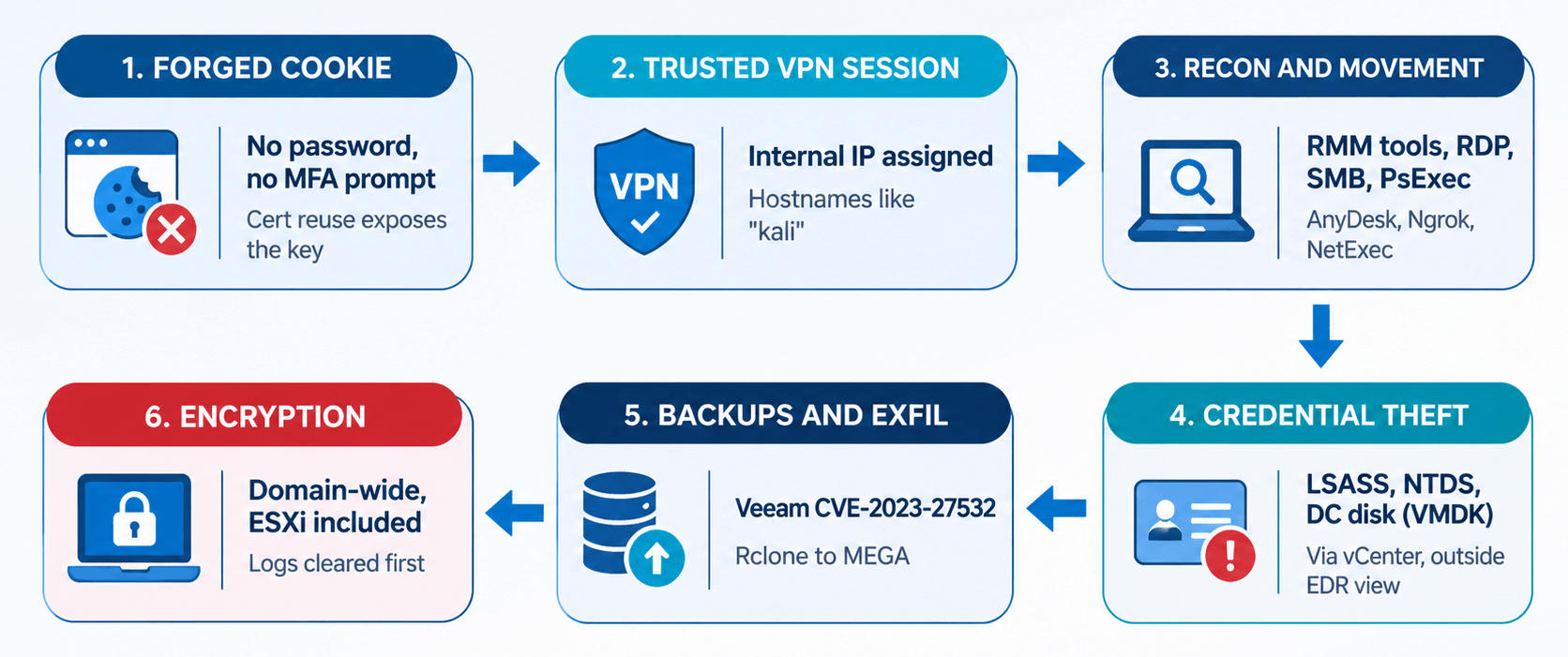
Qilin's June playbook, per Arctic Wolf
Arctic Wolf investigated multiple distinct June 2026 intrusions that all began with CVE-2026-0257 and ended in Qilin encryption. The pattern was consistent enough to hunt for:
- Access: VPN sessions from machines self-identifying as "kali", with overlapping source IPs across intrusions that suggest shared tooling.
- Persistence: AnyDesk, Ngrok, LogMeIn and a MeshAgent scheduled task, often staged under C:\PerfLogs\.
- Credentials: an LSASS dump through rundll32.exe comsvcs.dll, MiniDump written to a file with an .odt extension to dodge .dmp alerts, plus ntdsutil Install From Media to pull the Active Directory database.
- Movement: SoftPerfect Network Scanner, NetExec, then PsExec over the C$ admin share, with RDP as a fallback toward domain controllers, backup servers and file servers.
- Evasion: enterprise-wide event log clearing and, in some cases, Defender real-time protection disabled.
- Exfiltration and impact: Rclone to MEGA, ProtonDrive and FileZilla, Veeam targeted before encryption, then a password-gated win.exe run with --no-admin. Some intrusions skipped exfiltration and went straight to encryption.
The virtualization pivot: vCenter, ESXi and offline credential theft
Unit 42's October update adds the part that should change how CISOs think about tier-0 assets. In one case, the attackers moved from the compromised VPN gateway to the vCenter appliance, disabled the execInstalledOnly control on ESXi hosts, and ran a custom tool against a domain controller's virtual disk (VMDK) to extract credentials offline.
Working on the disk file directly sidesteps any EDR agent running inside the guest operating system. Your domain controller can be fully monitored and still be read from underneath. This is why hypervisor management belongs in the same protection tier as Active Directory itself. One caveat from Truesec's research: execInstalledOnly is a useful speed bump, not a guarantee, because an attacker with enough access can switch it off, exactly as seen here.
Chaining Veeam CVE-2023-27532 to reach the backups
Unit 42 also reports these actors combining their VPN access with exploit tooling for Veeam Backup & Replication CVE-2023-27532. This is the second CVE in the story, and it is a useful reminder about age. It is a missing-authentication flaw (CWE-306, CVSS 7.5) that exposes the encrypted credentials stored in the Veeam configuration database. Veeam fixed it in March 2023, CISA added it to the KEV catalog in August 2023 with known ransomware use, and the fixed builds are 12.0.0.1420 P20230223 and 11.0.1.1261 P20230227.
A three-and-a-half-year-old, patched, KEV-listed bug is still doing work in 2026. Attackers do not retire a CVE because the calendar says it is old. They retire it when it stops working.
Why VPN Authentication Bypass Keeps Winning for Ransomware Groups
This is not a one-vendor problem. Qilin affiliates have used edge-device flaws across several vendors, and the logic is simple. A VPN or firewall is internet-facing by design, it sits outside most endpoint telemetry, and a successful login looks like an employee working remotely. ReliaQuest described the flaw as a reliable way into networks for ransomware groups and assessed that exploitation is highly likely to continue over the next three months, which carries into January.
The exposed surface is large. Shadowserver data cited in BleepingComputer's coverage counted more than 167,000 internet-reachable GlobalProtect instances. Not all are vulnerable, since the bug needs a specific configuration, but nobody outside the organization can tell which ones are.
What Enterprise Security Teams Should Do Now: Patch, Hunt, Contain
Step 1: Close the door
- Upgrade to a fixed PAN-OS or Prisma Access build from the table above.
- Disable the authentication override options (generate and accept cookie) on the portal and gateway if you do not need them.
- If you keep them, use a dedicated certificate used only for override cookies. Never reuse the portal or gateway HTTPS certificate.
- Check whether GlobalProtect is mapped to management interfaces. Unit 42 flags ports 4443 and 3879 as exposure points, and says to restrict them with Interface Management profiles.
Step 2: Throw out anyone already inside
- Terminate all active GlobalProtect sessions after patching. ReliaQuest warns that patching alone may not remove access established before remediation.
- Hunt GlobalProtect authentication logs for these indicators:
A hostname like "kali" is a strong lead but not proof on its own. Treat any match as a reason to open an incident, then confirm.
Step 3: Hunt inside the network
- Alert on rundll32 comsvcs.dll MiniDump, ntdsutil IFM arguments, unsanctioned PSEXESVC.exe, and remote writes to C$ from workstations.
- Block or alert on AnyDesk, Ngrok, LogMeIn, MEGA and Rclone unless the business owns them.
- Watch Event ID 1102 and security tool disablement, and forward logs to a SIEM in real time so clearing the local log does not erase the evidence.
- If exploitation is suspected, rotate domain admin passwords, service accounts and cloud storage credentials, and reset KRBTGT twice.
Step 4: Harden what sits beneath AD and the backups
- Treat vCenter and ESXi as tier-0. Use MFA for vCenter, local SSO groups rather than Active Directory groups for authorization, and restrict ESXi admin rights on hosts that run domain controller VMs.
- Enable and monitor execInstalledOnly, and alert when it is disabled.
- Patch Veeam to the fixed builds, and keep the backup repository off Active Directory with dedicated local accounts.
What This Means for CISOs
Four questions are worth taking to your next risk review. Which of our VPN and firewall appliances use cookie or token features we never audited? Does our patch process rank edge flaws by first-published score, or by exploitation evidence? If a gateway handed an attacker a trusted session tomorrow, what would we see, and who would see it? And are our hypervisor management plane and backup servers protected like the domain controllers they can read?
The honest answer to the third question is usually "less than we would like." That is the gap this campaign lived in.
At Loginsoft, we have spent over six years focused on cybersecurity, backed by roughly 18 years of IT engineering, and have analyzed more than 20,000 CVEs. Our LOVI platform enriches both CVEs in this story, CVE-2026-0257 and CVE-2023-27532, with patch timelines and exploitation evidence, and correlates them with EPSS, CISA KEV, ATT&CK techniques and threat actor attribution. That is what lets a team see, in one place, that a "medium" firewall flaw and a 2023 backup bug belong on the same urgent list.
Conclusion
CVE-2026-0257 is a small configuration condition with an outsized blast radius. It gave Qilin and INC a trusted session, skipped MFA, and put them one step from vCenter, domain controller disks and backups. The fix exists. The hard part is proving that nobody used the door before you locked it. Patch, kill sessions, hunt, rotate where needed, and move the hypervisor and backup layers up your protection tiers.
FAQs
Q1. What is CVE-2026-0257?
CVE-2026-0257 is an authentication bypass in the GlobalProtect portal and gateway of Palo Alto Networks PAN-OS and certain Prisma Access releases. When authentication override cookies are enabled and the cookie certificate is reused elsewhere, an unauthenticated attacker can forge a cookie and open a VPN session. Palo Alto patched it on May 13, 2026.
Q2. Does CVE-2026-0257 bypass MFA?
Yes, in practice. The forged authentication override cookie replaces the whole login, so the gateway never prompts for the second factor. Unit 42 reports that Qilin and INC operators used the flaw to bypass MFA and establish VPN sessions.
Q3. Which PAN-OS versions are affected by CVE-2026-0257?
PAN-OS 10.2, 11.1, 11.2 and 12.1 builds older than the fixed releases are affected, along with certain Prisma Access releases. Cloud NGFW and Panorama are not affected. Check the Palo Alto Networks advisory for the exact fixed build on your branch.
Q4. Are Qilin and INC really exploiting this flaw?
Yes. Arctic Wolf traced multiple June 2026 Qilin intrusions to CVE-2026-0257, and Unit 42 updated its threat brief on October 19, 2026 to name Qilin (Spikey Scorpius) and INC (Tarnished Scorpius). ReliaQuest also reports Settra ransomware activity.
Q5. How do I know if my GlobalProtect gateway was compromised?
Search GlobalProtect authentication logs for successful cookie-based logins to the local admin account, the spoofed MAC address aa:bb:cc:dd:ee:ff, and hostnames such as GP-CLIENT, DESKTOP-GP01, WINDOWS-LAPTOP-001 and kali. Also look for POST requests to /ssl-vpn/login.esp carrying the portal-userauthcookie field.
Q6. Is patching enough to stop these ransomware attacks?
No. ReliaQuest warns that patching alone may not remove access established before remediation. After upgrading, terminate all active GlobalProtect sessions, hunt for prior access, and rotate credentials if exploitation is suspected.
Q7. Who are the Qilin and INC ransomware groups?
Qilin, formerly Agenda, is a ransomware-as-a-service operation active since 2022 and the most prolific group by victim count since Q2 2025. INC Ransom is a ransomware-as-a-service operation that emerged in mid-2023, tracked as Tarnished Scorpius or GOLD IONIC. Both use affiliates and double extortion.
Table of Contents

From Zero-Days to Forgotten Patches: TSGA Backdoor, C3RB3R Ransomware and Exploits Within Hours
From Zero-Days to Forgotten Patches: TSGA Backdoor, C3RB3R Ransomware and Exploits Within Hours
Explore the key security, speed, and performance differences between TLS 1.3 and TLS 1.2
Ready to Find and Fix Your Security Weak Points?
LoginSoft's cybersecurity experts help organizations conduct thorough gap analyses, build prioritized remediation roadmaps, and achieve measurable security maturity improvements.
Schedule a Security Assessment
Hari Charan
Director of Security Research & Threat Intelligence
A MESSAGE FROM OUR TECHNOLOGY LEADER
The NVD enrichment cutback is not a surprise to us - it’s the inflection point we’ve been preparing for. At Loginsoft, we’ve spent years building the research depth and tooling infrastructure to independently enrich vulnerabilities at scale, with the accuracy and context modern security programs require. LOVI is our answer. Our mission is simple: ensure that no CVE relevant to your environment goes unanalyzed, unscored, or unactioned - regardless of what remains in NIST’s queue.
Key Takeaways
- Standard audit tools do not detect intentionally malicious packages. Tools like npm audit and pip-audit focus on known vulnerabilities, not malware behavior. A newly published malicious package with no CVE or advisory can pass these checks undetected.
- The attack surface is trust, not just code. Typosquatting, dependency confusion, and malicious updates exploit package-manager resolution and implicit trust. Developers and CI pipelines may install packages without verifying their provenance or behavior.
- Registry controls are only one layer of defense. Registry scanning, malware detection, and maintainer 2FA reduce risk, but attackers exploit gaps between these controls. Effective protection combines behavioral analysis, dependency pinning, SBOM governance, and build-environment isolation.
Stay Ahead
Get the Latest Cybersecurity Insights
Security research, threat intelligence, vulnerability updates, product news, and expert insights, delivered directly to your inbox. Stay informed. Stay secure.

BLOGS AND RESOURCES
Latest Articles
By using this website, you agree to the storing of cookies on your device to enhance site navigation, analyze site usage, and assist in our marketing efforts. View our Privacy Policy for more information.
Accept




© Copyright 2026, All Rights Reserved by Loginsoft
Privacy policy