
- Production AI is not a model plus an API. It is nine engineering layers - data/retrieval, model, orchestration, guardrails, evaluation, observability, integration, human escalation, and cost - each with its own design requirements, failure modes and operational owner.
- Security and governance are architecture decisions, not compliance tasks. Prompt injection, data exfiltration and tool misuse are attack classes unique to AI systems. A production threat model, least-privilege access design and immutable audit trail must be designed in from Layer 1, not bolted on after go-live.
- Evaluating non-deterministic output requires a fundamentally different methodology. You cannot regression-test a language model the way you regression-test a function. Production AI evaluation compares statistical distributions, not exact outputs, and requires an evaluation harness that runs in CI/CD before every deployment.
Every article about moving AI to production tells you to "think about more than the model." Almost none of them tell you what, specifically, that means.
This article does. Below is the complete nine-layer reference architecture that separates a production AI system from a proof of concept. Every layer exists in a mature enterprise deployment. None of them exist in a typical POC. Understanding all nine - and the failure mode each prevents - is the starting point for any honest production timeline.
Loginsoft's AI engineering practice builds all nine layers as an integrated system. This article is the reference architecture behind that work.
The Complete Production AI Stack
None of the leading articles on this topic publishes a production reference architecture. Every layer below exists in a mature deployment. None of them exists in a typical POC.
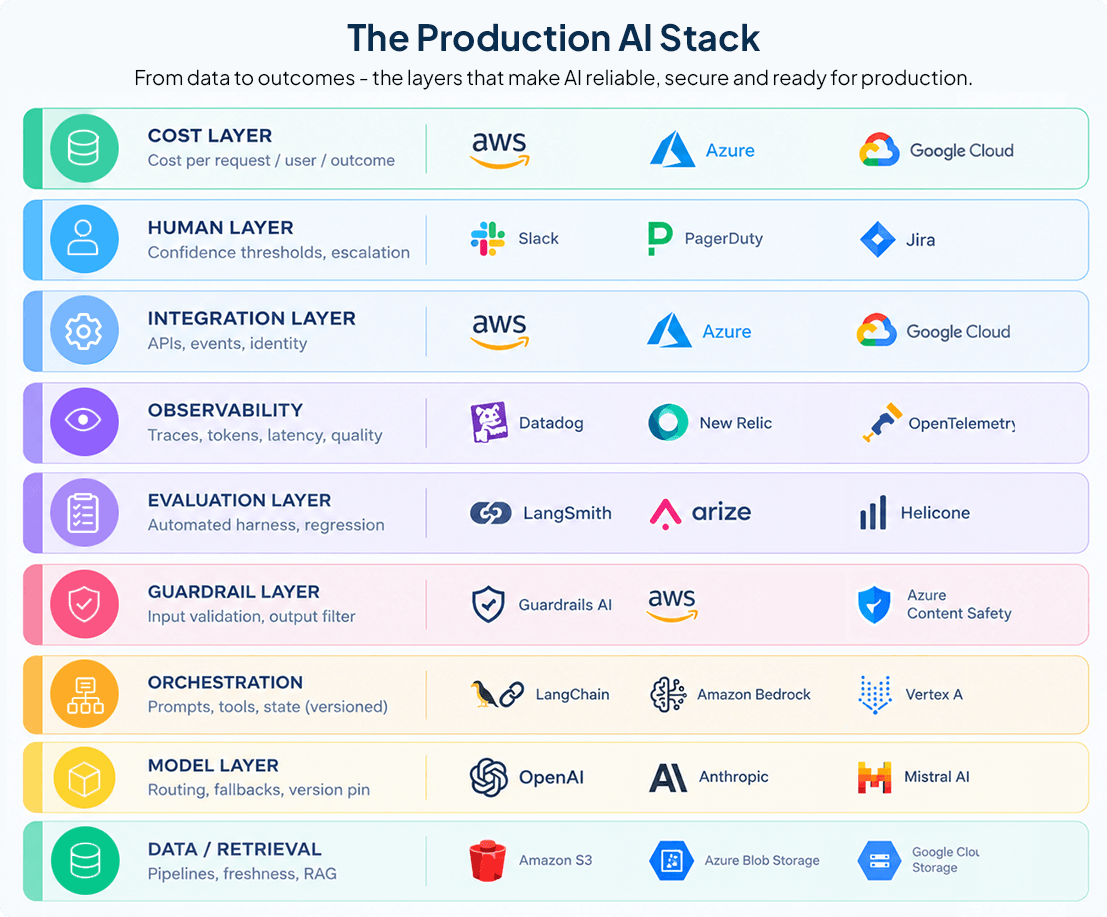
Layers 1-4: The Foundation No POC Builds
Layer 1: Data and Retrieval
A RAG pipeline is not a vector database. It is a managed process that keeps documents current, chunks them appropriately, maintains metadata for filtering and attribution, and has an observable failure mode when upstream data sources change. Production pipelines have SLAs for data freshness and test coverage for retrieval quality. POCs use static snapshots.
Layer 2: Model
Production systems rarely use a single model for all requests. A routing layer directs queries based on complexity, latency budget and cost - simple classification to a smaller model, complex reasoning to a larger one. Version pinning ensures a provider model update does not silently change output behaviour. A model registry tracks which version is deployed in which environment.
Layer 3: Orchestration
The prompt engineering that made your POC work is not documented anywhere. In production, prompts are versioned artefacts in a prompt registry, with change history, deployment tracking and rollback capability. If a prompt changes and output quality drops, you need to know which prompt changed, when, and by whom.
Layer 4: Guardrails
A guardrail layer intercepts inputs before they reach the model and outputs before they reach the user. Input validation catches prompt injection attempts, off-topic queries and policy violations. Output filtering catches hallucinations, toxic content and outputs that would violate regulatory obligations. Policy enforcement applies business rules the model should not be making decisions about.
Layers 5–9: Evaluation, Observability and Operational Control
Layer 5: Evaluation
You cannot regression-test a language model the way you regression-test a function. An evaluation harness runs a defined set of test cases against the current system state, scores outputs against human-labelled references or a judge model, and tracks quality signals over time. The harness runs in CI/CD before every deployment. Loginsoft's breakdown of the seven dimensions of production AI quality explains how to weight each quality signal for your use case.
Layer 6: Observability
Every production request should produce a trace: the prompt sent, the model used, the tokens consumed, the latency at each layer, the output produced, and whether a guardrail fired. Aggregated across requests, this data shows where cost is accumulating, where latency is degrading, and where quality is trending downward before a user notices.
Layer 7: Integration
The integration layer connects the AI system to the enterprise: authentication (who is this user?), authorisation (what can the system do on their behalf?), event handling, and the rate limits, timeouts and error handling that make the system behave predictably when dependencies are unavailable. Most enterprise systems were not designed with AI agents as a principal. Retrofitting identity support is non-trivial.
Layer 8: Human Escalation
Every AI system in production needs an explicit answer to: what happens when the model is not confident enough to act? The answer is a confidence threshold below which the request escalates to a human, routes to a fallback model, or returns an explicit "I don't know." Escalation paths are first-class features. The McDonald's drive-thru case is what happens when this layer is absent.
Layer 9: Cost
Cost per request is the product of token volume, model tier and retrieval cost. Cost per outcome divides that by the completion rate of the task the system is performing. If your cost per outcome exceeds the value the outcome generates, no amount of technical sophistication makes the system viable. These numbers must be visible to the team that owns the system - not just the finance team.
Security, Governance and Compliance Are Architecture, Not Paperwork
The controls in this section are not compliance checkboxes. They are architecture decisions that determine whether your AI system can be trusted at enterprise scale.
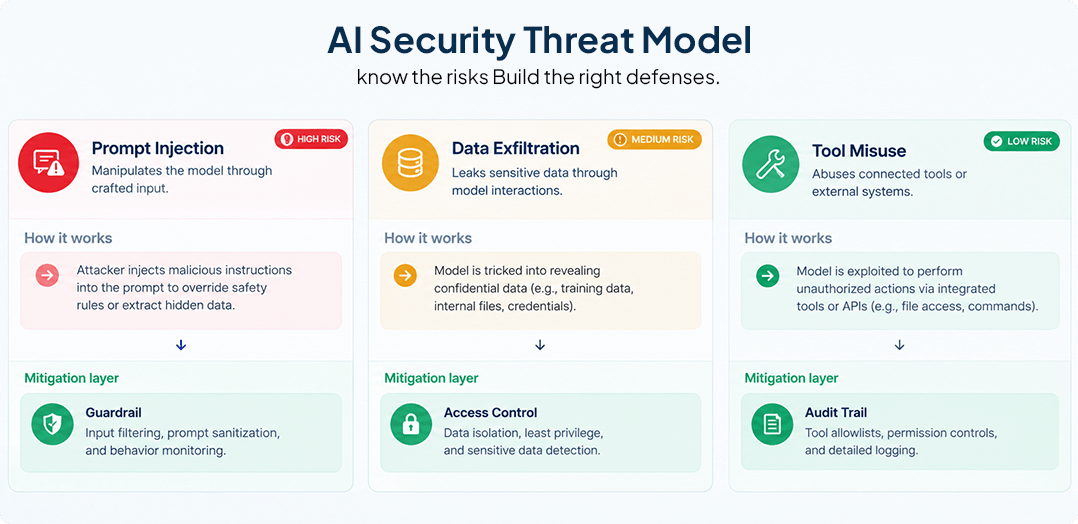
Threat model: prompt injection, data exfiltration, tool misuse
A production AI system has an attack surface traditional applications do not. Prompt injection attempts to override the system's instructions. Data exfiltration through the context window is a documented attack class. Tool misuse - where an agent is manipulated into taking an unintended action - is the most consequential failure mode for agentic systems. Whether an AI agent should ever hold admin access is a design decision with direct security implications. OWASP's Top 10 for LLM Applications is the standard starting point for AI-specific threat modelling.
Least-privilege access for non-human actors
An AI agent should have the minimum permissions required to complete its defined task. It should not have write access where read access is sufficient. It should not be able to execute actions a human reviewer cannot inspect and reverse.
Audit trails and regulatory mapping
When your AI system produces an output that causes a downstream consequence, you must be able to reconstruct the exact inputs, context and configuration state that produced it. The trace must be captured at the point of action, stored immutably, and queryable by governance stakeholders. High-risk AI systems under the EU AI Act require conformity assessments and human oversight mechanisms. The NIST AI Risk Management Framework provides an operationalisable structure for the same requirements in the US context.
Evaluating and Monitoring a Non-Deterministic System
Building an evaluation set that resembles production, not the demo
A production-grade evaluation set is constructed from a representative sample of actual production inputs - including edge cases, adversarial inputs and out-of-distribution queries - drawn after the model was built by a reviewer who was not involved in building it. The goal is to break the system, not validate it.
The four quality signals that matter
- Semantic similarity to a reference set - does the output say the same thing as a correct answer?
- Factual consistency - does the output contradict information in its own context window?
- Judge model scoring - does a separate, purpose-built model rate this output as acceptable?
- Downstream metric correlation - does a higher model quality score predict higher task completion in production?
Monitoring drift after go-live
Input drift occurs when the distribution of inputs shifts from what the system was designed for. Prediction drift occurs when model outputs shift without a corresponding input change - often signalling a provider-side model update. Performance drift occurs when downstream business metrics degrade: completion rates drop, escalation rates increase. All three should have defined thresholds and named owners before go-live.
The release gate
The release gate conditions - quality score threshold, latency SLA, security review sign-off, model card completion, human-escalation path test and rollback procedure - should be specified before the Harden phase begins, not at the end of it. Loginsoft's AI model release gate framework documents how to structure that decision and who owns each criterion.
FAQs
Q1. Should we use open-source or closed-source models in production?
Both are viable with different risk profiles. Closed-source APIs (OpenAI, Anthropic, Google) offer lower operational overhead but introduce provider dependency and cost exposure. Open-source models (Llama, Mistral, Qwen) offer deployment control and cost predictability but require you to own the infrastructure, updates and safety evaluation. The decision should be driven by data residency requirements, latency SLA, cost model and your team's ability to operate model infrastructure.
Q2. What is the difference between MLOps and LLMOps?
MLOps covers the full lifecycle of machine learning models: data pipelines, training, evaluation, deployment, monitoring and retraining. LLMOps is the subset adapted for large language models - where output is non-deterministic, evaluation has no ground truth, prompts are versioned artefacts, inference cost is token-level, and failure modes include prompt injection and hallucination. If your production system is an LLM or LLM-backed agent, LLMOps practices are not optional additions to MLOps. They are the operating model.
Q3. How do we handle model updates from providers without breaking production?
Pin the model version in your deployment configuration so updates are opt-in, not automatic. Run your evaluation harness against any new version before routing production traffic to it. Treat a provider model update as a deployment event that requires passing the same quality gate as any internal change. Teams without version pinning discover provider updates through degraded user experience, not through monitoring.
Q4. How do you safely test an AI agent before giving it production access?
Shadow mode: the agent processes real inputs and produces outputs, but those outputs are logged rather than acted upon. Compare shadow outputs against the existing process for a defined period - typically two to four weeks. Only after shadow-mode quality metrics meet the release gate threshold should the agent be permitted to take real actions, and initially only on a canary population with full observability and a tested rollback path.
Table of Contents

Final Week of September: CISA KEV Grew as Emergency Warnings Dropped Before Advisories
Final Week of September: CISA KEV Grew as Emergency Warnings Dropped Before Advisories
Explore the key security, speed, and performance differences between TLS 1.3 and TLS 1.2
Ready to Find and Fix Your Security Weak Points?
LoginSoft's cybersecurity experts help organizations conduct thorough gap analyses, build prioritized remediation roadmaps, and achieve measurable security maturity improvements.
Schedule a Security Assessment
Hari Charan
Director of Security Research & Threat Intelligence
A MESSAGE FROM OUR TECHNOLOGY LEADER
The NVD enrichment cutback is not a surprise to us - it’s the inflection point we’ve been preparing for. At Loginsoft, we’ve spent years building the research depth and tooling infrastructure to independently enrich vulnerabilities at scale, with the accuracy and context modern security programs require. LOVI is our answer. Our mission is simple: ensure that no CVE relevant to your environment goes unanalyzed, unscored, or unactioned - regardless of what remains in NIST’s queue.
Key Takeaways
- Standard audit tools do not detect intentionally malicious packages. Tools like npm audit and pip-audit focus on known vulnerabilities, not malware behavior. A newly published malicious package with no CVE or advisory can pass these checks undetected.
- The attack surface is trust, not just code. Typosquatting, dependency confusion, and malicious updates exploit package-manager resolution and implicit trust. Developers and CI pipelines may install packages without verifying their provenance or behavior.
- Registry controls are only one layer of defense. Registry scanning, malware detection, and maintainer 2FA reduce risk, but attackers exploit gaps between these controls. Effective protection combines behavioral analysis, dependency pinning, SBOM governance, and build-environment isolation.
Stay Ahead
Get the Latest Cybersecurity Insights
Security research, threat intelligence, vulnerability updates, product news, and expert insights, delivered directly to your inbox. Stay informed. Stay secure.
BLOGS AND RESOURCES
Latest Articles
By using this website, you agree to the storing of cookies on your device to enhance site navigation, analyze site usage, and assist in our marketing efforts. View our Privacy Policy for more information.
Accept


© Copyright 2026, All Rights Reserved by Loginsoft
Privacy policy