
- A POC and a production system are different engineering problems. The POC proved the model can work. Production requires eight additional layers - guardrails, observability, evaluation harness, integration, identity, cost model and human escalation - that a typical proof of concept never builds.
- The five failure gaps are diagnosable before productionisation begins. Undefined success criteria, no integration path, accuracy as the only metric, no evaluation framework, and deferred security are each fixable. Teams that ship address all five before they write a line of production code.
- Both outcomes - success and failure - were determined before go-live. The McDonald's drive-thru withdrawal and the Klarna support deployment show the same pattern: the production outcome was set by architectural decisions made before launch, not by the quality of the model.
Your AI proof of concept worked. The model hit the number, the stakeholders nodded, and production deployment landed on the roadmap. That was months ago. The system is still not live.
This is not a niche failure. Independent research consistently puts the share of AI proofs of concept that never reach production somewhere between 70 and 90 percent. The cause is almost never the model. It is the gap between what a POC actually tests and what production actually demands - a gap most teams discover too late, mid-deployment, under timeline pressure.
This article diagnoses that gap across five dimensions: the terminology confusion that sets the wrong expectations, the nine things that change between a POC and a live system, the four risks every POC should test but most only test one of, the five engineering failures that kill the majority of AI deployments, and two public case studies that show exactly what the difference looks like in practice. If your POC is stuck, the reason is almost certainly here. Loginsoft's AI engineering practice has helped enterprise teams close every one of these gaps.
Get the Terminology Right Before the Budget Conversation
Teams waste months building the wrong thing because they are using the wrong word. A budget conversation that conflates a proof of concept with a minimum viable product will consistently underfund the former and overpromise on the latter.
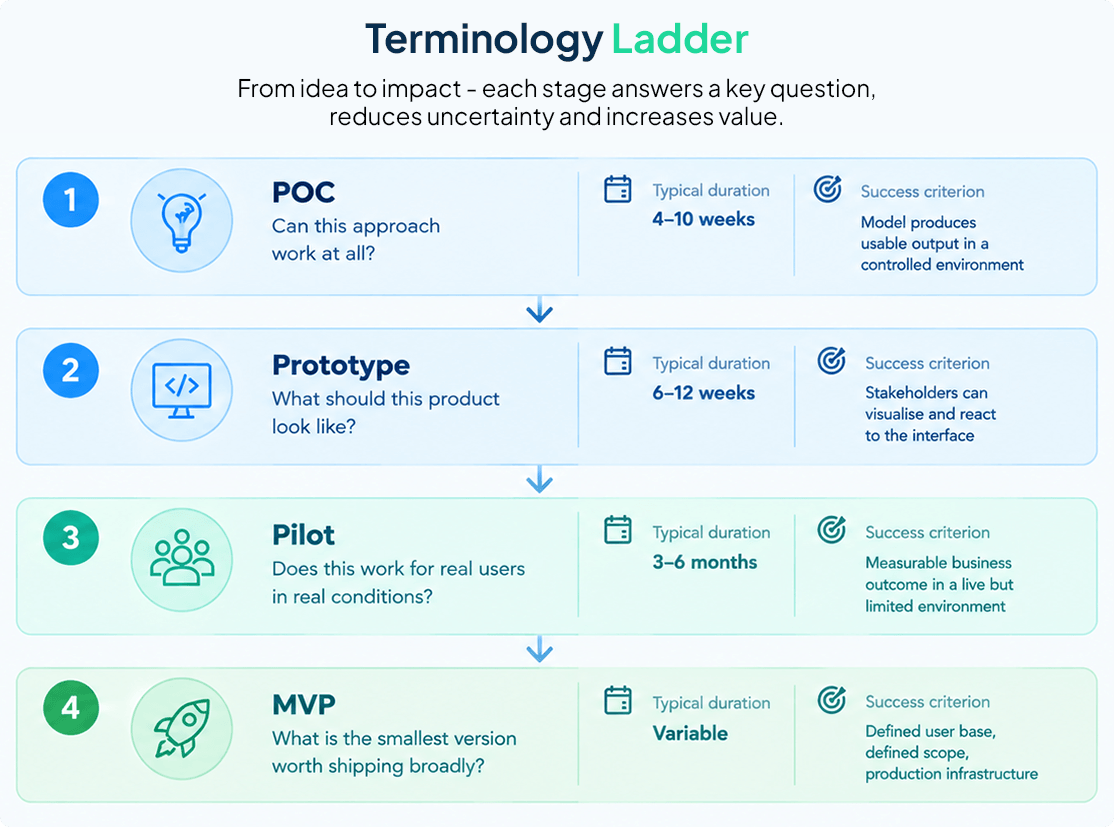
Why an AI POC is not a software POC
A traditional software POC delivers a deterministic result. An AI proof of concept does not. Quality is statistical, output varies across runs, and "it works" is a distribution, not a condition. A success criterion written for a software POC will produce a false confidence score for an AI one.
What Actually Changes Between a POC and Production
The honest answer: almost everything. Not the model. The entire system around it.
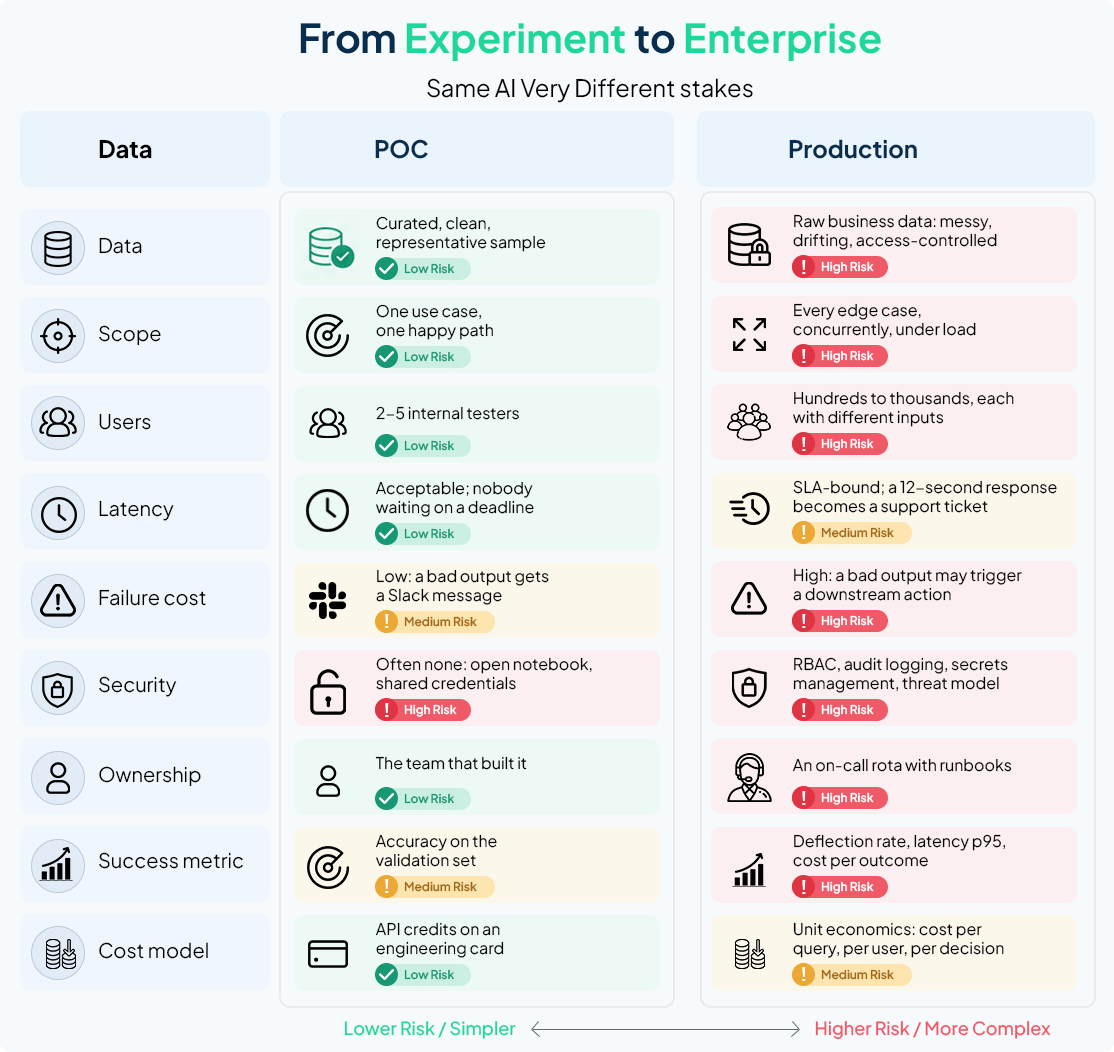
The data gap is the first thing that breaks
The validation set that made your POC look good was assembled to cover the cases you knew about, in a format your model was designed for. Production data has unknown edge cases, inconsistent formats, missing fields, and upstream pipeline failures.
A demo owner is not an on-call rota
Someone built the POC. When it breaks at 2am on a Tuesday, who gets paged? The answer to that question does not exist in most POC organisations. The absence of it is what "operationalise" actually means in practice.
The Four Risks Every POC Should Test - and Most Only Test One
Standard POC design asks teams to test four risks in parallel: technical feasibility, business viability, data readiness and operational scalability. In practice, most POCs only test the first.
Technical feasibility: proven at demo volume or at your volume?
A model achieving 87% accuracy against 500 curated records may score 71% against the full production corpus. If feasibility was tested against a curated sample, you have not tested feasibility. You have tested possibility.
Business viability: does the value survive inference cost?
A GPT-4-class call costs roughly $0.01–0.05 per thousand tokens. Run the arithmetic against your query volume and the value each correct output generates. If cost per outcome exceeds the margin the outcome creates, the business case does not survive the move to production.
Data readiness: accessible, lawful and representative
"Our data is ready" typically means it is accessible to the team that built the POC in the environment that team controls. Production data readiness means accessible to a non-human system acting on behalf of a user, governed under applicable data protection obligations, and representative of the full range of future inputs including drift.
Operational scalability: 500 sandbox records vs. 50,000 live
Rate limits, cold-start latency, memory constraints and vector index performance all look different at 100x. A system validated at demo load is not validated at production load.
If you cannot answer all four, you do not have a production problem yet. You have a POC gap.
Why Most AI POCs Never Ship: Five Engineering Gaps
The AI project failure rate is cited as evidence of AI's inherent difficulty. It is actually evidence of five diagnosable engineering failures, each fixable before it becomes fatal.
Gap 1: The POC was scoped to succeed
Success criteria written after a successful demo are not success criteria. They are rationalisation. The teams that ship define their exit criteria before they write the first prompt.
Gap 2: No integration path into the systems where work happens
An AI system that lives in its own application does not get used. If the model output does not reach the CRM, ERP or ticketing system where the relevant human makes a decision, adoption will be zero regardless of accuracy.
Gap 3: Accuracy was the only metric
A model that achieves 94% accuracy and fails catastrophically on the 6% representing your highest-risk inputs is not production-ready. Loginsoft's guide to the seven dimensions of production AI quality covers the full picture - latency under load, hallucination rate, cost per query and refusal rate - that POC evaluation typically skips.
Gap 4: No evaluation framework before the build began
An evaluation set assembled to validate a system you have already built will, reliably, validate it. Production-grade evaluation requires test sets designed independently of the development process, covering failure modes the system was not trained to avoid.
Gap 5: Security, access and ownership were deferred
In most POCs, security is a post-ship concern. Credentials are shared, access is permissive, audit logs do not exist, and system ownership is left open. The question of whether an AI agent should ever hold admin access must be answered before the first production credential is issued, not after.
What These Gaps Look Like in Public: Two Deployments, Two Outcomes
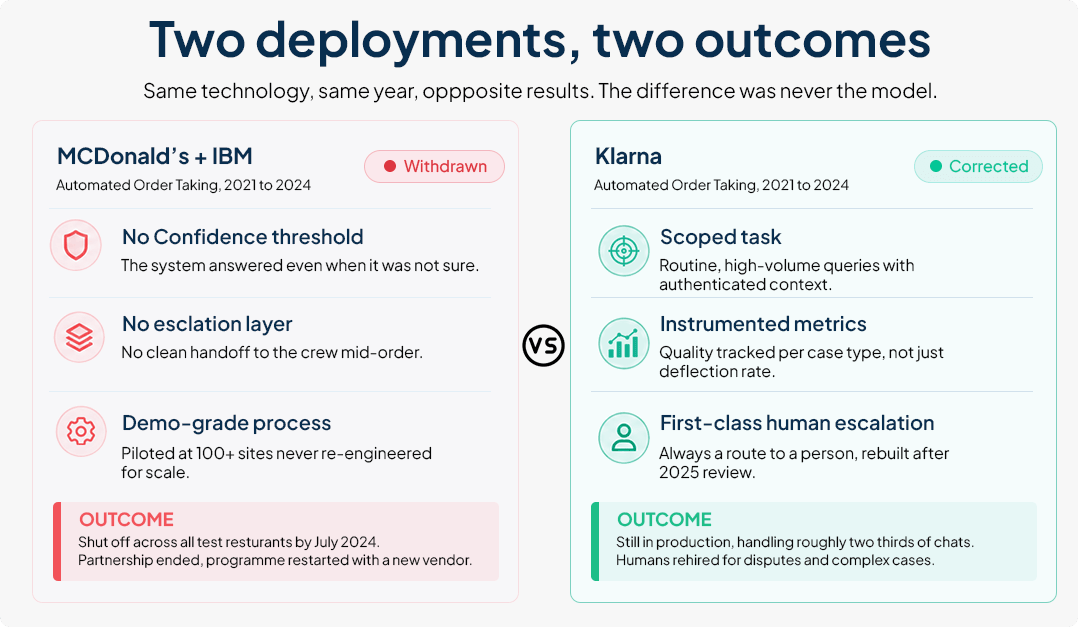
McDonald's - withdrawn after 100+ locations
McDonald's ended its IBM drive-thru ordering partnership in June 2024, after multi-year deployment across more than 100 restaurants. The documented failure modes were structural: no confidence threshold below which the system handed off to a human, and no graceful degradation for ambiguous inputs. The technical architecture was solvable. The failure was in the absence of a guardrail layer and a human-in-the-loop design - both production concerns, not POC concerns.
Klarna - 2.3 million conversations in month one
Klarna published metrics in February 2024 showing their AI assistant performed work equivalent to approximately 700 full-time agents, with resolution time dropping from 11 minutes to 2 minutes. Scope was rigidly constrained to defined query types, deflection rate was instrumented from day one, and escalation to a human agent was a first-class path, not a fallback of last resort.
The pattern
Both systems were technically capable. One treated production as a continuation of the POC. The other treated production as a separate engineering problem with its own architecture, metrics and failure modes. The outcome was correspondingly different.
FAQs
Q1. What should our POC have done that most POCs skip?
Three things: pre-defined success criteria agreed before the POC runs, not after it succeeds; a realistic data sample drawn from a representative slice of production data rather than a curated subset; and an integration stub - even a mock of the downstream system the AI will interact with - that surfaces identity, permissions and API design questions before they add weeks to the Scale phase.
Q2. Our POC succeeded on demo data. What do we do when production data behaves differently?
This is a data readiness gap, not a model failure. Instrument the production data pipeline to understand the distribution gap between demo and live data, assess whether synthetic augmentation closes it for fine-tuning, and redefine the evaluation set against the production distribution before continuing. If the gap is fundamental - production data lacks the structure the model requires - the POC result does not transfer and scope must be revised.
Q3. How long does it take to go from POC to production?
For a well-scoped, integration-ready system with clean data access, the Harden-Scale-Operationalise timeline runs 14–24 weeks. The most common elongating factor is not engineering work: it is data access approvals (3–8 weeks), security review scheduling (2–4 weeks) and change management for business teams who will own the system. Enterprise timelines of 6–12 months are common when these factors are not addressed in parallel with technical work.
Q4. Is the model the hardest part?
Rarely. In most stalled deployments the model performed adequately in the POC. The hard parts are the eight layers around the model: evaluation harness, guardrails, integration, observability, identity, human escalation, cost model and operating ownership. Discovering this mid-deployment - after the model is built - is the most expensive version of this lesson.
Table of Contents

Final Week of September: CISA KEV Grew as Emergency Warnings Dropped Before Advisories
Final Week of September: CISA KEV Grew as Emergency Warnings Dropped Before Advisories
Explore the key security, speed, and performance differences between TLS 1.3 and TLS 1.2
Ready to Find and Fix Your Security Weak Points?
LoginSoft's cybersecurity experts help organizations conduct thorough gap analyses, build prioritized remediation roadmaps, and achieve measurable security maturity improvements.
Schedule a Security Assessment
Hari Charan
Director of Security Research & Threat Intelligence
A MESSAGE FROM OUR TECHNOLOGY LEADER
The NVD enrichment cutback is not a surprise to us - it’s the inflection point we’ve been preparing for. At Loginsoft, we’ve spent years building the research depth and tooling infrastructure to independently enrich vulnerabilities at scale, with the accuracy and context modern security programs require. LOVI is our answer. Our mission is simple: ensure that no CVE relevant to your environment goes unanalyzed, unscored, or unactioned - regardless of what remains in NIST’s queue.
Key Takeaways
- Standard audit tools do not detect intentionally malicious packages. Tools like npm audit and pip-audit focus on known vulnerabilities, not malware behavior. A newly published malicious package with no CVE or advisory can pass these checks undetected.
- The attack surface is trust, not just code. Typosquatting, dependency confusion, and malicious updates exploit package-manager resolution and implicit trust. Developers and CI pipelines may install packages without verifying their provenance or behavior.
- Registry controls are only one layer of defense. Registry scanning, malware detection, and maintainer 2FA reduce risk, but attackers exploit gaps between these controls. Effective protection combines behavioral analysis, dependency pinning, SBOM governance, and build-environment isolation.
Stay Ahead
Get the Latest Cybersecurity Insights
Security research, threat intelligence, vulnerability updates, product news, and expert insights, delivered directly to your inbox. Stay informed. Stay secure.
BLOGS AND RESOURCES
Latest Articles
By using this website, you agree to the storing of cookies on your device to enhance site navigation, analyze site usage, and assist in our marketing efforts. View our Privacy Policy for more information.
Accept


© Copyright 2026, All Rights Reserved by Loginsoft
Privacy policy