Introduction
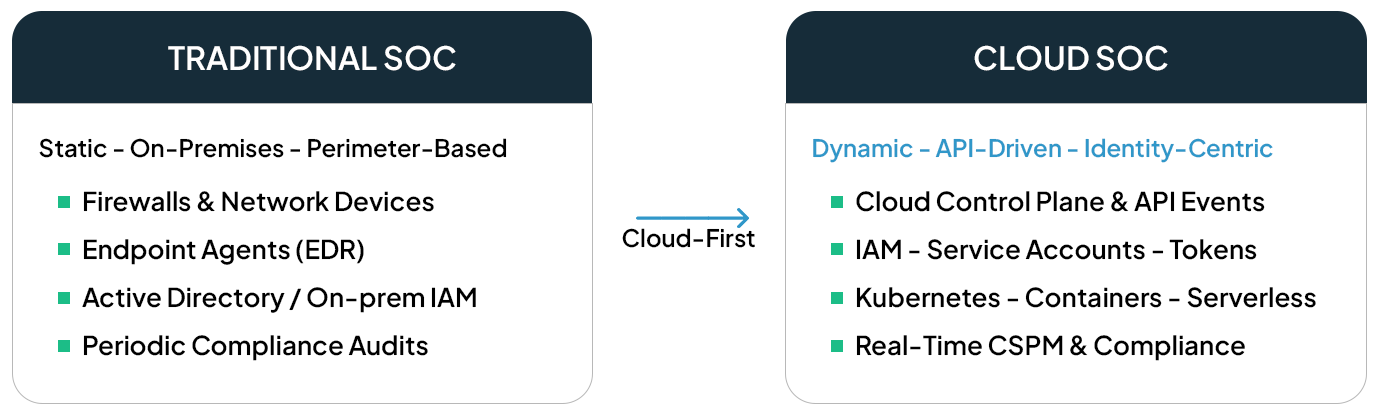
Cloud adoption continues to accelerate as organizations embrace AWS, Azure, GCP, and cloud-native technologies to improve agility, scalability, and innovation. As cloud environments grow, security teams need continuous visibility into workloads, identities, APIs, configurations, and user activity to maintain a strong security posture and support business operations.
Cloud Security Monitoring & Detection, often referred to as a Cloud SOC, provides visibility by continuously monitoring cloud infrastructure, applications, and security events across multi-cloud environments. By correlating telemetry from cloud platforms, SIEM solutions, Kubernetes environments, endpoint agents, and threat intelligence sources, organizations can quickly identify suspicious activity, investigate potential threats, and improve incident response effectiveness.
Loginsoft helps enterprises build and operationalize Cloud SOC capabilities for modern cloud-native environments. With expertise in cloud security engineering, detection development, vulnerability research, SIEM integration, and threat intelligence, we enable organizations to achieve continuous visibility across complex cloud infrastructures and strengthen their ability to detect, investigate, and respond to evolving threats.
Key takeaways:
- Understand what Cloud Security Monitoring & Detection (Cloud SOC) is and why it matters, including how continuous monitoring provides visibility across cloud identities, workloads, configurations, data, and network activity.
- Learn how a Cloud SOC helps organizations detect threats, misconfigurations, identity misuse, and compliance risks earlier, enabling faster response and reducing the likelihood of security incidents.
- Discover the business value of Cloud SOC, including stronger security posture, improved compliance readiness, lower operational risk, and the ability to scale cloud adoption with greater confidence.
What is Cloud Security Monitoring & Detection?
Cloud Security Monitoring & Detection, often called a Cloud SOC, is the continuous monitoring of cloud environments to identify security threats, vulnerabilities, misconfigurations, and unauthorized activity. It collects and analyzes data from cloud platforms such as AWS, Azure, and GCP, including user activity, workloads, APIs, configurations, and network traffic.
Unlike traditional SOCs that focus on on-premises infrastructure, a Cloud SOC is designed for dynamic cloud environments where resources, permissions, and services change constantly. It provides real-time visibility into cloud operations and helps security teams quickly identify suspicious behavior, exposed assets, excessive permissions, and potential attacks.
By combining cloud telemetry with threat intelligence and security analytics, Cloud Security Monitoring & Detection enables organizations to detect risks earlier, respond faster to incidents, and maintain a stronger cloud security posture.
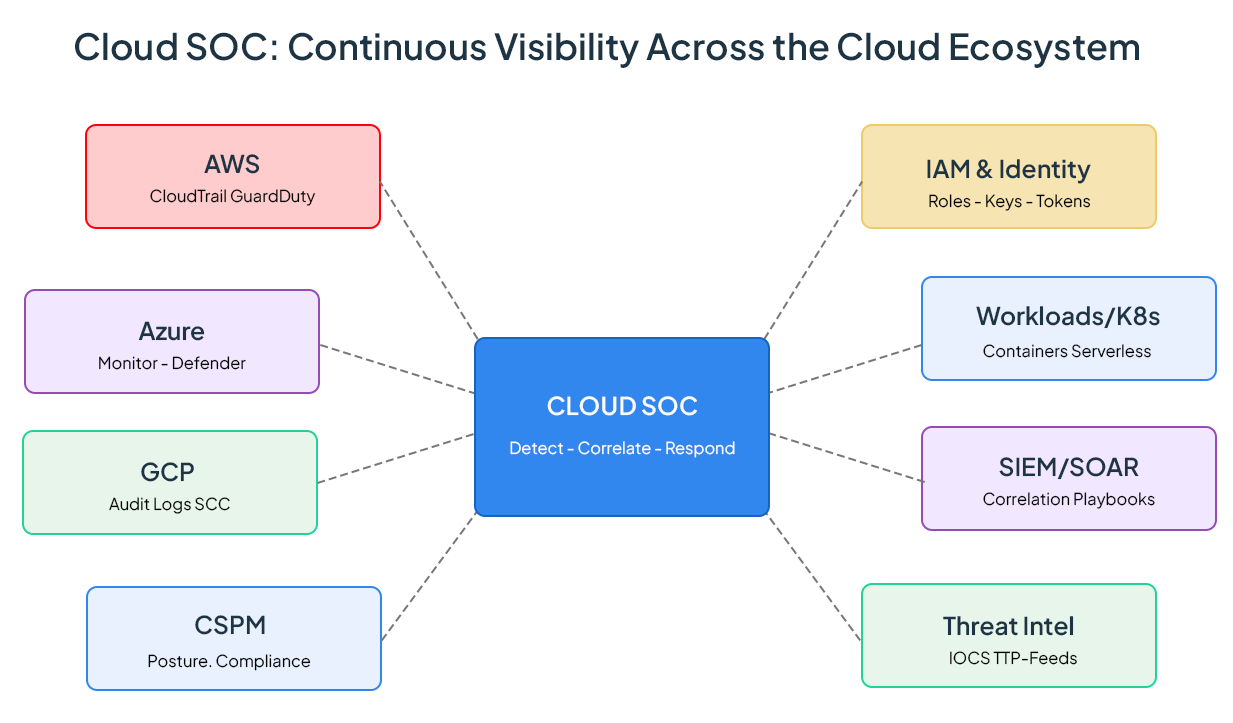
What Changes Between Traditional SOC and Cloud SOC?
Why Cloud SOC is No Longer Optional
Cloud environments are not inherently insecure, but they are inherently complex. That complexity, combined with the speed of cloud adoption, creates conditions where security posture can degrade silently and systematically. The business consequences are severe.
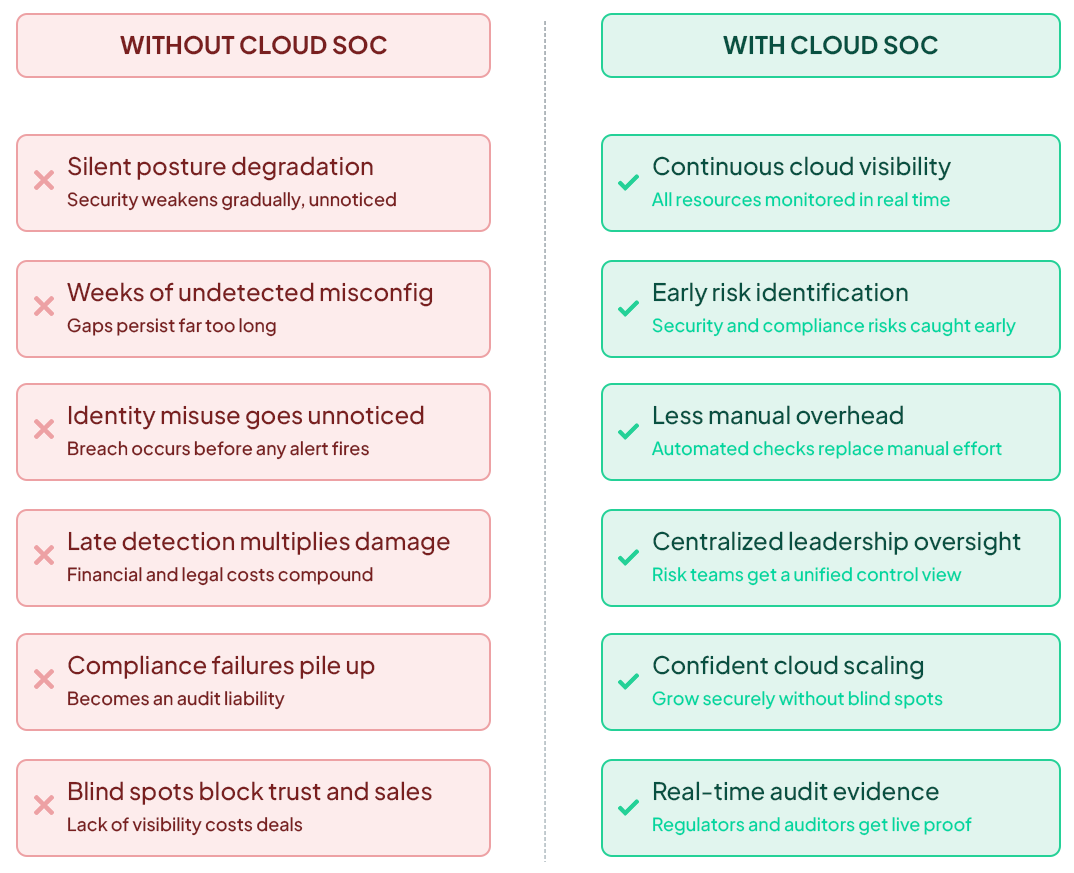
Why Cloud SOC Has Become a Business-Critical Capability:
Security posture can degrade silently unless it is monitored continuously.
Cloud environments change constantly as new workloads, APIs, identities, storage resources, and configurations are deployed every day. Even small configuration changes, such as excessive IAM permissions, publicly exposed storage buckets, disabled logging, or unpatched workloads, can introduce serious security gaps without triggering immediate alerts. Because these issues often accumulate gradually across multi-cloud environments, organizations may remain unaware of growing exposure until an attacker exploits the weakness. Continuous posture monitoring Posture drift, risky configurations, and policy violations are identified in real time before they evolve into major security incidents.
Late detection significantly increases financial, legal, and reputational damage.
The longer a threat goes undetected in a cloud environment, the higher the business impact. Attackers can move across workloads, escalate privileges, steal data, disrupt services, or maintain persistent access. Delayed detection increases response costs, downtime, compliance penalties, legal risk, and reputational damage. Continuous cloud monitoring helps reduce MTTD and MTTR, enabling faster detection and response to limit damage and disruption.
Identity misuse directly translates into data loss, outages, and compliance failures.
In modern cloud environments, identity is the main security perimeter. Users, service accounts, IAM roles, API keys, and machine identities control access to cloud resources and data. If these identities are misused or compromised, attackers can bypass defenses and access critical systems. Continuous monitoring of identity activity helps detect suspicious logins, privilege escalation, unusual API usage, and excessive permissions early to prevent breaches, outages, or compliance issues.
Lack of monitoring becomes a trust and sales blocker.
Enterprise customers, partners, and regulators now expect strong security visibility and continuous monitoring. During audits or procurement reviews, organizations must show how they detect and respond to cloud threats. Poor or inconsistent monitoring can reduce trust, slow down deals, and raise concerns about security. Continuous monitoring improves assurance and shows a mature approach to managing cloud risk.
Visibility into who is accessing what, from where, and why improves operational control.
Cloud Security Monitoring & Detection gives visibility to user activity, workloads, access patterns, login locations, privileged actions, and API usage across cloud environments. This helps security teams understand normal behavior and quickly spot anomalies like unusual logins, unauthorized access, or suspicious privilege use. Centralized visibility also improves investigations and speeds up incident response across cloud systems.
Early identification of security and compliance risks reduces long-term exposure.
Continuous monitoring allows organizations to detect vulnerabilities, policy violations, insecure configurations, and compliance gaps as they emerge rather than during periodic audits or after an incident occurs. By identifying issues early, organizations can remediate risks faster, reduce exposure to windows, maintain stronger compliance with readiness, and prevent minor weaknesses from escalating into larger operational or regulatory problems.
Reduced dependency on manual checks and reactive investigations improve efficiency.
Traditional security reviews often depend on manual audits, spreadsheets, and reactive investigations after incidents occur. In fast-changing cloud environments, this does not scale well. Continuous monitoring automates data collection, analysis, and alerting, helping security teams focus on real threats instead of manual work. This improves efficiency and reduces fatigue and delays in investigations.
Centralized oversight strengthens leadership and enterprise risk management.
Cloud SOC capabilities provide centralized visibility across AWS, Azure, GCP, SaaS applications, and hybrid infrastructure from a single operational view. This enables security leaders, risk teams, and executives to better understand organizational exposure, monitor security posture trends, track compliance readiness, and make informed decisions about cloud risk. Centralized oversight also improves governance consistency across distributed business units and cloud environments.
Confidence to scale cloud adoption securely enables business growth.
As organizations expand their cloud environments, security controls must scale alongside business growth. Continuous monitoring provides the visibility, automation, and threat detection needed to support rapid cloud adoption without losing governance or control. This enables organizations to innovate faster, deploy workloads with confidence, and accelerate digital transformation while maintaining a strong security posture.
Strategic Business Outcomes of Cloud Security Monitoring & Detection
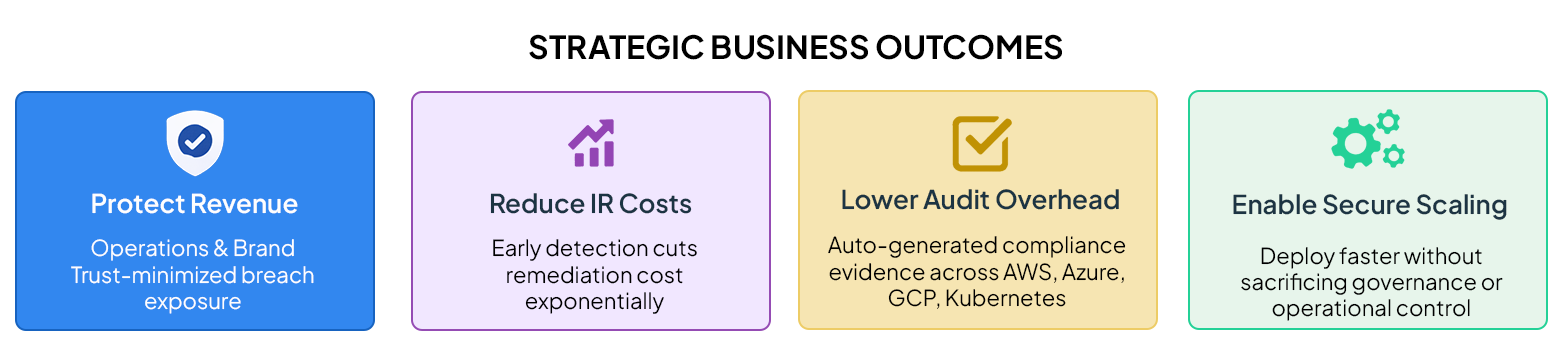
Protects Revenue, Operations, and Brand Trust
Cloud security incidents can impact far more than the security team they can disrupt operations, affect revenue, damage customer trust, and harm brand reputation. Threats such as compromised identities, exposed storage, ransomware, or unauthorized data access can have significant business consequences. Cloud SOC capabilities continuously monitor cloud activity to detect threats early, helping organizations reduce the risk of data breaches, service disruptions, and long-term business impact.
Reduces Incident Response and Remediation Costs
The cost of a cloud security incident increases significantly once attackers gain persistent access or sensitive data is exposed. Issues such as misconfigured storage, excessive permissions, exposed API keys, or unmonitored workloads can create opportunities for attackers. Continuous cloud monitoring helps identify these risks early through real-time visibility, automated alerting, and behavioral analysis, enabling faster response and reducing operational disruption. This allows organizations to focus on proactive risk reduction rather than reactive incident recovery.
Lowers Compliance and Audit Overhead
Modern compliance frameworks require organizations to demonstrate continuous monitoring, security visibility, and access governance. Manually preparing for audits across cloud environments can be time-consuming and inefficient. Cloud SOC capabilities automate monitoring, configuration tracking, identity oversight, and evidence collection, helping organizations identify compliance gaps in real time. This reduces audit effort, improves certification readiness, and strengthens overall governance.
Enables Secure and Scalable Cloud Adoption
As cloud environments grow across regions, workloads, containers, and third-party services, manual security oversight becomes difficult to scale. Cloud SOC capabilities provide continuous monitoring, automated detection, and centralized visibility, helping organizations support rapid cloud growth without sacrificing security or governance. This enables businesses to adopt and scale cloud services with greater confidence while maintaining control over security, compliance, and risk.
Strategic Business Outcomes Enabled by Cloud SOC
Enables sustained cloud growth without proportionally increasing security risk.
As organizations expand across multi-cloud environments, Kubernetes platforms, SaaS applications, and distributed workloads, security complexity increases. Each new service, integration, or identity introduces potential risk. Cloud SOC capabilities provide continuous monitoring, posture assessment, identity visibility, and real-time threat detection, helping organizations maintain security and compliance as they scale. This enables cloud growth without a proportional increase in security risk.
Supports better risk-informed strategic decision-making.
Traditional security reporting often relies on periodic audits and manual reviews that may not reflect real-time cloud risks. Cloud SOC capabilities provide continuous visibility into identities, workloads, vulnerabilities, configurations, and cloud activity, giving security leaders a current view of organizational risk. This helps leadership prioritize investments, improve security operations, make informed decisions, and strengthen long-term governance and risk management.
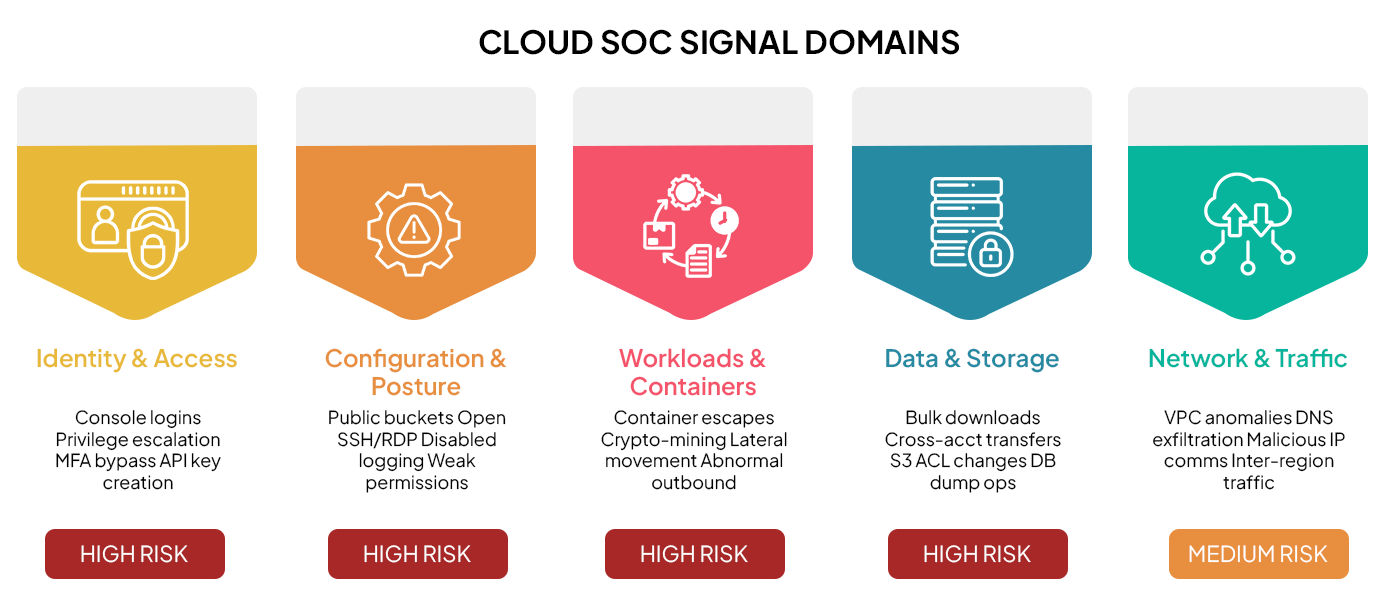
What Does Cloud SOC Monitor? The Signal Taxonomy
A mature Cloud SOC does not monitor a single category of events. It ingests and correlates signals across five critical domains, each covering a distinct segment of the cloud attack surface.
How Cloud Security Monitoring & Detection Operates: The Continuous Operational Lifecycle
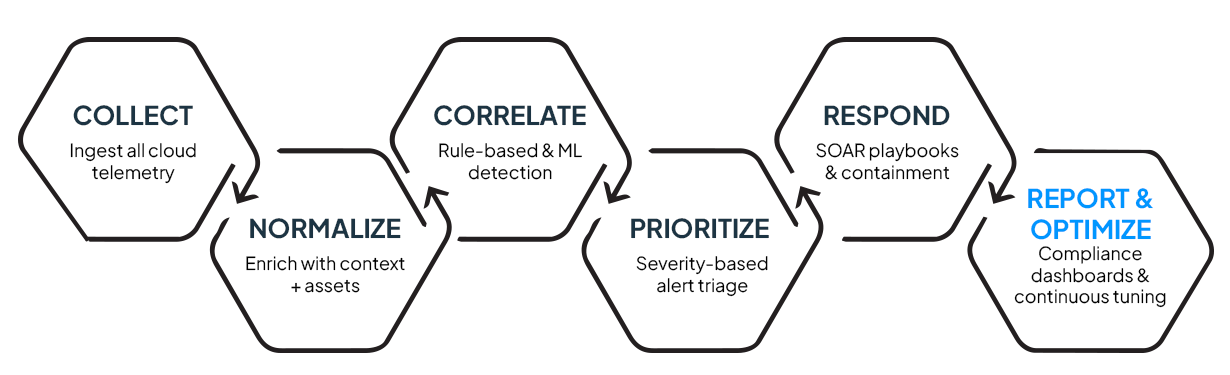
A Cloud SOC is more than a dashboard or alerting system. It is a continuous security operations process that provides real-time visibility, threat detection, investigation, and response across cloud environments. By continuously collecting and analyzing cloud activity, identities, configurations, workloads, and API events, a Cloud SOC helps organizations detect and respond to security threats more effectively.
1. Signal Collection
The Cloud SOC lifecycle begins by continuously collecting telemetry from cloud platforms, workloads, identities, applications, and network activity. Data from sources such as cloud audit logs, Kubernetes environments, endpoint agents, APIs, and SaaS applications is centralized for analysis. The goal is to provide comprehensive visibility across cloud infrastructure and services while minimizing security blind spots.
2. Normalization and Context Enrichment
Cloud data often comes from multiple sources and formats, making it difficult to analyze directly. A Cloud SOC normalizes this data and enriches it with context such as asset importance, user identities, workload ownership, vulnerability information, and threat intelligence. This helps security teams understand not only what happened, but also the potential risk and business impact of an event.
3. Correlation and Threat Detection
After telemetry is normalized and enriched, a Cloud SOC correlates signals from identities, workloads, configurations, and network activity to identify threats, suspicious behavior, and policy violations. Using detection rules, behavioral analytics, and threat intelligence, it can uncover attack patterns that may not be obvious when viewed as isolated events. This helps organizations detect sophisticated cloud threats more accurately and earlier in the attack lifecycle.
4. Alert Prioritization and Investigation
Detected events are prioritized based on risk, severity, and potential business impact. High-risk alerts are escalated for immediate response, while lower-priority events are reviewed by analysts. Using centralized visibility and contextual information, security teams can quickly determine whether an alert is a genuine threat, a policy violation, or a false positive. Automated investigation workflows help improve accuracy and reduce response times.
5. Response and Remediation
When a threat or policy violation is confirmed, a Cloud SOC initiates response actions to contain and remediate the issue. Automated workflows can revoke compromised credentials, isolate affected workloads, block malicious activity, and correct insecure configurations. These actions help reduce the impact of incidents, prevent further compromise, and ensure a consistent and efficient response process.
6. Reporting, Governance, and Continuous Optimization
Cloud SOC operations provide dashboards, metrics, and reports that help security leaders track threats, compliance status, security posture, and incident response performance. Automated reporting simplifies audit preparation and governance. Insights from investigations and incidents are also used to continuously improve monitoring, detection rules, and response processes, helping organizations adapt to evolving cloud environments and emerging threats.
Common Mistakes Organizations Make Without a Cloud SOC
Relying on Periodic Security Assessments Instead of Continuous Monitoring
Many organizations still rely on periodic audits and reviews, but cloud environments change daily. Without continuous monitoring, security gaps and misconfigurations can remain undetected until they are exploited.
Treating Cloud Environments Like Traditional Data Centers
Traditional SOC approaches were built for static on-premises environments and often lack visibility into cloud-native services, APIs, identities, and Kubernetes workloads. This can create significant monitoring blind spots.
Generating Excessive Alerts Without Proper Context or Correlation
Collecting large volumes of cloud logs alone does not improve security. Without context and correlation, teams face alert fatigue and may overlook high-risk threats hidden among low-priority alerts.
Underestimating the Importance of Identity-Centric Monitoring
Identity is the primary security perimeter in the cloud. Organizations that do not continuously monitor IAM activity, privileged access, and authentication behavior may miss signs of credential misuse, privilege escalation, and unauthorized access.
How Loginsoft Enables Enterprise-Grade Cloud Security Monitoring & Detection
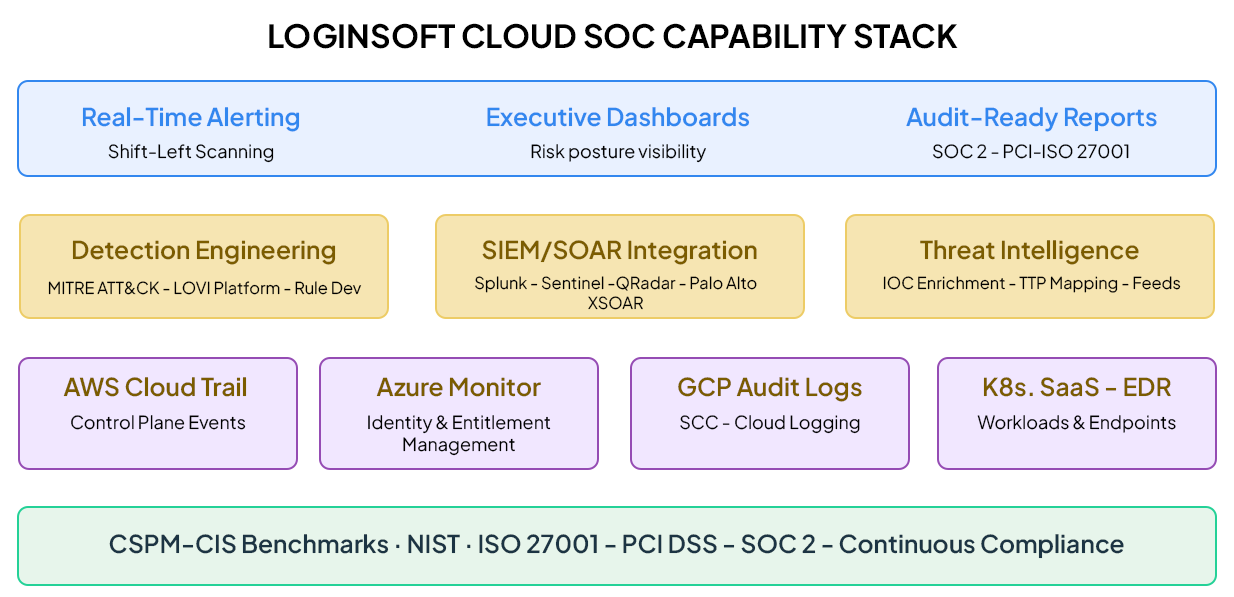
A comprehensive approach to Cloud Security Monitoring & Detection goes beyond centralized logging and alerting. By combining cloud telemetry, threat intelligence, contextual analysis, and detection engineering, organizations gain meaningful visibility across complex cloud environments enabling more accurate threat detection, faster response, stronger governance, and reduced enterprise risk.
Research-Driven Detection Engineering
Detection capabilities are continuously refined using emerging threat intelligence, cloud attack techniques, and real-world adversary behavior. This helps organizations identify high-risk activities such as privilege escalation, credential misuse, suspicious API activity, and cloud-native attack techniques.
Engineering-Grade Cloud Telemetry Integration
Telemetry from cloud platforms, Kubernetes environments, IAM systems, and security tools is integrated into centralized security operations platforms. This improves visibility, alert quality, investigation efficiency, and cross-environment threat detection.
Continuous Posture Monitoring and Compliance Visibility
Continuous Posture monitoring helps identify misconfigurations, excessive permissions, exposed assets, and compliance gaps across cloud environments. Automated assessments improve governance, simplify audit readiness, and support ongoing compliance efforts.
Unified Multi-Cloud Security Operations
A centralized monitoring and detection approach provides visibility across AWS, Azure, GCP, SaaS applications, and hybrid environments. This enables consistent security operations, stronger governance, and improved incident response across complex cloud infrastructures.
Conclusion:
Cloud Security Monitoring & Detection is now essential for organizations operating in the cloud. As cloud environments constantly change, security risks such as misconfigurations, exposed credentials, and identity misuse can emerge without warning. A mature Cloud SOC provides continuous visibility across identities, configurations, workloads, data, and network activity to detect threats early and respond quickly. This proactive approach reduces detection and remediation times, strengthens compliance, and improves overall security posture. Beyond security, continuous monitoring helps protect business operations, maintain customer trust, and support confident cloud growth.
FAQs
Q1. What is Cloud Security Monitoring and Detection?
Cloud Security Monitoring and Detection also called Cloud SOC is the continuous process of collecting, analyzing, and correlating signals from cloud environments to identify misconfigurations, suspicious activity, and active threats across cloud infrastructure. It answers the question: “What is happening in our cloud right now, and does any of it indicate risk or an active attack?”
Q2. What is a Cloud SOC (Security Operations Center)?
A Cloud SOC is a dedicated function, team, or managed service that continuously monitors cloud infrastructure including identity and access, workloads, configurations, data stores, and network traffic to detect and respond to threats in real time. Unlike traditional SOCs built for on-premises environments, a Cloud SOC is designed specifically for the dynamic, API-driven nature of cloud platforms like AWS, Azure, and GCP.
Q3. Why is continuous cloud monitoring important?
Cloud security posture degrades silently without continuous monitoring. Misconfigurations accumulate, IAM permissions drift, and threats often remain undetected until significant damage has already occurred. Late detection dramatically increases financial, legal, operational, and reputational impact, especially in dynamic multi-cloud environments were infrastructure changes constantly. Continuous Cloud SOC capabilities reduce detection and response time by providing real-time visibility into cloud activity, helping organizations identify and contain threats before they escalate into large-scale security incidents.
Q4. What signals does a Cloud SOC monitor?
A mature Cloud SOC continuously monitors five primary signal domains across cloud infrastructure. These include Identity and Access signals such as IAM activity, login anomalies, privilege escalation, and API key misuse; Configuration and Posture signals such as misconfigurations, CIS benchmark violations, and exposed services; Workloads and Containers including runtime anomalies, container escape attempts, and lateral movement; Data and Storage activity such as unauthorized access, bulk downloads, and bucket exposure; and Network Traffic signals including VPC flow anomalies, DNS exfiltration, and communication with malicious IP addresses. Continuous correlation across these domains enables earlier and more accurate threat detection.
Q5. How is Cloud SOC different from traditional SIEM?
Traditional SIEM platforms were originally designed for relatively static on-premises infrastructure centered around network devices, firewalls, and endpoint logs. Cloud SOC extends beyond legacy SIEM by incorporating cloud-native telemetry collection, API-level visibility, identity monitoring, serverless telemetry, workload activity, and continuous posture assessment across dynamic cloud environments. Unlike traditional SIEM architectures, Cloud SOC capabilities are designed specifically for highly distributed, ephemeral, and API-driven infrastructure where identities, workloads, configurations, and cloud resources change continuously. Cloud SOC also integrates compliance automation, real-time configuration monitoring, and cloud-native threat detection capabilities that are not native to traditional SIEM environments.
Explore the key security, speed, and performance differences between TLS 1.3 and TLS 1.2
Ready to Find and Fix Your Security Weak Points?
LoginSoft's cybersecurity experts help organizations conduct thorough gap analyses, build prioritized remediation roadmaps, and achieve measurable security maturity improvements.
Schedule a Security Assessment
Hari Charan
A MESSAGE FROM OUR TECHNOLOGY LEADER
The NVD enrichment cutback is not a surprise to us - it’s the inflection point we’ve been preparing for. At Loginsoft, we’ve spent years building the research depth and tooling infrastructure to independently enrich vulnerabilities at scale, with the accuracy and context modern security programs require. LOVI is our answer. Our mission is simple: ensure that no CVE relevant to your environment goes unanalyzed, unscored, or unactioned - regardless of what remains in NIST’s queue.
Get Notified