API Security
What Is API Security?
An Application Programming Interface (API) enables one software system to communicate with another. When an application exposes an API, external systems or clients can request specific services or data from it.
API security focuses on protecting these interfaces from misuse, abuse, and cyberattacks. Just like applications, servers, and networks, APIs are attack surfaces, and because they expose functionality to external parties, they are often attractive targets for attackers.
API security is a critical part of modern web application security. Most digital applications today rely heavily on APIs, and each exposed API introduces additional risk. A helpful analogy is opening a building to the public: while it allows business to function, it also increases the likelihood of unauthorized or malicious activity. APIs work the same way, by allowing outside access, they expand the potential attack surface.
Common API Security Risks
APIs face a wide variety of threats, many of which stem from improper design, weak access controls, or insufficient monitoring. Some of the most common risks include:
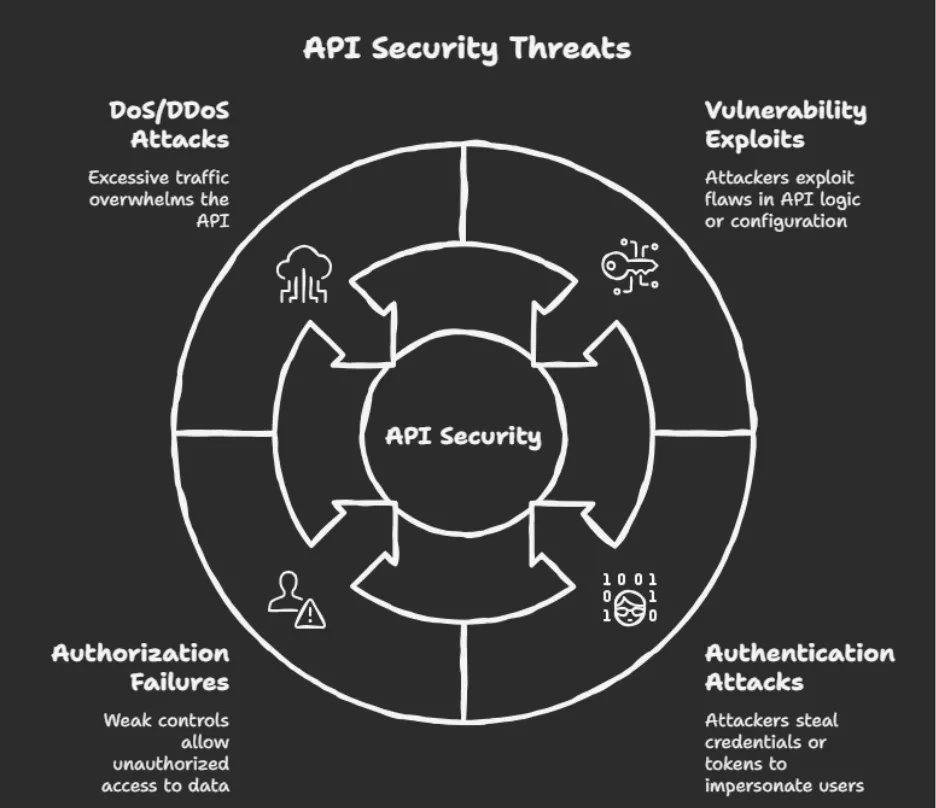
Vulnerability Exploits
Attackers may send specially crafted requests designed to exploit flaws in an API’s logic or configuration. These vulnerabilities can lead to unintended access or system compromise. Industry groups like OWASP publish lists of the most critical API vulnerabilities, including issues such as injection attacks and security misconfigurations. When an exploit targets a previously unknown flaw, it is considered a zero-day threat, which is particularly difficult to defend against.
Authentication-Based Attacks
APIs typically require authentication to verify who is making requests. However, authentication mechanisms can be compromised if attackers steal credentials, intercept tokens, or obtain valid API keys, allowing them to impersonate legitimate users.
Authorization Failures
Authorization controls define what authenticated users are allowed to do. When these controls are weak or incorrectly implemented, users may gain access to data or functionality beyond their intended permissions, increasing the risk of data exposure.
DoS and DDoS Attacks
APIs can be overwhelmed by excessive traffic, either accidentally or intentionally. In denial-of-service (DoS) or distributed denial-of-service (DDoS) attacks, attackers flood an API with requests to slow it down or make it unavailable to legitimate users.
To mitigate these threats, organizations rely on layered API security strategies such as strong authentication, authorization enforcement, rate limiting, schema validation, and web application firewalls (WAFs).
Why Web API Security Matters
As technologies like cloud computing and the Internet of Things (IoT) continue to grow, APIs have become the primary way systems exchange sensitive information. APIs often handle credentials, financial data, personal information, and operational controls.
An insecure API can provide attackers with a direct entry point into otherwise well-protected systems. Common attack techniques include man-in-the-middle (MITM) attacks, injection attacks, DDoS attempts, and broken access control exploitation. Securing APIs is therefore essential to protecting the entire application ecosystem.
Understanding APIs
At its core, an API is simply a mechanism that allows two software systems to interact.
For example, a mobile mapping app does not store global street data locally. Instead, it requests that information from a backend service that maintains up-to-date geographic data. The connection between the app and the backend service is made possible through an API.
API Security Across REST, SOAP, and GraphQL
Different API architectures introduce different security considerations. REST, SOAP, and GraphQL each require tailored security controls.
REST API Security
REST APIs use standard HTTP methods and resource-based URLs. Common security considerations include:
- Authentication mechanisms such as API keys, OAuth tokens, or JWTs
- Authorization controls to restrict access to specific resources
- Rate limiting to prevent abuse and DoS attacks
- Input validation to protect against injection and scripting attacks
- HTTPS encryption to secure data in transit
- CORS policies to control which domains can access the API
Securing REST APIs requires a comprehensive approach that addresses each of these areas.
SOAP API Security
SOAP APIs rely on XML-based messaging and often use protocols such as HTTP or SMTP. Key security practices include:
- Encrypting sensitive data within SOAP messages
- Validating XML against defined schemas
- Using WS-Security standards for message integrity and authentication
- Transmitting data over HTTPS
- Applying digital signatures to verify message authenticity
GraphQL API Security
GraphQL exposes a single endpoint that supports flexible queries, which introduces unique risks:
- Strong authentication and authorization for queries and mutations
- Rate limiting to prevent query abuse
- Input validation and sanitization
- Query depth and complexity limits to prevent resource exhaustion
Because GraphQL allows clients to define exactly what data they retrieve, careful access control is essential.
Most Common API Attack Categories
Modern API attacks typically fall into four broad categories:
Lack of Visibility and Governance
Attackers exploit undocumented, unmanaged, or third-party APIs, often referred to as shadow or zombie APIs, that lack proper oversight.
API Abuse and Misuse
In these attacks, APIs are used exactly as designed, but in unintended ways that result in data leakage or abuse due to weak design controls.
Business Logic Exploitation
Attackers slowly analyze how an API behaves to uncover flaws in business logic, enabling unauthorized access or misuse over time.
Stolen Credentials and Social Engineering
Attackers use phishing or social engineering to obtain valid API credentials, allowing them to operate as legitimate users. A large percentage of API attacks originate from authenticated, but malicious actors.
Common API Vulnerabilities
Industry research highlights recurring API weaknesses, including:
- Broken object-level authorization
- Broken authentication
- Improper property-level access control
- Unrestricted resource consumption
- Broken function-level authorization
- Abuse of sensitive business workflows
- Server-side request forgery (SSRF)
- Security misconfiguration
- Poor API inventory management
- Unsafe consumption of third-party APIs
These vulnerabilities underscore the need for continuous visibility and protection.
API Security Best Practices
To reduce API-related risk, organizations should adopt the following best practices:
- Enforce strong authentication and authorization
- Use SSL/TLS to encrypt all API traffic
- Apply zero-trust access principles
- Patch vulnerabilities promptly
- Monitor APIs for abnormal behavior
- Conduct regular security testing and audits
- Deploy API gateways for traffic control
- Use Web Application and API Protection (WAAP) solutions
Loginsoft Perspective
At Loginsoft, API Security is treated as a high-impact area of cyber risk. Through our Threat Intelligence, Vulnerability Intelligence, and Security Engineering Services, we help organizations identify API threats and reduce exposure.
Loginsoft supports API security by
- Identifying API related vulnerabilities
- Enriching detections with threat intelligence
- Monitoring API abuse and attack patterns
- Supporting secure API design and testing
- Improving visibility into API risk
Our intelligence-led approach ensures APIs remain secure without slowing innovation.
FAQ
Q1. What is API Security
API Security is the practice of protecting application programming interfaces from unauthorized access and attacks.
Q2. Why are APIs targeted by attackers
Because APIs expose data and business logic directly to the internet.
Q3. What are common API security risks
Broken authentication, excessive data exposure, and API abuse.
Q4. How does API security differ from web security
API security focuses on programmatic access rather than user driven interactions.
Q5. How does Loginsoft help with API security
Loginsoft identifies API threats and enriches detection with threat intelligence to reduce risk.
Explore the key security, speed, and performance differences between TLS 1.3 and TLS 1.2
Get the Latest Cybersecurity Insights
Security research, threat intelligence, vulnerability updates, product news, and expert insights, delivered directly to your inbox. Stay informed. Stay secure.