Detection-as-Code
What is Detection-as-Code?
Detection-as-Code (DaC) is a cybersecurity methodology that applies software engineering practices to the development, testing, management, deployment, and maintenance of security detection logic.
Instead of creating and modifying detection rules manually inside a SIEM, EDR, XDR, or security analytics platform, Detection-as-Code treats detection content as version-controlled code. Teams can review, test, validate, deploy, monitor, update, and roll back detection rules through structured engineering workflows.
Common Detection-as-Code practices include Git-based version control, peer review, automated testing, linting, CI/CD pipelines, reusable components, documentation, and automated deployment.
Detection-as-Code does not replace a SIEM or detection platform. It provides an engineering framework for managing the detection content that operates within those platforms.
Why Detection-as-Code Matters
Modern security teams manage large volumes of telemetry across endpoints, cloud environments, identities, networks, applications, and security platforms. At the same time, attacker techniques continue to evolve.
Manually maintaining detection rules can make it difficult to track changes, validate detection logic, identify outdated rules, or deploy updates consistently.
Detection-as-Code brings software development practices into detection engineering. Version control provides change history, automated testing validates detection behavior, peer review improves oversight, and CI/CD enables repeatable deployment.
This approach helps security teams treat detections as continuously maintained security assets rather than static rules configured once inside a security platform.
How Detection-as-Code Works
Detection-as-Code treats detection logic as managed code rather than configuration that exists only inside a security product.
A typical lifecycle includes:
- Create - Develop a detection based on a threat, incident, attack technique, vulnerability, or security requirement.
- Store - Save the detection in a version-controlled repository.
- Test - Validate syntax, logic, metadata, and expected behavior.
- Review - Submit changes for peer review through a pull request.
- Deploy - Use CI/CD automation to deploy approved detections.
- Monitor - Evaluate alerts, false positives, detection coverage, and performance.
- Tune - Update detection logic as threats, telemetry, or environments change.
This creates a repeatable lifecycle for developing, maintaining, and improving security detections.
Detection-as-Code Workflow
A mature Detection-as-Code workflow generally follows:
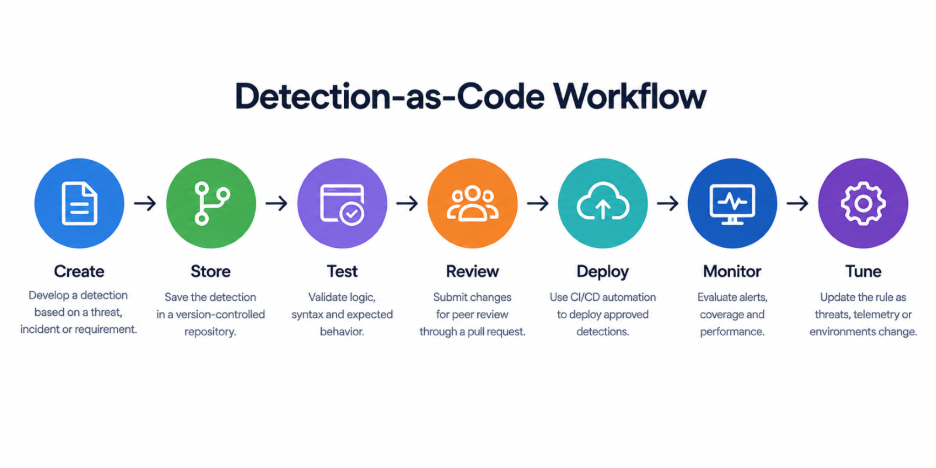
The workflow can begin with threat intelligence, incident findings, threat hunting, vulnerability intelligence, adversary behavior, compliance requirements, or identified gaps in existing detection coverage.
Once a detection is developed, automated checks can validate the content before it reaches production.
Version Control for Detection Rules
Version control is a fundamental component of Detection-as-Code.
A Git repository can store:
- Detection rules
- Test cases
- Detection metadata
- Documentation
- Configuration files
- Lookup data
- Reusable detection components
- Deployment configuration
Version history allows teams to identify what changed, when the change occurred, and who made it. Previous versions can also be restored when a change causes unexpected behavior.
Automated Detection Testing
Automated testing helps determine whether detection rules behave as expected before deployment.
Test cases can include:
- Known malicious events
- Known benign events
- Historical incidents
- Synthetic telemetry
- Edge cases
- Adversary-emulation activity
- Sanitized production events
Effective testing should include both positive cases, where a detection should trigger, and negative cases, where legitimate activity should not generate an alert.
Testing cannot guarantee complete threat coverage, but it provides a repeatable method for identifying broken logic and reducing unnecessary alerts.
Sigma Rules
Sigma is a vendor-neutral format for describing security detection rules.
Sigma can help organizations create portable detection content that can be converted for supported security platforms.
It is particularly useful for organizations operating multiple SIEM environments or seeking to reduce dependence on a single detection platform.
However, portability does not guarantee identical detection behavior. Differences in telemetry, field mappings, query capabilities, and platform implementation can affect how a Sigma rule performs after conversion.
Detection Tuning
Detection tuning improves the quality and usefulness of generated alerts.
Common tuning activities include:
- Reducing known benign activity
- Adjusting thresholds
- Adding environmental context
- Excluding approved applications
- Refining detection conditions
- Correlating multiple events
- Improving data normalization
- Updating logic after infrastructure changes
The goal is not simply to generate more alerts. Effective tuning aims to produce alerts that provide useful, actionable security signals.
Detection Quality Metrics
Detection programs can measure multiple aspects of detection quality.
Common metrics include:
- True-positive rate
- False-positive rate
- Precision
- Alert volume
- Detection coverage
- Mean Time to Detect (MTTD)
- Mean Time to Respond (MTTR)
- Detection latency
- Test coverage
- ATT&CK technique coverage
- Data-source coverage
- Detection failure rate
- Rule deployment frequency
Metrics should be interpreted in context. A large detection library does not necessarily indicate strong security coverage if the rules generate excessive noise or depend on unavailable telemetry.
Detection Coverage
Detection coverage measures how effectively an organization's detection program addresses relevant threats and attacker behaviors.
Coverage can be evaluated against:
- MITRE ATT&CK techniques
- Threat intelligence
- Organizational threat models
- Critical assets
- Cloud services
- Identity systems
- Endpoint activity
- Network activity
- Application activity
Detection-as-Code makes coverage easier to track because detection definitions and associated metadata can be maintained in a structured repository.
Detection-as-Code Challenges
Detection-as-Code introduces engineering requirements that organizations need to manage.
Technical Expertise
Teams may need knowledge of Git, CI/CD, testing frameworks, query languages, and software-development workflows.
Telemetry Quality
Incomplete, inconsistent, or poorly normalized telemetry can prevent detections from working effectively.
Test Data
Maintaining representative malicious and benign test cases requires continuous effort.
Platform Differences
Different SIEM, EDR, and XDR platforms use different schemas, query languages, fields, and capabilities.
Detection Drift
Detection logic can become outdated as infrastructure, applications, telemetry, and attacker techniques change.
Pipeline Security
Repositories and CI/CD pipelines used to deploy detections become security-sensitive assets and must be protected against unauthorized modification.
Key Benefits of Detection-as-Code
Version Control
Maintains a complete history of detection changes and provides a mechanism for comparing or restoring previous versions.
Peer Review
Allows security engineers to review detection logic before deployment, improving oversight and collaboration.
Automated Testing
Helps identify syntax problems, broken logic, unexpected matches, and other issues before production deployment.
Faster Deployment
CI/CD automation reduces manual deployment work and enables approved detection changes to move through a consistent process.
Consistency
Standardized development and deployment workflows help teams manage detection content consistently across environments.
Scalability
Automation makes it easier to manage larger detection libraries without relying entirely on manual security-console configuration.
Portability
Structured detection formats can make detection content easier to adapt across supported security platforms.
Rollback
Version-controlled detection content can be restored to a previous state when a deployment produces unexpected results.
Collaboration
Detection engineers, threat hunters, SOC analysts, and security teams can collaborate through a shared development workflow.
Detection-as-Code in SIEM
Detection-as-Code complements a SIEM rather than replacing it.
A SIEM generally provides telemetry collection, log storage, search, correlation, detection execution, alert generation, and investigation capabilities.
Detection-as-Code provides the engineering process for creating, testing, versioning, reviewing, and deploying the logic that operates within or alongside the SIEM.
Detection-as-Code in EDR and XDR
Detection-as-Code can also support endpoint and extended detection environments.
Detection logic can use:
- Process activity
- File activity
- Registry changes
- Authentication events
- Network connections
- Endpoint telemetry
- Cloud activity
- Identity events
- Cross-platform correlations
Implementation depends on the capabilities and detection languages supported by the security platform.
Detection-as-Code Best Practices
Organizations implementing Detection-as-Code should:
- Store detection logic in version control.
- Use pull requests for peer review.
- Define standardized detection metadata.
- Build positive and negative test cases.
- Automate linting and validation.
- Integrate detection testing into CI/CD.
- Map detections to relevant threat behaviors.
- Track telemetry and data-source dependencies.
- Monitor false positives and detection quality.
- Maintain reusable detection components.
- Protect repositories and deployment pipelines.
- Regularly review, tune, and retire outdated detections.
- Test important detections against simulated adversary behavior.
- Document response guidance alongside detection logic.
Detection-as-Code Maturity
Organizations can progressively mature their Detection-as-Code capabilities.
Level 1 - Manual: Detections are primarily created and modified directly in security platforms.
Level 2 - Versioned: Detection rules are stored in source control.
Level 3 - Tested: Automated tests and validation are introduced.
Level 4 - Automated: CI/CD handles validation and deployment.
Level 5 - Continuous: Detection coverage, telemetry, alert quality, adversary simulation, and detection performance are continuously measured and improved.
FAQs
Q1. What is Detection-as-Code?
Detection-as-Code is the practice of managing security detection logic using software engineering practices such as version control, peer review, automated testing, and CI/CD deployment.
Q2. Why is Detection-as-Code important?
Detection-as-Code helps security teams improve change tracking, testing, collaboration, deployment consistency, and the scalability of detection engineering.
Q3. How does Detection-as-Code work?
Detection-as-Code stores detection logic in version control, validates it through automated testing, reviews changes through an engineering workflow, and deploys approved rules using automation.
Q4. What are the key benefits of Detection-as-Code?
Key benefits include version control, peer review, automated testing, faster deployment, consistency, scalability, portability, rollback capabilities, and improved collaboration.
Q5. Does Detection-as-Code replace a SIEM?
No. Detection-as-Code provides an engineering methodology for managing detection logic, while a SIEM provides capabilities such as telemetry collection, analysis, correlation, alerting, and investigation.
Q6. How does Git support Detection-as-Code?
Git provides version control for detection rules, allowing teams to track changes, review modifications, compare versions, collaborate, and restore previous versions.
Q7. How does CI/CD support Detection-as-Code?
CI/CD pipelines can automatically validate, test, package, and deploy detection content after changes are reviewed and approved.
Q8. What is Sigma's role in Detection-as-Code?
Sigma provides a vendor-neutral format for writing detection rules. It can help teams maintain portable detection content and convert rules for supported security platforms.
Q9. How are Detection-as-Code rules tested?
Rules can be tested against malicious events, benign events, synthetic telemetry, historical incidents, and adversary-emulation activity to validate expected behavior.
Q10. How does Detection-as-Code reduce false positives?
Automated testing, peer review, monitoring, and tuning help teams identify unnecessary alerts and refine detection logic based on real-world activity.
Q11. Can Detection-as-Code work across multiple security platforms?
Yes. Portable formats and structured workflows can help organizations manage detection content across multiple platforms, although platform-specific adaptation may still be required.
Q12. What are the main challenges of Detection-as-Code?
Common challenges include technical skill requirements, telemetry gaps, test-data maintenance, platform differences, detection drift, false-positive tuning, and securing detection repositories and deployment pipelines.
Explore the key security, speed, and performance differences between TLS 1.3 and TLS 1.2
Get the Latest Cybersecurity Insights
Security research, threat intelligence, vulnerability updates, product news, and expert insights, delivered directly to your inbox. Stay informed. Stay secure.